






In This Article
- Pi Network (PI) Price Prediction 2026–2030
- Pi Network Price History
- Pi Network Price Prediction 2026
- Pi Network Price Forecast: Long-Term Outlook 2027–2030
- Our Pi Network Price Prediction Methodology
Pi Network Recent Events and News
- Open Mainnet Goes Live
- Over 18 million users completed KYC and more than 8 million migrated by the end of 2024
- Major Upgrades to KYC and Wallet Access
- .pi Domains and a $100M Developer Fund
- $100 million Pi Network Ventures fund announced on May 14, 2025
- Real-World Adoption: PiFest and Map of Pi
- AI Teasers Stir Speculation
- Pi Network and Use Cases
- What Drives the Price of PI?
- Is Pi Network (PI) a Buy?
- Conclusion
Pi Network is a mobile-first crypto project seeking to make token mining available to everyday users. Unlike the intricacies associated with Bitcoin, Bitcoin Cash, or Litecoin mining, anyone with a smartphone can mine the Pi Network’s PI token without investing thousands of dollars in specialized gear.
It was initially launched in 2019 by Dr. Nicolas Kokkalis and Dr. Chengdiao Fan, both of whom are Stanford graduates. Since then, it has gained popularity due to its distinct “mobile mining” method. Unlike other mobile miners that generate PI tokens, its creators assert that it does not deplete the battery or strain the smartphone.
After years of development and postponements, the Pi Network launched on the mainnet in February 2025, with leading exchanges like OKX, Gate.io, and MEXC listing PI for trading. Since then, the token has experienced significant volatility, but this Pi Network price prediction will help you understand where PI could be headed over the next five years. And you can plan your investment journey accordingly.
Rising Crypto- Editor’s Choice

- New Bitcoin L2 presale offering massive staking rewards
- By using a SVM Bitcoin Hyper is revolutionizing Bitcoin's potential
- Early buyers can use $HYPER tokens for transactions, staking, and ecosystem governance
 Bank Card
 BNB
BNB ETH
ETH- +1 more



Pi Network (PI) Price Prediction 2026–2030
In this Pi Network price prediction, we shall explore the network’s potential, the impact of the mainnet, and what the future looks like considering market conditions, roadmap, and other macroeconomic factors.
In short, our PI price forecast is as follows:
From 2019 through January 2025, PI existed as an IOU token, trading on multiple exchanges. These tokens were volatile, and at one point, before the February 2025 mainnet launch, PI traded at over $200. In February 2025, PI was listed on OKX for $0.50. It later rose to as high as $3 on OKX and multiple other exchanges like Bitget and MEXC. Currently, as of June 20, 2026, Pi is trading at
, which is a
change over the past 24 hours. Well, Pi is down from its all-time high of
, set on 26 Feb 2025 and it has a market cap of
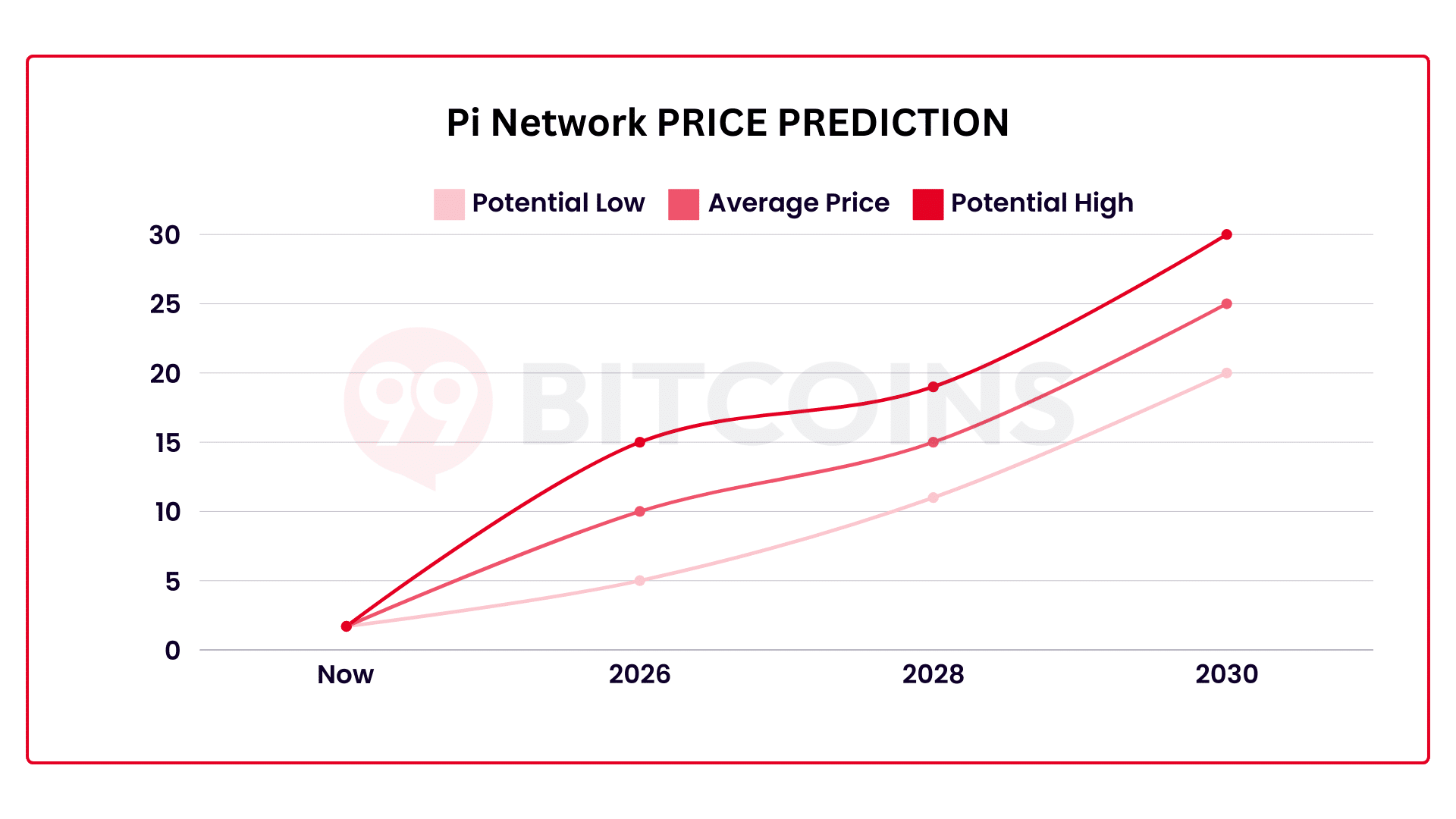
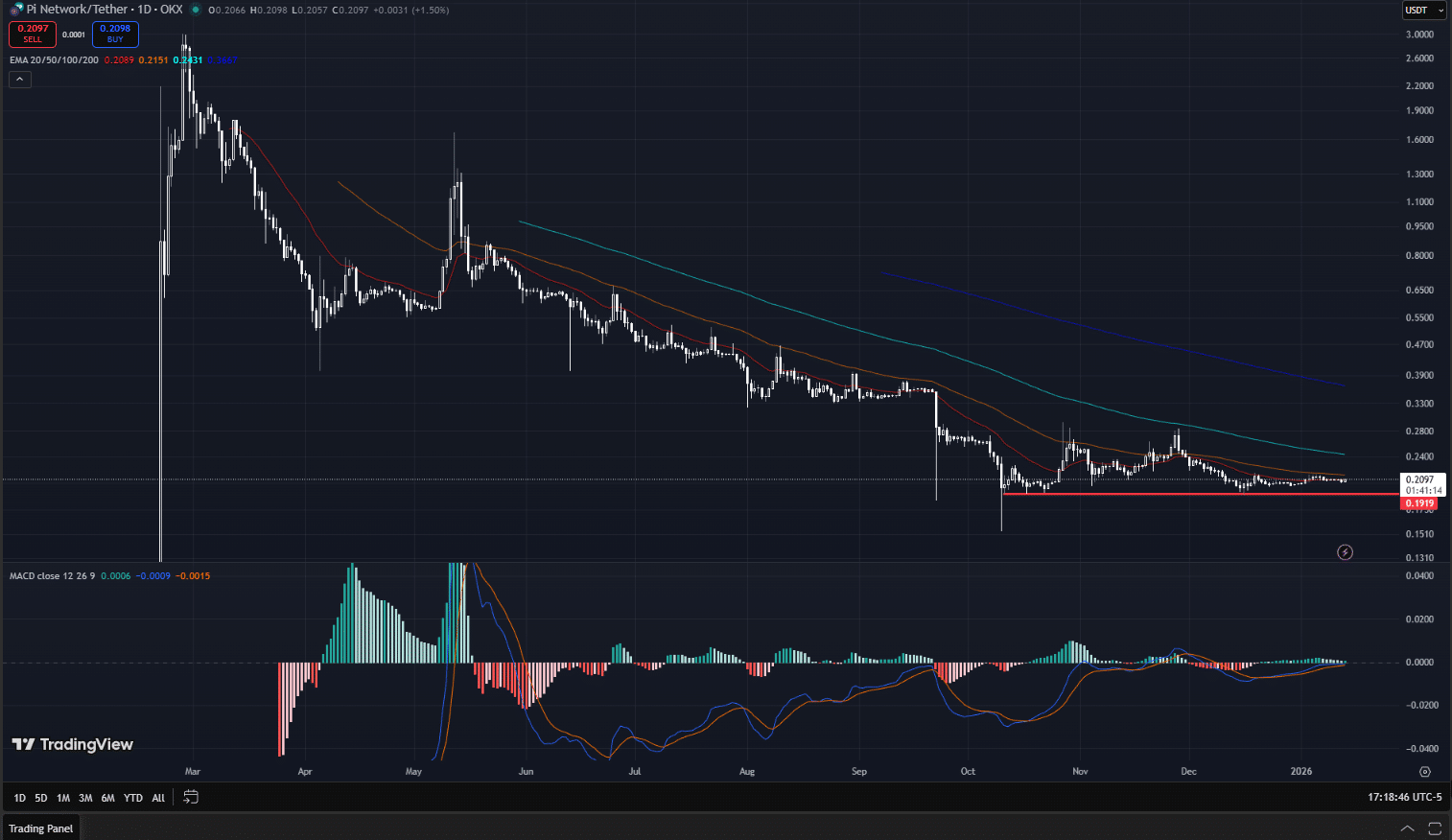
. From a technical perspective, Pi Network enters 2026 in a clear macro downtrend. Since peaking shortly after launch, PI has consistently printed lower highs and lower lows, with price trading below all major moving averages (50, 100, and 200-day EMAs). This structure signals that sellers remain in control, and any upside attempts are likely corrective rather than trend-reversing. The $0.19–$0.20 zone stands out as a critical support area, where price has recently stabilized. A clean break below this level would expose PI to deeper downside toward the $0.12–$0.15 region, which aligns with historical demand zones on the chart. On the upside, the $0.30–$0.35 range represents the first meaningful resistance, reinforced by prior consolidation and declining EMAs. Momentum indicators offer limited optimism. The MACD shows flattening bearish momentum, suggesting selling pressure is slowing, but there is no confirmed bullish crossover. This points to a potential base-building phase rather than a sustained recovery. 2026 outlook: If PI can hold above $0.19 and gradually reclaim the 50-day EMA, a slow grind higher toward $0.25–$0.45 is possible in favorable market conditions. However, without a structural trend break, upside remains capped and volatility risks stay elevated. Looking further out, Pi Network’s long-term price trajectory will depend on whether it can exit its extended distribution phase and establish a durable higher-low structure. As of now, the chart reflects a token still searching for equilibrium after post-launch excess. For 2027, the key technical question is whether PI can reclaim and hold above the 200-day EMA. This level, currently well above price, has acted as persistent dynamic resistance. A successful reclaim would mark the first credible shift toward a neutral-to-bullish regime. Until then, price action is likely to remain range-bound. In a conservative scenario, PI may spend much of 2027 oscillating between $0.15 and $0.75, with rallies facing selling pressure near former breakdown levels. Any move higher would likely be gradual and dependent on broader market strength rather than project-specific momentum. By 2030, assuming long-term survival and steady adoption rather than explosive growth, the chart supports a slow structural recovery rather than a return to early speculative highs. A base formed above $0.25 could allow PI to trade into the $0.80–$1.50 range over multiple cycles, but this would require sustained higher lows and long-term capital re-entry. Long-term takeaway: The technicals favor a measured, low-expectation recovery path, not a parabolic rebound. PI remains a high-risk asset whose upside potential is constrained by historical resistance and weak trend structure. Our Pi Network price prediction is based on historical trends and, most importantly, post-mainnet price action. PI prices are still evolving. With the mainnet now live and the coin available on a few major exchanges, traders will have to wait and see how it grows over time. PI’s prices will be shaped by market cycles, and the boom and bust will either make or break the coin in the coming years. The past few years have been huge for Pi Network. After years of operating in a closed mainnet environment, the project finally threw open the doors, and things have been moving fast ever since. After a long wait, Pi Network finally launched its Open Network on February 20, 2025. This marked the end of the “enclosed” phase, where users couldn’t interact with external services or networks. With this launch, Pi became fully accessible, and developers could now connect external apps and services directly to the Pi blockchain. The Core Team announced the launch date on February 11 and confirmed it again just before going live. By December 2024, Pi publicly shared that over 18 million users had successfully completed KYC, and more than 8 million had already migrated to the mainnet. These numbers showed just how quickly the project was expanding. The team also rolled out system upgrades to speed up both KYC and migration, helping users move their tokens over more efficiently. A grace period was extended into early 2025 so more Pioneers could finish the process and join the open mainnet. In June 2025, the team rolled out a new “KYC Sync” feature to make it easier for users to verify their identity across devices and linked apps. There’s also now email-based two-factor authentication and simplified wallet activation for those who are partially KYC’d. Translation: it’s finally becoming less of a headache to move from mining to actually using Pi. On March 14, 2025 (Pi Day), Pi introduced .pi domains, a system that lets users claim Web3-style usernames inside the Pi ecosystem. These domains were launched through a live auction system, with a public stats dashboard to track registrations and pricing. The domain system came with official policies and ongoing updates from the Core Team, giving users a structured way to build digital identity on Pi. In May 2025, the Pi Foundation launched a major initiative called Pi Network Ventures, backed by a $100 million fund. The goal is to support startups, dApps, and utility-focused projects built around Pi. This funding includes both Pi and fiat capital and is intended to help grow the app ecosystem and encourage developers to build real use cases on the network. Even before the Open Network went live, Pi was already working to promote real-world adoption. One of the main efforts was PiFest, a merchant event series that ran through late 2024. These events focused on getting local businesses to accept PI as payment, supported by both the community and the Core Team. They played a big role in helping people see PI as more than just a mined token sitting in an app. This event brought together over 125,000 registered sellers, allowing people to spend Pi for real goods and services. Meanwhile, a community-built tool called Map of Pi has become a hit, with 1.8 million users using it to find nearby Pi-friendly businesses. In a surprising twist, Pi’s co-founder Nicolas Kokkalis teased the idea of AI integration during the Consensus 2025 conference. No full details yet, but the hints have sparked buzz about how Pi might tie into generative AI tools, whether in decentralized identity, intelligent assistants, or future DApps. Pi Network is a decentralized blockchain, just like Solana and Ethereum. However, its key difference is that it prioritizes mobile mining, allowing anyone with a smartphone—known as pioneers—to mine without investing thousands of dollars in expensive gear or worrying about their battery being drained. This is possible because it uses the Stellar Consensus Protocol (SCP). In this system, node operators create “security circles” to check and confirm transactions. Instead of using a lot of energy like Bitcoin’s proof-of-work method, the network relies on “social trust” for security. All users — including node operators, pioneers, and network ambassadors — must complete KYC (Know Your Customer) to verify their identity. This ensures each account belongs to a real person and not a bot. Pi Network launched its beta in 2019 before activating the enclosed mainnet in late 2022. After months of delays, the mainnet officially launched on February 20, 2025. Central to the Pi Network is the PI token, which is used as a means of payment. All transfers are paid in PI. At the same time, the token can be staked for an annual yield. Pi Network’s co-founder, Dr Nicolas Kokkalis has always shown greater confidence in the project. “Pi Network has enabled global merchant adoption by providing a complete ecosystem experience on Pi through apps and utilities in the Pi Browser, an active user base, and overall accessibility.” – Dr Nicolas Kokkalis If we take a closer look at the on-chain metrics of the network, we can assert that PI’s fundamentals look strong. With 5.1 billion PI tokens locked and only 1.7 billion unlocked, the Pi network is using a controlled release strategy to rule out the risk of oversupply. We must also acknowledge the fact that 6.8 billion tokens have migrated to the mainnet, which simply suggests active participation from users. The circulating supply of 6.8 billion tokens shows there’s already considerable liquidity in the market. Hence, the future prospects of the token don’t look dull. PI price action will be shaped by the following: Based on Pi Network’s fundamentals and on-chain analysis, PI could be a potential option for diversifying your portfolio. However, the network is currently facing criticism, particularly from the Hengyang Public Security Bureau in China. The bureau has accused Pi Network of operating a pyramid scheme due to its referral-based growth model, which resembles multi-level marketing. In response, the Pi Network team has clarified that the warning came from a government authority, not a court or judge, and does not serve as proof that the project is a scam. Additionally, the requirement for users to submit personal details to mine or validate transactions raises questions about the security of their sensitive data. In the project’s early years, a data leak occurred through a third-party provider, Yoti. The Pi Network team stated they were not responsible for the incident. Despite these concerns, Pi Network still has an active community made up of millions of pioneers and ambassadors. PI is also available for trading on multiple exchanges, including OKX. Before proceeding, do your due diligence. If you choose to buy PI, explore the following exchanges: Afterward, move your tokens to a non-custodial and reputable wallet like Best Wallet. Here, you have control of your private keys and you don’t have to worry about hackers. Best Wallet is used by over 500,000 people across the globe and offers exciting features like the “Upcoming Tokens” section, where you can invest in some of the best crypto presales of 2026. If you want to know more about this wallet, check out our detailed Best Wallet Review. As of early 2026, Pi Network is still in the process of finding price stability following its mainnet launch and the sharp post-listing sell-off that followed. While the project continues to attract attention due to its mobile-first approach and large global community, PI’s market performance shows that expectations have cooled, and price discovery remains ongoing. At current levels, PI is trading well below its early highs, reflecting broader market caution and uncertainty around long-term adoption. Future price appreciation will depend less on speculation and more on tangible progress, including real-world utility, ecosystem growth, exchange liquidity, and regulatory clarity. Community engagement remains a supportive factor, but competition within the payments and Layer-1 space is intense. Overall, PI remains a high-risk, early-stage crypto asset. Any sustained upside will require a clear shift in market structure and evidence that the network can convert its user base into consistent on-chain activity. Investors should approach PI with realistic expectations and an understanding that long-term outcomes are far from guaranteed. See Also: Pi Network is a decentralized blockchain project that allows users to mine crypto on their mobile devices without high energy consumption. Pi Network uses mobile mining, making it more accessible and energy-efficient than Bitcoin’s resource-intensive mining process. Yes, PI is listed on top exchanges like Binance and OKX, providing liquidity and accessibility. Established in 2013, 99Bitcoin’s team members have been crypto experts since Bitcoin’s Early days. Weekly Research Monthly readers Expert contributors Crypto Projects Reviewed
Year
Potential Low
Average Price
Potential High
2026
$0.12
$0.25
$0.45
2027
$0.15
$0.40
$0.75
2030
$0.25
$0.80
$1.50
Pi Network Price History
Pi Network Price Prediction 2026
Pi Network Price Forecast: Long-Term Outlook 2027–2030
Our Pi Network Price Prediction Methodology
Pi Network Recent Events and News
Open Mainnet Goes Live
Over 18 million users completed KYC and more than 8 million migrated by the end of 2024
Major Upgrades to KYC and Wallet Access
.pi Domains and a $100M Developer Fund
$100 million Pi Network Ventures fund announced on May 14, 2025
Real-World Adoption: PiFest and Map of Pi
AI Teasers Stir Speculation
Pi Network and Use Cases

What Drives the Price of PI?
Is Pi Network (PI) a Buy?
Conclusion
FAQs
What is Pi Network (PI)?

How does the Pi Network differ from Bitcoin?
Is Pi Network listed on exchanges?
References

Why you can trust 99Bitcoins