







In This Article
Although blockchains and smart contracts promise to transform entire industries, they suffer from a critical limitation: they cannot natively access real-world data. Smart contracts are deterministic by design, meaning they can only operate on information already stored on-chain. Before Chainlink, this restriction severely limited what decentralized applications could do in practice.
Chainlink (LINK) solved this problem by developing decentralized oracle networks (DONs), a way to securely connect smart contracts to outside data sources. These oracles allow smart contracts to reliably access real-time information such as cryptocurrency prices, interest rates, weather updates, sports scores, and data from traditional financial markets, all without relying on a single centralized provider.
Since its launch, Chainlink has evolved far beyond basic price feeds. Today, it provides a growing suite of decentralized infrastructure services, including cross-chain interoperability (CCIP), verifiable randomness (VRF), proof of reserves, automation, and data streams. These tools are increasingly used across DeFi, gaming, real-world asset (RWA) tokenization, and enterprise blockchain deployments.
Crucially, Chainlink’s technology has also gained traction well beyond crypto-native applications. Major banks, asset managers, and market infrastructure providers have partnered with Chainlink to explore on-chain settlement, tokenized securities, and hybrid finance models. As blockchain adoption expands into traditional finance, Chainlink is positioning itself as the middleware layer that allows smart contracts to interact with the real economy at scale.
Rising Crypto- Editor’s Choice

- New Bitcoin L2 presale offering massive staking rewards
- By using a SVM Bitcoin Hyper is revolutionizing Bitcoin's potential
- Early buyers can use $HYPER tokens for transactions, staking, and ecosystem governance
 Bank Card
 BNB
BNB ETH
ETH- +1 more

As LINK gains adoption, investors are asking questions like ‘Can Chainlink sustain $10?’ or even ‘Can Chainlink reach $1000?”
In this article, we’ll outline our price prediction for LINK – the crypto token that powers the Chainlink network – for 2026 throughout 2030.
LINK Forecast Overview
Chainlink addresses one of the most fundamental constraints in blockchain design, and in doing so, it has steadily positioned itself as core infrastructure for Web3. As decentralized applications expand into real-world finance, payments, and asset tokenization, demand for secure, reliable oracle and interoperability services continues to grow. This long-term utility underpins a constructive outlook for LINK.
Chainlink Price Prediction Outlook
2025 (retrospective): Chainlink continued to solidify its role as core blockchain infrastructure rather than a pure price-driven asset. The network expanded its footprint across DeFi, gaming, and enterprise use cases, with particular momentum in real-world asset (RWA) tokenization, proof-of-reserve frameworks, and cross-chain settlement. Adoption of Chainlink’s Cross-Chain Interoperability Protocol (CCIP) accelerated, positioning LINK as a critical middleware layer as traditional finance and on-chain systems increasingly intersected. While LINK’s price action remained volatile and closely tied to broader market conditions, 2025 reinforced Chainlink’s long-term relevance as demand for secure data feeds and cross-chain connectivity continued to grow.
2026: Looking into 2026, Chainlink’s upside will depend less on partnerships alone and more on execution and usage growth. If CCIP continues to gain adoption among institutions and Layer-1/L2 networks, and if tokenized assets scale meaningfully on public blockchains, LINK’s value capture could improve. Under these conditions, LINK may average around $40, with a potential trading range between $35 and $55, reflecting both utility-driven demand and market cycles.
2030: Over a longer horizon, Chainlink’s ambition to support an “internet of contracts”, where smart contracts seamlessly interact with off-chain systems, multiple blockchains, and traditional financial infrastructure, remains a compelling thesis. If the network successfully cements itself as the default oracle and interoperability layer for tokenized finance, derivatives, and automated settlement, LINK could reach $80 or higher by 2030, assuming favorable adoption and regulatory clarity.
Regulatory Backdrop
LINK’s price action in prior years was weighed down by regulatory uncertainty, particularly during periods of aggressive enforcement from U.S. regulators. However, sentiment improved sharply in late 2024 following leadership changes at the SEC and a broader shift toward engagement rather than confrontation with the crypto industry. As regulatory clarity improves and institutions grow more comfortable deploying on-chain infrastructure, Chainlink stands to benefit from reduced headline risk and renewed capital inflows.
| Year | Potential Low | Average Price | Potential High |
|---|---|---|---|
| 2026 | $35 | $40 | $55 |
| 2030 | $50 | $65 | $80 |
LINK Price Prediction 2026
Over the past several years, Chainlink has firmly established itself as the leading decentralized oracle network (DON) and, increasingly, a foundational layer for the broader Web3 stack. What began as a solution for simple price feeds has evolved into a full suite of services supporting interoperability, data availability, proof-of-reserve systems, and cross-chain messaging.
A key differentiator for Chainlink is its deep and growing engagement with traditional financial infrastructure. The project has collaborated with major institutions and market utilities, including SWIFT, DTCC, Fidelity International, UBS Asset Management, JP Morgan, and BNY Mellon. These initiatives focus on bridging on-chain systems with existing financial rails, particularly in areas such as real-world asset (RWA) tokenization, cross-chain settlement, and automated compliance workflows.
Chainlink’s relevance to this convergence was underscored in late 2024, when World Liberty Financial, a DeFi initiative associated with the Trump family, adopted the Chainlink standard to support its integration with the Aave protocol. The announcement contributed to a sharp rally in LINK, with the token gaining roughly 30% in December 2024. While political affiliations alone are not a long-term investment thesis, the partnership highlighted Chainlink’s position as a preferred infrastructure provider for high-visibility DeFi deployments.

Looking into 2026, LINK’s outlook is further shaped by a shifting regulatory environment in the United States. For much of the previous cycle, the token’s performance was weighed down by regulatory uncertainty and repeated implications from the SEC that oracle and middleware projects could fall under securities scrutiny. That backdrop changed following the resignation of former SEC Chair Gary Gensler and the appointment of Paul Atkins, whose approach is widely viewed as more constructive toward digital assets.
Under Atkins’ leadership, the SEC has signaled a greater willingness to engage with the crypto industry rather than rely on enforcement-first tactics. This shift has coincided with tangible progress from Chainlink itself. In August 2025, the network launched live, low-latency data streams for U.S. equities and ETFs, enabling DeFi protocols to securely reference high-quality market data for assets such as Apple stock. This development represents a meaningful step toward regulated, on-chain financial products.
Around the same time, Chainlink also partnered with the U.S. Department of Commerce to bring official macroeconomic data, such as GDP releases, on-chain, further expanding the scope of verifiable, real-world information available to smart contracts.
We’re excited to launch Chainlink Data Streams for U.S. equities & ETFs—real-time, low-latency data to power the next generation of tokenized RWA markets.https://t.co/CwKVkUnZxO
These new Data Streams are being adopted by top DeFi protocols, including @GMX_IO, @KaminoFinance,…
— Chainlink (@chainlink) August 4, 2025
Internally, the Chainlink ecosystem continues to expand aggressively. Its long-term vision includes connecting blockchains into an “internet of contracts,” scaling CCIP as a standard for cross-chain communication, and supporting trillions of dollars in tokenized assets. The project’s partner list now spans major protocols and platforms such as Aave, GMX, Lido, and Google Cloud, alongside thousands of other integrations.
We're excited to announce that Chainlink and the United States Department of Commerce (@CommerceGov) have worked together to bring U.S. government macroeconomic data onchain.https://t.co/qHIw8DyEgX
These new Chainlink Data Feeds securely deliver critical information around key…
— Chainlink (@chainlink) August 28, 2025
In August 2025, Chainlink also introduced its first Chainlink Reserve, a mechanism designed to accumulate LINK using on-chain service fees and enterprise revenue. These tokens are purchased directly from decentralized markets, gradually reducing circulating supply and aligning network usage with token demand.
We're excited to announce the launch of the Chainlink Reserve, a new upgrade centered on the creation of a strategic onchain reserve of LINK tokens.https://t.co/ENs52Qjnn2
The Chainlink Reserve is designed to support the long-term growth and sustainability of the Chainlink… pic.twitter.com/vUElyovvYs
— Chainlink (@chainlink) August 7, 2025
Taken together, growing institutional adoption, regulatory headwinds easing, expanding on-chain services, and improving token economics, Chainlink remains well positioned within the evolving Web3 and tokenization landscape. Based on current trends, LINK could reasonably trade at an average price near $20 as we enter 2026, with upside dependent on broader market conditions and continued execution.
Buy LINK With Best WalletLINK Price 2026-2030 Predictions
Given the heavily hyped partnership between Chainlink and the Trump family’s World Liberty Financial platform, platform development, and high profile endorsement, the price of LINK should consistently experience bullish catalysts for at least the duration of Donald Trump’s presidential administration. This will last for another four years, which will take us through almost to the end of the decade.
Most of Chainlink’s ambitious goals are likely to be realized during this time, even if we allow for the possibility that the majority of the tradfi sector lags behind the pioneers who are already partnering with Chainlink. It’s worth remembering that legacy financial institutions and their infrastructures are truly monolithic, and therefore will require considerable time to fully catch up and integrate with Web3 technologies. An institution’s ability to do this will determine its ability to compete with its peers over the coming years and decades, so the motivation to adopt Web3 tech is certainly present already.
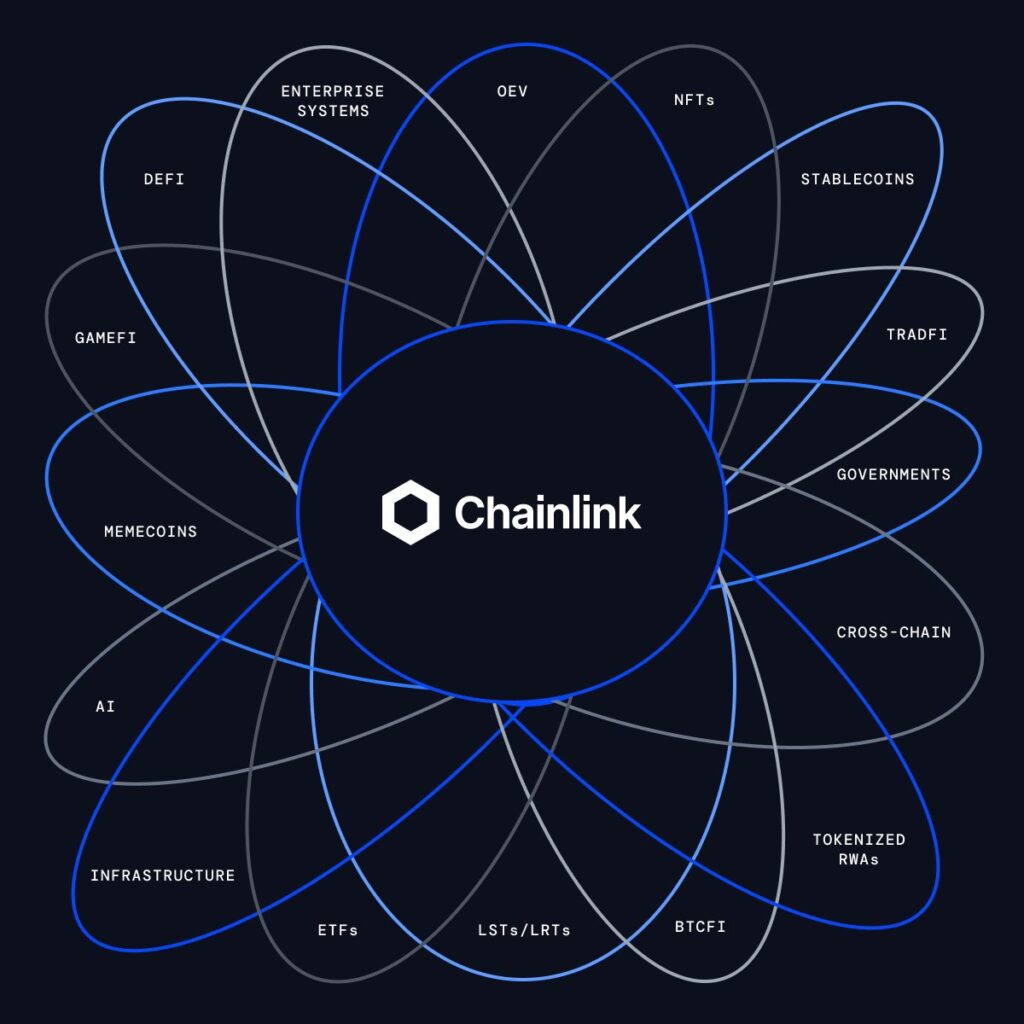
As Chainlink and its LINK token are becoming so deeply entrenched within the tradfi industry, and not just Web3, it’s possible that the price of LINK could eventually decouple from the influence of Bitcoin and Ethereum and outperform the market during difficult times.
Given the unpredictable nature of the current geopolitical landscape, and the considerable macroeconomic difficulties that countries around the world have experienced over the last few years, turbulent times are almost certainly ahead for the financial markets in general. The possibility of a “black swan” event is always present, and we have yet to see how the fast-moving AI revolution will fully impact our economy, markets, and society as we move towards 2030.
In any case, the sheer diversity and scope of the Chainlink project means that it can integrate with almost any Web3-related technology in some way. This should give it a much greater degree of resilience than the average altcoin. Our Chainlink 2030 price prediction is based not only on market trends, but LINKs growing integration in traditional finance.
We therefore expect LINK to trade at an average price of $40 by the end of 2026.
Our LINK Price Prediction Methodology
As Chainlink is so closely integrated within the tradfi sector, and its partnership with World Liberty Financial has proven so influential on the LINK crypto token price, we deeply considered the potential impact of the above factors in our Chainlink price prediction for 2026 to 2030. We’ve also employed our own unique market prediction models, and considered the past performance of the LINK price via in-depth technical analysis.
The combination of the above, combined with additional fundamental analysis of the Chainlink project as a whole, gives us exceptional confidence in our bullish position for the LINK price over the rest of the decade.
LINK Price History
Ever since the LINK price began to explode in 2019, Chainlink token holders have been through a real emotional rollercoaster. Rising from a mere $0.50 in January 2019 to an all-time high of $53 in May 2021, and then falling as low as $4.76 by May 2023, LINK has been hugely volatile, even as its team has continued steadily building and expanding the scope and reach of the Chainlink project.
At this point, Chainlink has established itself as the go-to provider of decentralized oracle services not only for the Web3 sector, but also legacy financial institutions, tradfi infrastructure heavyweights, and enterprise corporations like Google.
Within the LINK community – a group known as “LINK Marines” due to their willingness to accept LINK’s volatility, claims of price suppression and market manipulation have been very common over the years. Considering the huge disparity between Chainlink’s success and LINK’s price action, this is understandable.
However, the uncertainty induced by the SEC’s attacks on the crypto industry (including claims that tokens like LINK should be categorized as securities) provides a clearer explanation as to why LINK has been so undervalued.
With government endorsement and clear rules, including the enactment of the GENIUS Act, LINK should now have an almost clear path to new all-time highs. The GENIUS Act is pro-DeFi, a sector that Chainlink plays a pivotal role in.
Chainlink Expert Predictions
The LINK Marine community’s patience has been tested to breaking point throughout the last bear market – but since things now look more bullish, LINK’s performance has attracted more interest to the project than ever before.
The top crypto analyst and influencer Scient has created a detailed strategy for LINK investors:
$LINK, Higher is programmed.
• Pretty confident that lows at $18 will hold — 0.75 fib + 1W S/R confluence.
Sometime in Feb/March, we will get a leverage wick to sweep the liquidity at the $18 lows; I would happily add more in that case.
TLDR: $17-$19 area to bid incase of a… pic.twitter.com/WCZsUInIOC
— Scient (@Crypto_Scient) January 29, 2025
Ash Crypto – one of the world’s most popular crypto traders – has predicted that LINK could even reach $250 to $500 in 2026:
My targets for next 6-12 months:$BTC: $150k-$250k$ETH: $10k-$15k$BNB: $900-$1,400$SOL: $450-$800$XRP: $3-$5$DOGE: $1-$3$PNUT: $3-5$DOT: $50-$120$APT : $60-100$SUI : $6-8$LINK: $250-$500$AVAX: $200-$300$ICP: $120-$160$INJ: $180-$250$TIA: $100-$150$MANTA: $30-$70
— Ash Crypto (@AshCrypto) November 13, 2024
The crypto market tends to move in four-year cycles, and now that it’s been four years since LINK peaked in 2021, all eyes are on this token as the industry waits to see what comes next.
What Is Chainlink?
Chainlink is the ultimate solution to a fundamental problem that severely constricts the potential of blockchain and smart contract technologies – namely their inability to easily, reliably, and securely access data sources and other services from the outside world. By creating and maintaining decentralized oracle networks (DONs) that are dedicated to various specific tasks, Chainlink is now able to provide Web3 projects with a range of services, including:
- Cryptocurrency price feeds for DeFi platforms and services
- Weather data
- Financial market data
- Sports results data
- Proof of reserves (including cross-chain and off-chain asset reserves)
- Chainlink VRF (a verifiable random number generator)
- Chainlink Automation (enabling automatic smart contract execution)
- Chainlink Functions (providing custom compute functions and API connectivity for Web3 projects)
- Chainlink CCIP (Cross-Chain Interoperability Protocol), enabling token transfers and other forms of communication to take place between blockchains
Taken as a whole, Chainlink is in the process of creating an “internet of blockchains” and an “internet of contracts” – empowering any Web3-related project to realize its full potential without technical restrictions.

Each of the services listed above is extremely complex and involves a wide array of technical challenges that require constant improvements and updates, particularly regarding security.
Chainlink has proven itself exceptionally capable in this regard, and its network has never been hacked or otherwise compromised.
This achievement has enabled Chainlink to partner with thousands of Web3 projects (including top DeFi protocols like Aave), spanning across the following sectors:
- DeFi (Decentralized Finance)
- Gaming (including GameFi)
- NFTs
- Enterprise blockchains
- Insurance
- Climate markets
- Sustainability initiatives
- Real-world asset (RWA) tokenization
Throughout 2024, traditional financial institutions have demonstrated intense interest in Web3 and crypto – starting with Bitcoin and Ethereum ETFs, and now moving towards DeFi, RWAs, and generally bridging the gap between tradfi and Web3. Chainlink has played a key role in countless projects involving some of the very biggest names in tradfi and legacy financial infrastructure, such as:
- Swift (a secure financial messaging network used by over 11,000 banks in over 200 countries).
- The DTCC (Depository Trust & Clearing Corporation), which clears trillions of dollars of financial market activity daily, and quadrillions of dollars in value per year.
- JP Morgan (the largest bank in the United States).
- UBS Asset Management (which manages over $5.7 trillion in total value).
- Franklin Templeton ($1.68 trillion under management).
- Banco Central do Brasil (Brazil’s central bank).
Chainlink also recently announced a key partnership with World Liberty Financial – a new DeFi platform owned and operated by the family of Donald Trump.
Put simply, Chainlink is everywhere in the Web3 industry, and has developed a stellar reputation as the default standard for decentralized oracle networks and Web3 infrastructure services.
The most recent market data for the LINK crypto token can be viewed using this continuously updated table:
| Coin Name | Chainlink (LINK) |
|---|---|
| Chainlink Price | $13.90 |
| Chainlink Price Change 24h | ▲ 0.38022% |
| Chainlink Price Change 7d | ▼ -5.46% |
| Chainlink Market Cap | $10,399,902,450 |
| Circulating Supply | 1,000,000,000 |

LINK Crypto Token Use Cases
Sustainable and consistently effective security is a vital aspect of the Chainlink project, as oracle exploits and manipulative attacks can have catastrophic consequences for Web3 projects that rely on DONs in order to function properly. With this in mind, the LINK crypto token functions as the basis for an economy that exists within the Chainlink ecosystem, as a way to help safeguard decentralized oracle networks from bad actors.
Chainlink network participants can use the LINK token to pay service providers – thus incentivizing those providers to act in the entire network’s best interests (or risk their LINK tokens losing value).
LINK can also be staked to secure various oracle services, rewarding stakers with more LINK tokens (if the oracle remains reliable and trustworthy) and penalizing bad actors through a “slashing” mechanism (which forfeits some or all of the staked LINK collateral, and may use it to compensate those affected by the malicious activity).

Oracles (network nodes) that hold the largest amounts of staked LINK tokens can also benefit from a higher probability of being selected to complete various tasks – thus generating more rewards, as long as the oracle’s reputation stays high enough. Through this system, bad actors again run the risk of losing their staked collateral (and negatively impacting the value of their LINK tokens) if they behave disruptively or maliciously.
As Chainlink rapidly expands beyond Web3 and into the realms of tradfi and enterprise blockchain applications, the reach of decentralized oracle networks will increase exponentially. The already long list of DON use cases will eventually include the Internet of Things, smart cities, machine-to-machine transactions and communications (including AI agents and robots), real estate, securities markets, and more.
In every single use case, the LINK token will be used to power the Chainlink ecosystem’s internal economy and keep it secure. This is the primary reason why so many investors, projects, enterprises, and tradfi institutions are joining the Chainlink network – and also why the LINK Marines are so willing to hold on to their tokens for the long haul, despite the extreme volatility of LINK’s price action.
What to Do With Your LINK?
The LINK token is designed to power and secure the Chainlink ecosystem through its internal economy. This deliberately limits its primary use cases to paying for decentralized oracle services, and staking LINK tokens within oracles (network nodes) to generate rewards in LINK tokens.
Staking also helps to improve a given oracle’s reputation, as nodes with the most staked LINK will be selected to perform more tasks and generate more rewards.
Over time, the LINK token’s value is expected to naturally increase in line with demand – which is potentially unlimited, given the vast number of current and future use cases for decentralized oracle networks.
Thanks to Chainlink’s Cross-Chain Interoperability Protocol (CCIP), the project is already contributing to an “internet of blockchains” and an “internet of contracts,” which will empower and inspire developers and Web3 visionaries to create innovative products and services that are currently unimaginable.

The present state of the Web3 industry is commonly compared to the earliest days of the internet (when even the most visionary futurists couldn’t predict most of the apps and websites we take for granted today), and Chainlink is playing a central role in its ongoing evolution. Today, we’re used to existing in a constant state of “future shock” due to the AI revolution, visions of multiplanetary civilizations and interstellar travel, and the latest innovations in robotics.
All of the above and more will come to integrate Web3 tech in various ways – and the LINK token will play its own fundamental part in connecting and powering it all.
Therefore, although staking LINK tokens might not sound like the most exciting thing to do with a crypto investment, it actually plays a huge part in securing the future of Web3. Visions such as the one outlined above are inspiring more and more crypto enthusiasts to join the ranks of the LINK Marines, making Chainlink a great investment for those who connect with such an ambitious view of the future.
Where to Store LINK Tokens?
LINK tokens are mainly intended to be staked and used for payments within the Chainlink ecosystem – but many investors prefer self-custody as a convenient alternative. This ensures that your LINK tokens can be easily and immediately accessed, so you can sell and trade them with maximum convenience and minimal effort.
LINK holders who stake their tokens within an oracle’s dedicated staking smart contract also run the risk of losing their tokens in the event of a security breach – or even malicious actions on the part of the oracle itself, which could lead to its staked LINK being slashed (forfeited and lost).
Given the above, many LINK holders should consider using a self-custody crypto wallet such as Best Wallet (our recommendation), which provides immediate access to all of your stored cryptos within a simple smartphone app.
The Best Wallet app is available for iOS and Android, and also features its own staking mechanism, iGaming, and access to the latest and best crypto presales – including tokens capable of generating even more profits than LINK.
The Best Wallet ecosystem also includes the brand-new $BEST token – available for a limited time through its exclusive presale.
To learn more about Best Wallet and the $BEST token presale, click the button below:
Visit Best Wallet
What Drives the Price of LINK?
As we’ve noted throughout our price prediction analysis, the price of LINK crypto tokens has shown signs of consistent suppression since the middle of 2022 – which is largely due to the negative influence of the SEC’s extensive attacks on the crypto and Web3 industry.
Due to this issue, LINK’s price has been pushed far below its all-time high of $53, even though the project was only beginning to hint at its future potential when it hit that peak.
The price of LINK has managed to hold on through an arduous bear market thanks to the support of its LINK Marine community, and the recognition of thousands of partners from across the Web3 and tradfi industries. Throughout 2025, the combined efforts of the new SEC leadership, the crypto-friendly Trump administration, the Chainlink team, the project’s thousands of partners, and its resolute community of LINK Marines will give the LINK price its best possible chance of achieving new all-time highs in 2026.
The interactive chart below can be used to examine Chainlink’s past price performance across multiple time frames:
Is LINK a Buy?
By comparing Chainlink’s newfound status as a Web3 industry standard to its promising but still emerging position back in May 2021 (when the LINK price hit its all-time high of $53), we can see that LINK is very clearly undervalued.
Therefore, this crypto looks like a no-brainer for investors and traders who believe not just in one project or token, but the entire Web3 sector as a whole. Chainlink’s decentralized oracle networks have already been embraced by thousands of Web3 projects, are actively used across the crypto space and various industries, and have formed the basis of new projects and experiments involving the biggest financial institutions and infrastructure providers in the world.
The interest of the tradfi sector is particularly important, as it has historically been extremely resistant to even the thought of interacting with Web3 and crypto in any way at all. The creation of Bitcoin and Ethereum ETFs have undeniably helped to change some minds – but Chainlink’s outstanding achievements and performance have perhaps done even more to persuade the world’s bankers to work on brand-new blockchain innovations.
Now that the skies are finally clearing, LINK can reasonably be expected to take off in 2026. Naturally, investors will need to apply their own analysis, fundamental research, and risk management strategies to their own positions – but our position on LINK remains very strongly bullish.

LINK Forecast Conclusion
Very few Web3 projects have reached Chainlink’s level of real-world adoption, and the events of 2025 helped clarify why LINK continues to occupy a unique position in the crypto ecosystem.
By examining Chainlink’s fundamentals, its expanding role across DeFi and traditional finance, the regulatory shift in the U.S., and the project’s technical and on-chain trajectory, a consistent picture emerges. Chainlink is no longer just a price-feed provider; it is becoming core infrastructure for tokenized assets, cross-chain settlement, and institutional-grade on-chain data.
Looking back, many of the bullish projections made for 2025 were driven by regulatory uncertainty and delayed institutional participation. As those headwinds eased and Chainlink delivered live production integrations, LINK’s valuation began to reflect utility rather than speculation. Even so, at current levels, the token still trades below its prior all-time high of $53, a level that increasingly looks less like a ceiling and more like a historical reference point.
The idea of LINK reaching $1,000 remains a popular meme within the community, but that outcome would require a much broader shift in global on-chain settlement and real-world asset adoption. A more conservative, execution-based outlook places LINK at an average price of around $65 by 2030, assuming continued growth in institutional usage, fee-generating services, and supply discipline.
For investors seeking shorter-term opportunities rather than long-duration infrastructure plays, it may make sense to explore other areas of the market. Our guide to the best cryptocurrencies to buy right now highlights newer tokens and emerging narratives that could outperform in the nearer term as the market moves into 2026.
Find the Best Cryptos to Buy NowSee Also: Top Chainlink (LINK) Wallets in October 2026
FAQs
Is LINK a good investment?

The LINK crypto token will remain undervalued as long as its price remains below $53 – its previous all-time high. Although we always recommend that investors and traders use our analysis as part of their own research (and apply risk management strategies that they find appropriate), we are very bullish on LINK.
A key resource for further research is the Chainlink 2.0 whitepaper, which lays out the latest evolution of the Chainlink network through an accessible and technical 136-page document.
Is LINK worth buying?
The sheer scale of Chainlink’s ecosystem, which has been adopted by thousands of partners across Web3 and tradfi, is undeniable. Considering how many top projects, companies, and institutions are using the LINK token to transact and stake within the Chainlink network, it seems like a safe buy for investors who believe in the power of Web3 as a whole. That said, it’s always best practice to do your own research and conduct your own analysis – within which you can also integrate the price predictions and information we’ve presented in this article.
For further research into this vast project and ecosystem, we recommend the Chainlink 2.0 whitepaper.
Will the LINK crypto price reach $100?
While it’s safe to say that LINK is undervalued below $53, time will tell exactly how high its price can go. However, our price prediction indicates that LINK will reach an average trading price of $65 in 2030.
Can Chainlink reach $1,000?
As the full potential of the Chainlink ecosystem is a long way from being fully realized, a LINK price of $1,000 is not out of the question. However, even in the most bullish case, the question still remains as to when LINK could reach $1,000 – and at the present time, our prediction model indicates a maximum value of $80 for LINK in 2030.
It’s also worth bearing in mind that at a price of $1,000 per token, and a maximum capped supply of 1 billion tokens, LINK’s market cap at that point would be $1 trillion – although by 2030, this might seem like a relatively low valuation for a leading crypto project. By comparison, LINK’s current market cap is , with a current Chainlink price of .
How much will LINK be worth in 2025?
According to our price prediction models, the price of LINK crypto tokens will be $28 on average in 2025.
How much will LINK be worth in 2030?
The price of LINK in 2030 will be determined by a large number of variables and factors that cannot yet be fully known, and will induce considerable market volatility. However, our most detailed price analysis models indicate significant growth, leading to an average price of $80 in 2030, with a potential minimum price of $50.
Will DTCC use Chainlink in March 2025?
Yes, in March 2025, DTCC officially joined the ERC3643 Association, teaming up with Chainlink Labs. It’s a big step toward integrating Chainlink’s oracle tech into traditional finance. So yeah, this isn’t just talk — it’s happening.
Chain link price prediction
Depends who you ask, but most estimates put LINK somewhere between $13 and $50 over the next couple of years. If adoption keeps growing and big players keep jumping in, don’t be surprised to see it toward the higher end.
What stocks will benefit from Chainlink's (LINK) oracles and LINK token surge?
Look at crypto-heavy hitters like Coinbase (COIN), MicroStrategy (MSTR), and any Web3 infrastructure stocks. If Chainlink’s oracles become standard, these companies could ride the hype, especially if the LINK token pumps.
Chainlink price prediction 2025
Most predictions range between $13 and $29 by 2025. If crypto’s back in full bull mode and Chainlink keeps locking down real-world use cases, hitting the higher end is totally on the table.
Chainlink price prediction 2030
Long-term bulls think LINK could be worth $100 to $150 by 2030, maybe more if it becomes core infrastructure for both DeFi and TradFi. Others think it’ll chill around $30–$60. Bottom line? It depends on adoption and crypto’s staying power.
LINK coin price prediction
Short term: probably somewhere in the $15–$25 zone. Long term (think 2030), optimistic projections push it past $100. It’s one of the few tokens with real utility, which helps its case.
Can Chainlink reach $1000?
Never say never in crypto, but let’s be real, $1000 is a long shot. For LINK to pull that off, we’d need insane global adoption, major traditional finance integration, and probably a decade of compounding wins.
Which stocks might be impacted by Chainlink's LINK token test below $22?
If LINK dips below $22, crypto-adjacent stocks like Coinbase (COIN) and MicroStrategy (MSTR) might feel the sting. It’s more about investor sentiment than fundamentals — but in crypto, vibes move markets.
Can Chainlink reach $10?
LINK has already passed $10 and it’s still above $10 as of May 2025. So yep, consider that box checked.
References
- Chainlink’s Leading Position in Capital Markets, Tokenized Assets, and DeFi | 2024 Highlights (Chainlink)
- LINK Surges to 2021 Levels as Trump’s World Liberty Buys More Chainlink Tokens (Business Insider)
- Crypto advocate Paul Atkins picked as SEC chair by Donald Trump (Financial Times)
- Chainlink 2.0: Next Steps in the Evolution of Decentralized Oracle Networks (Chainlink)

Why you can trust 99Bitcoins
Established in 2013, 99Bitcoin’s team members have been crypto experts since Bitcoin’s Early days.
Weekly Research
100k+Monthly readers
Expert contributors
2000+Crypto Projects Reviewed