




Bitcoin depends on the community to survive. Without the web of miners and developers, the mainnet is as good as dead. Privacy purists and developers driven by the ideals of decentralization and censorship resistance might be the only people willing to contribute without earning anything. For the majority of “fans”, they are always jostling for that piece of Satoshi. The industry has grown so much so that entire mining farms are in operation, competing with ordinary folks for block rewards.
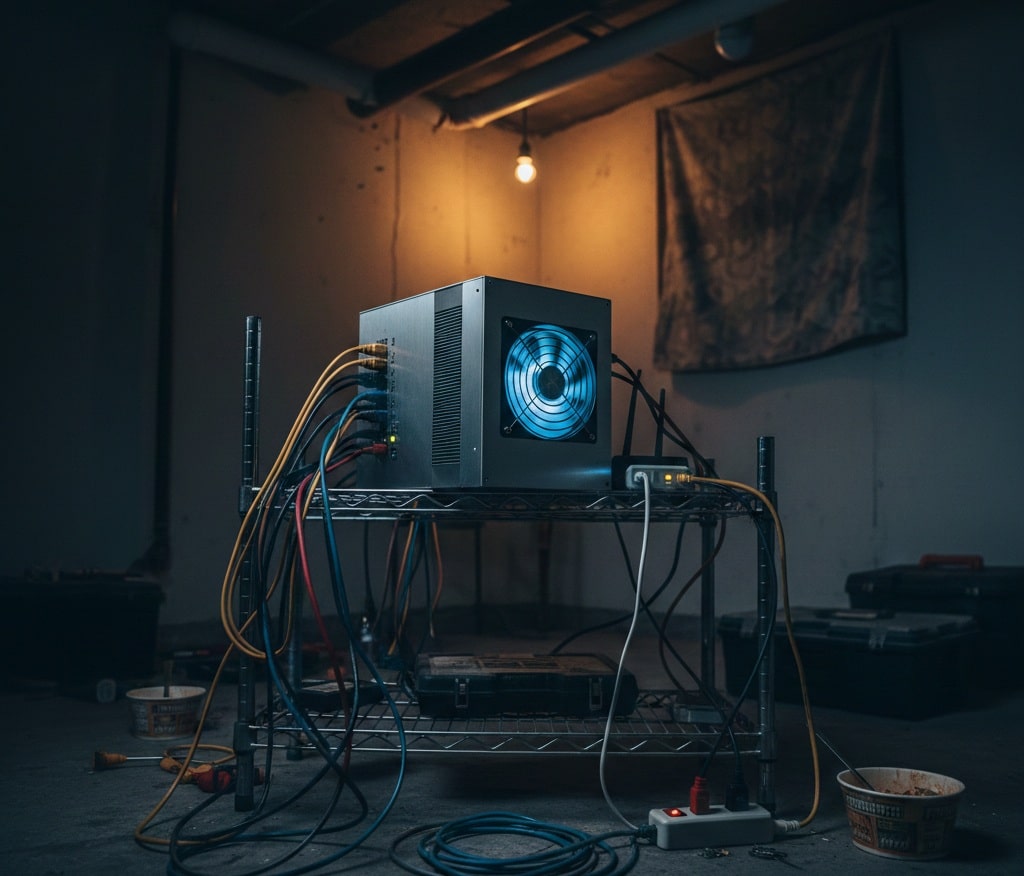
While Bitcoin mining pools like Foundry USA and Antpool dominate, regularly receiving block rewards, sometimes the script is changed and ordinary folks win. Recently, a solo Bitcoin miner hit the jackpot, earning the full 3.125 BTC block reward and fees associated with the block. If the miner HODLs, the stash is now worth north of $300,000.
"solo mining is dead" "you'll never find a block" "it's a waste of electricity"
tell that to these people who've mined a block with solo-miners connected to @Public_Pool_BTC on their umbrel
stay humble. run your own node. solo-mine on your own pool. pic.twitter.com/s0uEgjbatW
— Umbrel ☂️ (@umbrel) December 22, 2025
Given this handsome reward, it is no wonder why this feat is going viral, reigniting talk about whether home miners still stand a chance. This debate makes sense. As mentioned earlier, Bitcoin mining is now more industrial and expensive, pushing small players to the margins. The good news is that this is not the first time a solo miner is winning. If anything, the real surprise is that people misunderstand why it happens at all.
DISCOVER: 9+ Best Memecoin to Buy in 2026
How Bitcoin Mining Actually Works
Bitcoin relies on a proof-of-work (PoW) system to stay operational and trustless. This PoW mechanism is what allows miners to agree on which transactions are valid without needing to trust each other. Miners take a group of new, unconfirmed transactions and bundle them into a candidate block. To “seal” this block and add it to the blockchain, they must find a specific number called a Hash. When a miner finally finds a winning hash, it serves as proof that they expended a massive amount of computational work.
While it takes trillions of guesses to find the hash, other computers on the network can verify it instantly with a single calculation. The confirmation of this hash takes place roughly every ten minutes. The winning miner, who came ahead of everyone else, solving a math puzzle, writes the next block, and gets paid.
However, as mentioned earlier, mining is extremely competitive, and those who contribute more computing power stand a chance. And there is evidence to show this. Mining farms like MARA Holdings and RIOT Platforms have massive capacity. Accordingly, they regularly win block rewards.
Inside the world’s largest Bitcoin mine, Riot Platform’s Texas facility computes the SHA-256 math algorithm 10,500,000,000,000,000,000x every second in a global race to find the next block of the blockchain.
— Documenting ₿itcoin 📄 (@DocumentingBTC) December 28, 2025
DISCOVER: 20+ Next Crypto to Explode in 2026
The Age of Solo Mining And Generous Pools
Meanwhile, ordinary miners must join hands and form pools. These pools split block rewards into steady but small payouts. Some pools also charge a fee. Others don’t. Interestingly, the “solo miner” who solved Bitcoin block 927,47 was connected through Solo CKPool. Yes, while it is a pool per se, it allows individual miners to keep the entire block reward, minus a small fee, rather than splitting it with thousands of others in a traditional pool.
The miner contributed just in hash rate, or just 0.00002% of Bitcoin’s hash rate presently at over 1.15 ZH/s. At this rate, the odds didn’t favor the miner. Statistically, a miner of this size would only be expected to solve a block once every 82 years. That he struck gold essentially means he won the “Bitcoin Lottery.”
Congratulations to miner 1Ng9~VoQz with 270TH for solving the 311th solo block at https://t.co/UWgBvLkDqc! A miner of this size has a 1 in 30,000 chance of solving a block per day.https://t.co/5t7BgOCCVy pic.twitter.com/oPyHO6xdS4
— Dr -ck (@ckpooldev) December 11, 2025
In 2026, this won’t be an isolated event. This is all thanks to how Bitcoin, as a network, operates. The protocol is memoryless, meaning every single hash has exactly the same tiny chance of being the winning solution, regardless of whether it comes from a $100M data center or a single machine in a garage. Mining follows a randomness model where every attempt is independent. Run enough tickets across thousands of solo miners worldwide, and someone wins every few weeks.
Tracker data shows 22 solo-mined Bitcoin blocks over the past year. That works out to one win every 15.6 days. At this pace, evidence suggests that though winning could be highly improbable, decentralized “solo” wins are a baked-in feature of the network’s design.
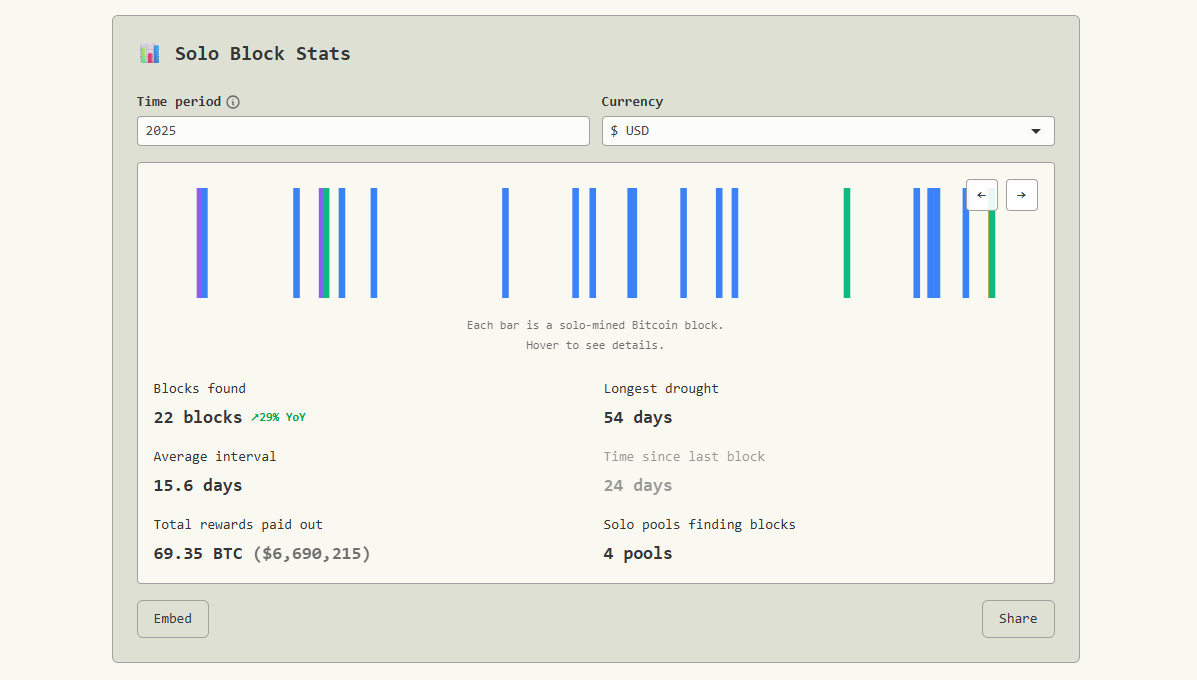
(Source: Solo Block Tracker)
Given the odds, you can run a Bitcoin miner, solo, for fun, not expecting a reliable income. The expected payout from solo mining matches pool mining over very long periods, but the waiting time can stretch decades. Meanwhile, industrial miners like RIOT and MARA Holdings need predictable cash flow to pay power bills and debt. Solo miners accept extreme variance because they treat it as a hobby or a lottery.
DISCOVER:
Follow 99Bitcoins on X For the Latest Market Updates and Subscribe on YouTube For Daily Expert Market Analysis.

Why you can trust 99Bitcoins
Established in 2013, 99Bitcoin’s team members have been crypto experts since Bitcoin’s Early days.
Weekly Research
100k+Monthly readers
Expert contributors
2000+Crypto Projects Reviewed