






Welcome to the first module of 99Bitcoins’ crypto education course. In this section, we’ll dive into the big question of why crypto exists and why blockchain is needed. By the end, you’ll understand the problem crypto is solving and why it matters today.
Why Crypto Exists: History of Money
Before we learn what crypto means and why it exists, we need to discuss money, its history, its current form, known as fiat, and the problems related to it.
Money is a tool we use to trade value and store purchasing power for the future. It makes exchange easier than bartering goods or services and allows humanity to store economic value earned today and carry it into future years. Over time, money evolved from seashells and metals like gold and silver to paper and digital forms.
Our current system relies on banks and governments to create and manage money, giving central authorities a lot of control.
Recent historical crises illustrate a critical flaw in the fiat money system: entrusting monetary control to human hands inevitably introduces the risks of mismanagement, errors, fraud, and corruption. These failures highlight the system’s inherent fragility and fuel the urgent argument for humanity to transition toward sound money principles.
Concept to Understand: Sound Money Sound money is a currency that retains its value due to a limited, unmanipulable supply, preventing inflation by state actors. Historically, periods like the Classical Gold Standard (late 19th Century), which constrained governments from printing money, and the early Roman Silver Denarius, which held a consistent metal content, led to great economic stability and trade. The United States also adopted a sound money principle with dollars backed by gold to reach global economic superpower status before abandoning the gold standard in 1971. Today, many believe that Bitcoin and certain cryptocurrencies offer a return to these principles because their fixed, scarce supply (e.g., Bitcoin’s 21 million limit) and decentralization prevent the political and human mismanagement that has historically plagued fragile fiat money systems.
Here are just a few notable examples of what can happen when nations abandon sound money principles and use a fiat monetary system, such as the one in place today.
The Weimar Republic in Germany (1920s)– The German Mark was completely destroyed by hyperinflation after the government’s decision to print massive amounts of unbacked fiat currency. The monthly inflation rate was estimated at 29,500%. At its worst, the exchange rate fell from 4.2 Marks to the US dollar in 1914 to 4.2 trillion Marks to the dollar by November 1923. Citizens had to use wheelbarrows of cash to buy a loaf of bread, which destroyed the life savings of the middle class and led to social and political chaos.
Zimbabwe (2000s)– Zimbabwe’s fiat currency, the Zimbabwean dollar (ZWD), suffered a complete collapse due to catastrophic money printing by the government. Driven by severe economic mismanagement and the need to finance budget deficits after crippling land reforms, the policy led to a peak monthly inflation rate of nearly 79.6% in late 2008. The ZWD became entirely worthless, forcing the country to abandon its own currency in 2009 and adopt foreign currencies like the US Dollar.
Hungary (1946)– Hungary holds the record for the worst hyperinflation in history, which utterly destroyed its currency, the Pengő. Following World War II, the government resorted to recklessly printing vast amounts of money to finance national reconstruction and manage massive war debts and Soviet reparations. This desperate monetary failure led to a peak monthly inflation rate of 4.19 quadrillion percent in July 1946, with prices doubling every 15 hours. The Pengő became completely worthless, leading the government to issue banknotes with denominations up to one sextillion before abandoning the currency entirely and replacing it with the Forint in August 1946.

Criticism of the Fiat Currency System
The very foundation of our modern global economy, known as the fiat monetary system, is not the bedrock of stability it is often made out to be. It operates on a shared belief, a collective faith in an abstract concept, whose intrinsic value is constantly being debated and questioned by a growing number of observers.
Criticisms of the Fiat System
- Inflation: Governments can print more anytime, which weakens the value of money.
- No real value: A dollar bill is just paper. It only works if people trust the system.
- Government manipulation: Governments, via central banks, control interest rates and money supply, which can go wrong.
- Debt trap: Countries often borrow more than they can repay.
- Wealth erosion: Over time, inflation eats away at your purchasing power.
- Inequality concerns: Inflationary pressures on fiat currencies tend to benefit those who hold assets, while average wage earners lose purchasing power over time if they hold cash in the bank.
Many people worldwide still don’t have access to banks. Trust in the financial system can break during crises. In 2008, the global financial crisis exposed serious weaknesses. In response, Satoshi Nakamoto (an anonymous figure) introduced Bitcoin as a new alternative.
Birth of Crypto and What It Means?
Cryptocurrency was introduced as a possible solution to fiat-related issues, offering a way for people to exchange value directly, without needing middlemen. The word crypto comes from “cryptography,” which means using codes and mathematics to protect information. There are thousands of cryptos in the market today, the most popular being Bitcoin.
In cryptocurrencies, cryptography is what keeps transactions secure and makes sure only the true owner can spend their money. You don’t need to understand the math to use it, just like you don’t need to know how the internet works to browse websites.
The 2008 Financial Crisis- The Birth of Bitcoin
The 2008 Global Financial Crisis was triggered by the systemic failure of major banks in the USA, due to excessive risk-taking with complex, poorly understood assets tied to the collapsing U.S. housing market. The crisis exposed the fundamental fragility of centralized financial institutions and the moral hazard created when governments felt compelled to bail out “too big to fail” entities with taxpayer money.
This profound erosion of public trust in banks and the traditional fiat system provided the core philosophical impetus for the creation of Bitcoin, which was proposed in late 2008 as a decentralized, peer-to-peer electronic cash system that could operate without the need for vulnerable, fallible intermediaries and a desire to return to sound money, outside of the manipulation of bank and government control.
Cryptography Explained Simply
To understand crypto, one must know the concept of cryptography. At its core, cryptography is about keeping information safe. The main way it does this is through something called encryption. Basically, turning readable information into secret code that only the right person can unlock.
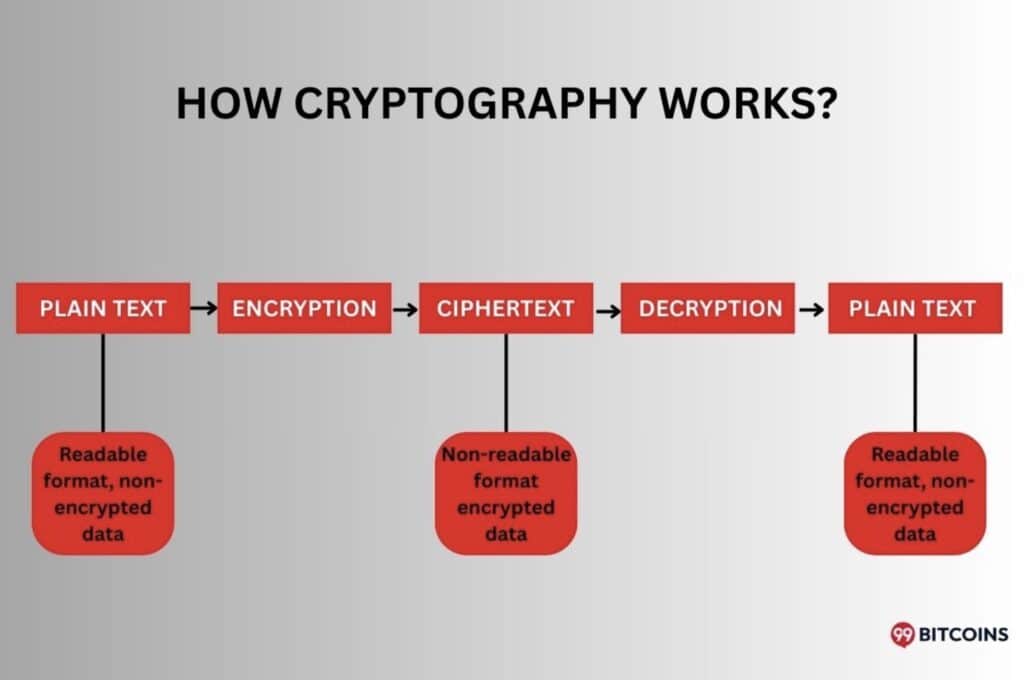
For example, imagine writing a message and then scrambling the letters so no one else can read it. Only the person with the right “key” can put the letters back in the right order. That’s how encryption works; it locks information so only the intended person can open it.
In crypto, this means that when you send money, the transaction details are locked up with encryption. Once locked, no one can secretly change the amount, the sender, or the receiver. This makes transactions secure, tamper-proof, and easy to verify by everyone without needing a bank to check. In case you have any further doubts, we recommend checking out our dedicated ‘What is Cryptocurrency?’ article to learn this concept in more detail.
Still unsure why crypto was needed when we had fiat already, take a look at this comparison table below.
Comparison Between Cryptocurrencies and Fiat Currencies
Feature
Cryptocurrencies
Fiat Currencies
Control
Decentralized: Governed by code and network participants
Centralized: Controlled by governments and central banks
Censorship
No censorship
Vulnerable to censorship
Supply
Fixed or predictable
Unlimited, governments can print more at will
Transactions
Peer-to-peer
Processed by banks and payment providers
Transparency
Public ledger visible to anyone
Records kept by financial institutions
Security
Secured by cryptography and consensus rules
Secured by trust in government and banks
Reversibility
Transactions are irreversible
Payments can be reversed or blocked
Access
Open to anyone with internet and a wallet
Requires bank accounts or approval
Form
Digital
Physical and digital
Chapter Quiz