






Dealing with crypto in Australia means there are tax rules to follow. This crypto tax guide for Australia explains what counts as taxable, how to report it, and what to keep track of so you’re ready at tax time.
Paying crypto taxes in Australia doesn’t have to be confusing. Once you know what the rules are and how to stay organised, it becomes much easier to handle.
Disclaimer: This guide is for general information only and does not constitute tax or accounting advice. We recommend speaking with a registered tax professional to get advice tailored to your personal situation. Crypto tax rules can vary depending on how you use your assets, so always double-check before lodging your return.
Key Takeaways
- Crypto is taxed in Australia as property, not currency, which means capital gains tax applies when you sell, trade, or spend it.
- Staking rewards, mining payouts, and crypto income must be reported as assessable income in Australian dollars.
- Holding crypto for over 12 months can make you eligible for the 50% capital gains tax discount as an Australian resident.
- ATO data-matching programs collect info from exchanges, so keeping accurate and complete records is essential.
- Using exchanges with built-in tax integrations, like Bitcoin.com.au or Independent Reserve, helps simplify reporting and ensures compliance.
Cryptocurrency Tax Australia: Summary
This guide will help you understand how crypto is taxed in Australia and what you’ll need to prepare for the next financial year. You’ll learn how to calculate capital gains, report crypto income, and keep ATO-compliant records with the help of automated tax tools.
We’ll also walk you through how future ATO programs will continue cross-checking exchange data, making proper reporting even more important. By choosing the right crypto exchanges and staying proactive with your records, you’ll be ready to handle tax season smoothly and avoid any surprises.
How Crypto Is Taxed in Australia?
If you’re living in Australia and dealing with crypto assets, the Australian Taxation Office (ATO) treats them more like investments than currency.
That means you’ll report them on your tax return, similar to shares. For details on how the ATO treats crypto assets, check the ATO’s official guidance on crypto asset investments.
Depending on how you use your crypto, you’ll either pay capital gains tax or regular income tax.
Crypto Classification
In Australia, crypto assets are considered CGT assets, so using or selling them usually creates a capital gains tax event. This includes NFTs, stablecoins, and tokens. If you’re holding crypto for investment, the capital gains tax rules apply. But if you’re running a business and selling crypto like stock, it’s considered trading stock, and those profits fall under business income tax.
Pro-tip: Check out ATO’s guide on ‘How to work out and report CGT on crypto’ for more details.
In some cases, income from cryptocurrency margin trading or staking may be considered ordinary income, which affects your tax treatment. So it’s important to know how each type of activity is viewed for tax purposes.
Taxable Events
In Australia, taxable events are any situations where you dispose of your crypto, such as selling it, swapping it for another coin, spending it, or gifting it, basically any time you stop owning it and receive something of value in return.
These are the most common types of taxable events involving crypto transactions:
In all cases, you’ll need to track transaction fees, use the correct market value, and include every disposal on your tax return to avoid mistakes with your crypto tax bill.
For background on how Australia’s digital asset tax policies are changing, the Treasury’s official response to the Board of Taxation’s review is a useful reference.
Non-Taxable/Not Immediately Taxable Situations
Not every crypto-related move creates a tax event right away:
Being clear about what qualifies helps reduce your tax liability and ensures you don’t underreport income or miss a tax deduction.
Types of Crypto Taxes For Australians
If you’re in Australia and use crypto, there are a few different ways the tax office might treat your activity. Most regular investors deal with capital gains tax when they sell or use their crypto.
If you’re earning crypto through staking or as payment for your work, that counts as regular income. And if you’re running a crypto-related business, you’ll be taxed like any other business, and the crypto you hold for sale is seen as trading stock.
Capital Gains Tax (CGT)
If you’re an investor, capital gains tax applies when you get rid of your crypto. That could be selling it for Australian dollars, swapping it for another token, using it to pay for something, or even gifting or donating it. Each time you do one of these things, you’ll need to calculate the difference between what you got and what you originally paid, including any extra costs. If you made a profit, you’ll usually pay tax on that gain. If you made a loss, you can use it to reduce your other gains, or carry it forward to future years.
If you’ve held the asset for at least 12 months and you’re an Australian resident, you might be able to claim a 50 percent discount on the capital gain. This only applies to individuals, not companies. You calculate your net capital gain and report it in your tax return for that financial year.

There’s also something called the “personal use asset” rule. If you genuinely bought crypto just to spend it on personal items and it cost less than ten thousand dollars, you might not need to pay tax on any gain. But the tax office says this rule rarely applies, especially if you’re holding crypto as an investment.
Australian law has also made it clear that crypto is not treated as foreign currency, which means it falls under capital gains and income rules instead of foreign exchange rules.
Income Tax
If you receive crypto, that can count as income. This includes things like staking rewards, airdrops, mining payouts, or being paid in crypto for your work. You need to include the value in Australian dollars at the time you received it in your income for the year. Later on, if you sell or use that same crypto, you’ll go through the capital gains process again, and the starting value will be the amount you already reported as income.
The tax office currently says that some airdrops you get without doing anything in return are not taxed right away. But once you sell those tokens, they do become taxable. On the other hand, if the airdrop is part of a reward program or comes with conditions, it can count as income when you receive it. Staking rewards are also income the moment you earn them.
Business Tax
If you’re running a business that deals in crypto, like trading, mining, or other regular activities, your tax situation is a bit different from someone who’s just investing. In that case, any crypto you hold to sell later is treated as trading stock. When you sell it, your profits are counted as ordinary income, and you can claim deductions for the expenses that relate to earning that income. You’ll also need to follow trading stock rules at the end of the financial year and keep proper records.
To figure out if you’re running a business, the tax office looks at things like how often you trade, how much money is involved, whether you have a business plan, and whether you’re operating in a commercial way. If you are in business, you might also have to deal with GST depending on whether the tokens you use fit the official definition of digital currency and how you’re using them.
Pro-Tip: The ATO has access to customer data from Australian crypto exchanges and runs data-matching programs to check for accurate reporting. So make sure your records are clear and up to date.
This is just general info. For anything specific to your situation, it’s always a good idea to speak with a registered tax agent.
How to Calculate Crypto Taxes in Australia?
To figure out how much tax you owe, you need to track every time you bought, sold, swapped, or used crypto.

You’ll also need to calculate any crypto gains or capital losses, then report it all on your tax return.
Let’s break it down:
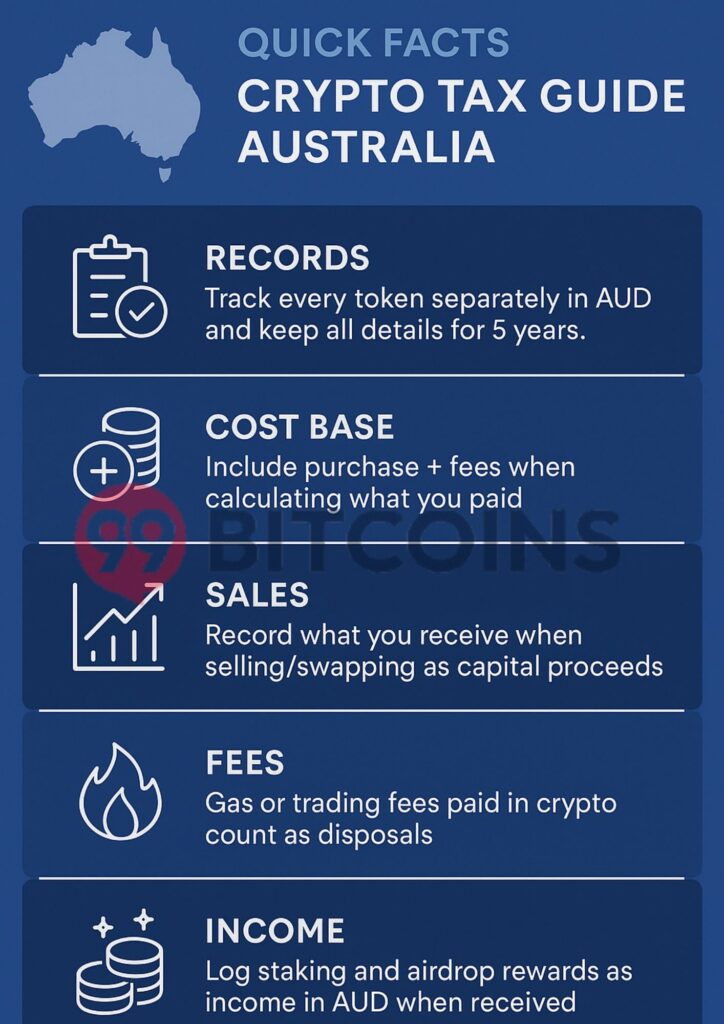
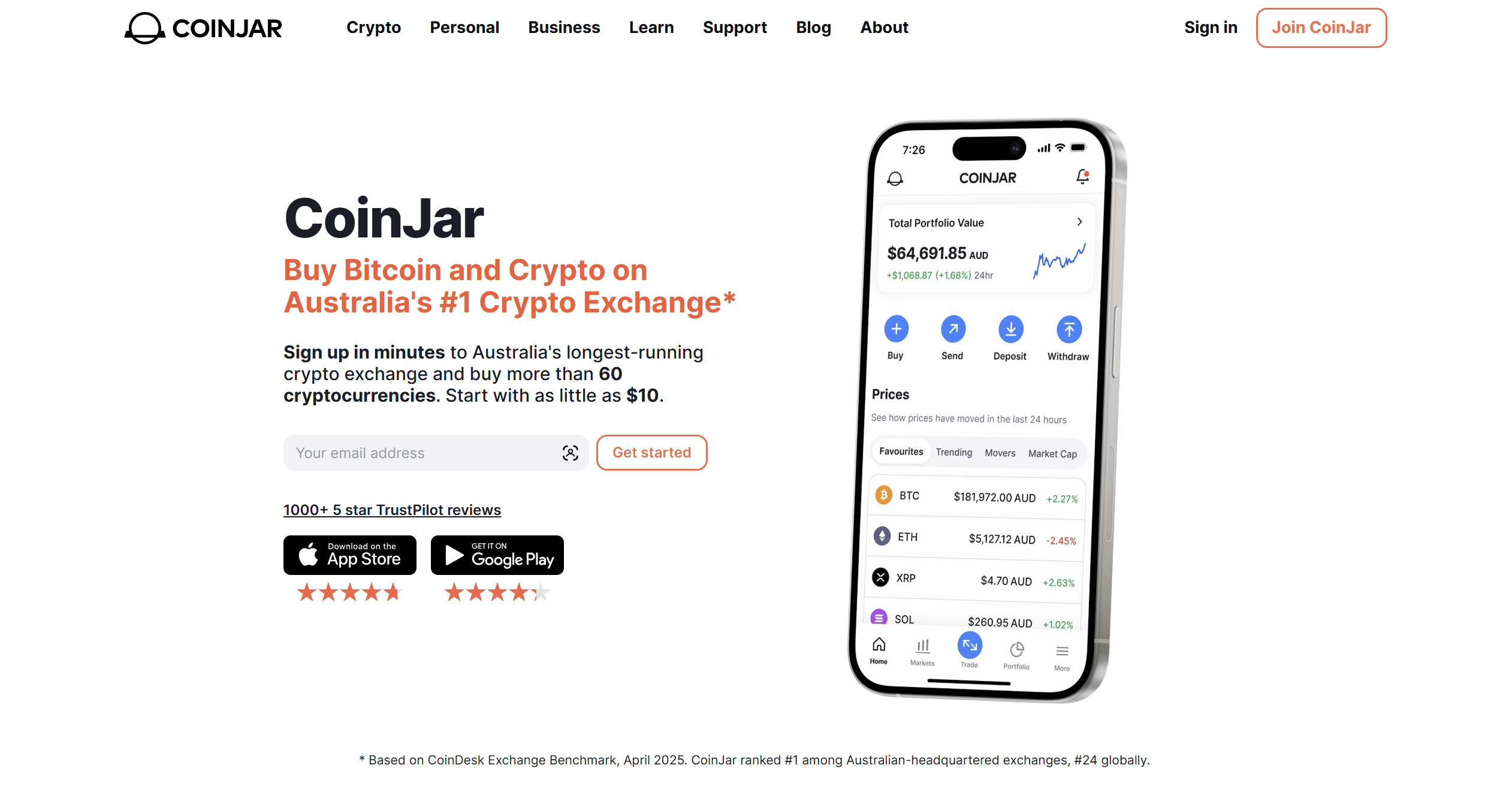
Collect all your crypto trades, staking rewards, and exchange data. Record each trade’s fair market value, time, date, token type, transaction fees, and values in Australian dollars. Keep records for at least five years in case tax agencies ask for them. Decide if you’re an investor or running a crypto business. Business activity creates business income, while investing typically triggers crypto capital gains. Mark every time you had a capital gains tax event, selling, swapping, gifting, or earning other income from crypto. Add it to your crypto tax return. Subtract your cost base (purchase price plus fees) from your capital proceeds. If you swapped tokens, use the market value of what you received. Tally up total capital gains and losses. If you end up with a net capital loss, you can carry it forward to reduce your crypto tax bill in the future. If you held the asset longer than a year, the capital gains tax (CGT) discount may apply. You’ll pay less tax on crypto gains. Include cryptocurrency gains from staking, mining, or margin trading as ordinary income. Add this to your total income for the financial year. Use the CGT section to report your net capital gain and the Other Income section for any staking or business income. If unsure, talk to a registered tax agent. The cost base is what you paid, including transaction fees and purchase costs in Australian dollars. The capital proceeds are what you received in return. If you swapped one crypto asset for another, use the value of the token you received. This is essential for figuring out your tax obligations and staying compliant. Crypto tax tools can make things easier. They connect to cryptocurrency exchanges, track all your transactions, convert amounts to fair market value, and generate reports that go straight into your crypto tax return. These tools help calculate your taxable event history and simplify the crypto tax for Australians. Just remember, you’re still responsible for making sure the info is accurate. You can’t blame the software if the tax agencies find errors, so double-check everything and make sure your tax treatment is consistent. Here are some good tips to know when it comes to managing and calculating your tax responsibilities in Australia when it comes to buying, selling, trading, or holding cryptocurrency. This is general information only. If you’re unsure about your situation, speak with a qualified professional who understands crypto tax and can clearly explain your tax obligations. IMPORTANT – Aussie crypto investor? Take a quick look at our ‘Top Crypto Tools for Australians‘ article; it’s packed with useful picks. Keeping detailed and accurate records is one of the most important parts of managing your crypto taxes in Australia. The ATO treats every crypto asset you own as a separate capital gains tax (CGT) asset, so you need to have enough information to show your gains, losses, and any income you’ve made from each one. You must keep these records for at least five years, and they need to be in English or easily translated into English. Good records also make things much easier if the ATO checks your data and asks for an explanation about your transactions. Pro-tip: The Australian Accounting Standards Board has also published research explaining how crypto assets are recognised and reported under current accounting standards. You’ll want to keep a full story for each transaction, from start to finish. That includes: For individuals, you’ll need to hang onto all this for five years from when you lodge your return. If you’re a business, you need to keep records for five years and also cover the full review period. Whether it’s digital or on paper, your records need to be readable, complete, and ready to share if asked. The ATO has been running a crypto data-matching program that covers tax years from 2014-15 through to 2025-26. As part of this program, the ATO collects info from Australian crypto exchanges and service providers. This includes your identity, account activity, and transaction details. Then they match that data with your tax return to see if anything was left out. They use different techniques to make sure they link the right data to the right person. The ATO doesn’t publish a list of the exchanges involved, so the process stays effective. Public reports show they request large sets of data to help them catch unreported crypto activity. So what does this mean for you? If what your exchange reports doesn’t match your tax return, the ATO might send you a letter asking you to explain. If things still don’t add up, they might change your return or start an audit. But if you’ve got strong records, you can usually sort it out quickly and avoid bigger problems. You can lodge your tax return online using myTax or go through a registered tax agent. Most people need to lodge by 31 October each year. If you’re using a tax agent and you’re on their list before 31 October, you might qualify for a later due date. The payment deadline is usually listed on your notice of assessment. Each year, the ATO reminds people about the deadline and the penalties for lodging late. Here’s how to report your crypto: Before you lodge, download all your exchange statements or CSV files, double-check your crypto wallet history, and save PDF copies of your return or any documents from your tax agent. This helps you stay organised and keeps your five-year record requirement in check. When it comes to sorting out your crypto taxes, it’s worth choosing a crypto exchange that helps you stay compliant with the ATO right from the start. The best Australian platforms make it easy to download tax-ready reports, track your portfolio in Australian dollars, and link directly with crypto tax software. This matters because the ATO expects you to keep detailed records for every crypto asset you buy, sell, or trade. It also runs a crypto data-matching program that compares exchange activity to your tax return. So choosing an exchange with built-in tax features saves time and helps you avoid costly mistakes later on. Look out for platforms that offer: Now, let’s take a closer look at some of the best options available. Bitcoin.com.au offers a built-in “Transactions – Tax” feature that connects directly to Crypto Tax Calculator. Once you link your account, your trades are synced automatically and can be used to generate ATO-ready reports. The platform also includes basic portfolio tracking so you can monitor performance all in one place. Some deal sites highlight a $20 Bitcoin bonus when you trade after signing up, though it’s always a good idea to double-check this in the app before relying on it. To know more about this platform, take a look at our dedicated Bitcoin.com.au review. Special offer: Get $20 worth of free Bitcoin when you sign up and trade, visit Bitcoin.com.au Independent Reserve has some of the best tax features for Aussie users. There’s a dedicated calculator section, plus direct connections to Crypto Tax Calculator and Koinly. You can even get a discount for using Crypto Tax Calculator through the platform. You can export all your transaction history in CSV or PDF format and use the API integration for automatic syncing. It also includes a portfolio view and AutoTrader tools to help you keep records consistent all year. Want to know more about this platform? Check out our comprehensive Independent Reserve review. Special offer: Get $20 worth of free Bitcoin when you sign up and trade, visit Independent Reserve Bitcoin.com.au and Independent Reserve make tax compliance easy by building tax tools right into their platforms. Both give you a direct path from your trade history to a clean, ATO-compliant report. Independent Reserve goes a bit further by offering more integrations and a published discount on the Crypto Tax Calculator. Bitcoin.com.au keeps things simple with a quick link to the Crypto Tax Calculator and automatic syncing. If your main goal is to save time during tax season and avoid headaches, both platforms are solid choices. Swyftx gives you the ability to export your transaction reports in CSV or PDF format. It also integrates directly with Koinly for automated syncing. Swyftx includes its own “Integrated Tax Reports” section to help you gather everything you need, although the report itself isn’t submitted directly to the ATO. The recommended approach is to connect your Swyftx account to Koinly using the API, or upload the exported data to any ATO-compliant tax software like Crypto Tax Calculator or Syla. CoinJar makes it easy to download full account statements in either PDF or CSV format. It’s also compatible with a wide range of Australian tax tools, including Crypto Tax Calculator, Koinly, Syla, CoinLedger, CoinTracker, and Coinpanda. This flexibility is great if you’re working with an accountant who prefers a specific tool. CoinJar has clear instructions for exporting your data, which makes it easy to stay organised. CoinSpot gives you everything you need to prepare for tax season. It has a tax help section with end-of-financial-year (EOFY) guides, detailed CSV exports, and API access. You can use these to connect with Crypto Tax Calculator, Koinly, Syla, or CoinLedger. The platform also explains how to use these tools effectively and highlights Crypto Tax Calculator as a trusted option for Australian users. This makes it easier to stay organised and compliant throughout the year. The best way to stay on top of your crypto tax in Australia is to treat every token as its own separate asset and record everything in Australian dollars at the time it happens. The ATO expects you to keep full details of every transaction, including dates, times, amounts, who you dealt with, the value in AUD, and any fees. These records need to be kept for at least five years. If you need help, the ATO even has a free calculator and record-keeping tool to make things easier at tax time. You’ll want to keep a close eye on two things: your cost base and your capital proceeds. The cost base is what you paid for your crypto, plus extra costs like trading fees or network fees. The capital proceeds are what you get when you sell or swap the asset. If you ever pay a fee in crypto itself, like a gas fee, that fee is considered a disposal too. You’ll need to include it in your records because it reduces your crypto holdings. Don’t wait until the end of the financial year to start sorting things out. Try to do a quick check once a month or once a quarter. Regular check-ins help you catch missing data, mispriced trades, or transfers between your own wallets that don’t count as disposals. It also helps you stay prepared in case your data gets flagged by the ATO’s crypto data-matching program, which is running through 2025-26. This program compares what exchanges report to what you put on your tax return. When you’re earning crypto, like through staking or airdrops, it’s important to treat those as income at the time you receive them. For staking, this means recording the market value of the tokens in AUD on the day you get them. Some airdrops aren’t taxed right away, but they usually are when you later sell the tokens. Once you do sell them, that’s a separate capital gains event. Keep both parts clearly labeled in your records so you don’t confuse income with gains. If you own more than one batch of the same token, it helps to track exactly which ones you sold. That way, you can match up the cost and selling price accurately. If you can’t do that, you can use something like the “first in, first out” method (FIFO), where you assume you sold your oldest tokens first. Just make sure you’re consistent and keep a record of the method you’re using. One of the most effective ways to reduce your crypto tax is to hold your assets for over 12 months before you sell. If you’re an Australian resident, this usually gives you a 50% discount on the capital gains you have to report. That means if you make a profit of $10,000 on Bitcoin you held for more than a year, only $5,000 would be taxed. This rule doesn’t apply to companies, though. You can also reduce your tax by using capital losses the right way. If you sell a crypto asset at a loss, you can use that loss to reduce your gains from other disposals in the same year. If your losses are bigger than your gains, you don’t lose them, you can carry them forward and use them in a future year. Just keep in mind that losses can only reduce capital gains, not your salary or other income. Be careful not to get caught in what the ATO calls a “wash sale.” That’s when someone sells an asset to create a tax-deductible loss, then buys it back straight away to keep holding it. The ATO is watching for these patterns and can disallow the loss if it looks like you only sold for tax reasons without actually changing your investment position. Make sure to claim all the costs you’re allowed to. Some of these include: These can either be included in your cost base to reduce your gains or claimed as deductions for managing your tax affairs. Keep all your invoices or receipts in case you need to show them later. In some cases, you might be able to claim a capital loss for crypto that has been lost or stolen. But this only applies if you can prove: Make sure you have wallet addresses, transaction history, and any relevant communication or screenshots to back it up. Also, think about when you’re selling crypto. Selling before or after June 30 could change which financial year the gain or loss falls into. Waiting just a few extra days could help you qualify for the 12-month discount or push gains into a future year when you might have fewer other profits. Finally, if you’re running a business, such as full-time trading or mining, the rules are different. In that case, crypto is considered trading stock, and profits are taxed as regular income. This also means you’ll need to follow more detailed record-keeping and stocktake rules. You should get advice and make sure your activity is being taxed under the correct system. One of the biggest mistakes people make is assuming that crypto swaps are tax-free. Swapping one token for another (for example, ETH for SOL) is treated as selling ETH and buying SOL. That means it’s a taxable disposal of the ETH, and you’ll need to work out the gain or loss based on the AUD value at the time of the swap. Another common issue is forgetting to convert values into Australian dollars. Every acquisition and disposal needs to be recorded in AUD based on the value at the time it happened. If you don’t, your capital gain or loss calculations could be completely off. It’s especially important to include any crypto paid in fees, as those are also considered disposals. Some people don’t report staking rewards or airdrops until they sell the tokens. That’s a mistake. Staking rewards are taxed as income when you receive them, based on the market value in AUD. If you sell those tokens later, that’s a separate event, and you’ll calculate any capital gain or loss based on the original value you already reported as income. People also sometimes try to claim the “personal use” exemption too broadly. This exemption only applies if you genuinely bought the crypto to use it for personal things, like buying a gift or paying for a coffee, and not as an investment. The ATO has said this exemption doesn’t apply very often, especially if you’ve held the crypto for a while or expected it to increase in value. Another major issue is poor record-keeping. If you don’t have accurate timestamps, AUD values, fee records, and notes on wallet transfers, it becomes very difficult to do your taxes properly. And if the ATO checks your data against what exchanges report, you could end up in trouble. Records must be kept for at least five years, so make sure they’re clear and complete. Lastly, it’s risky to assume the ATO won’t notice. The tax office has an active data-matching program that collects information from Australian exchanges. If what they receive doesn’t match what you report, you might get a letter, or worse, a full review. Keep your records clean and your reporting accurate to avoid any unnecessary issues. Managing crypto taxes in Australia comes down to staying organised and understanding what the Australian Taxation Office (ATO) treats as taxable. Since crypto is viewed as property, selling, swapping, or spending it usually triggers capital gains tax. Earning crypto through staking, mining, or payments counts as regular income and must be reported in Australian dollars. The smartest approach is to keep detailed records from the start. Use exchanges that offer tax integrations, like Bitcoin.com.au or Independent Reserve, and connect them with crypto tax tools to simplify your reporting. By planning ahead and tracking everything accurately, you’ll make tax season far less stressful. If things ever get complicated, a registered tax agent who specialises in crypto will help you stay compliant and avoid costly mistakes. DISCOVER: The ATO taxes crypto as property. You pay capital gains tax when you sell, swap, spend, or gift it. Crypto earned from staking, mining, or work is taxed as income. Work out your gains by subtracting what you paid (plus fees) from what you received in AUD. Add any crypto income at its AUD value when you got it. Exchanges like CoinSpot, Swyftx, CoinJar, Independent Reserve, and Bitcoin.com.au offer tax tools, CSV exports, and integrations with tax software. It makes tax time easier. You’ll get clean reports, avoid missing data, and stay ATO-compliant. Keep dates, amounts, AUD values, fees, wallet addresses, and what each transaction was for. Store records for at least five years. Yes. Selling or trading NFTs triggers capital gains tax. Creating or earning them may count as income. The ATO can match your exchange data. You risk penalties, audits, or changes to your tax return. Download your full transaction history, use tax software, stay organised, and report everything in AUD. Established in 2013, 99Bitcoin’s team members have been crypto experts since Bitcoin’s Early days. Weekly Research Monthly readers Expert contributors Crypto Projects Reviewed
Gather your records
Classify your activity
Identify taxable events
Calculate each disposal
Net gains and losses
Apply the CGT discount if eligible
Add crypto income
Report in your tax return
Cost Base & Capital Proceeds
Using Crypto Tax Tools
Record-Keeping & ATO Requirements for Aussies
What Records to Keep?
Data Matching & Audits
How to Lodge?
Choosing the Right Australian Exchange for AU Tax Compliance

Bitcoin.com.au: Offers Tax and Portfolio Integration Benefits

Independent Reserve: Provides Automation and Tax Beneficial Tools

Why These Two Are the Best for Tax-Ready Crypto Trading
Swyftx: Offers Integrated Tax Reports

CoinJar: Integrated with Tax Portfolio Tools
CoinSpot: Provides Advanced Tools for Aussies

Strategies to Simplify Crypto Tax in Australia

Area
Tip
Records
Cost Base
Sales
Fees
Routine Checks
Income
Tracking Method
How to Minimize Crypto Taxes (Legally)?
Common Mistakes to Avoid with Crypto Taxes

Conclusion
FAQs
How does the ATO tax cryptocurrency in Australia?

How can I calculate my crypto taxes in Australia?
Which Australian exchanges help with crypto tax reporting?
Why should I use a tax-friendly crypto exchange in Australia?
What records should I keep for crypto tax reporting?
Do I have to pay tax on NFTs in Australia?
What happens if I don’t report my crypto gains or income?
What is the best way to prepare for crypto tax season in Australia?
References

Why you can trust 99Bitcoins