







In This Article
- Our Verdict: Why Pepenode is a Legit Crypto Presale
- What is Pepenode?
- Pepenode Tokenomics & Presale Details
- Pepenode’s Roadmap: Is it Realistic?
- Who’s the Team Behind Pepenode?
- Auditing & Compliance: Is Pepenode Safe?
- Is Pepenode a Good Investment? PEPENODE Forecast
- How to Buy Pepenode
- Conclusion: Is Pepenode a Scam or Legit?
Pepenode (PEPENODE) revolutionizes blockchain mining with its mine-to-earn concept, based on a virtual mining ecosystem. The gamification project allows players to earn meme coins in a simulated environment, where they build and customize virtual mining rooms to maximize their hash power.
However, as a presale initiative, Pepenode’s mining ecosystem is scheduled to launch later in the roadmap timeline. Since this dynamic increases the investment risk, we advise conducting your own research and examining the question: Is Pepenode legit?
Discover more about Pepenode’s utility product, including its use cases, roadmap objectives, and token allocation. Assess whether PEPENODE tokens resemble a viable presale investment or if safer alternatives exist.
Our Verdict: Why Pepenode is a Legit Crypto Presale
The Pepenode whitepaper outlines a legitimate gamification platform with genuine utility. The founders currently offer no minimum viable product (MVP), yet the presale valuation factors these risks into the token price. Investors may wait until the mainnet launch in anticipation of price increases, but they will enter the market at a significantly higher market capitalization.
Contract audits highlight trust, and both SpyWolf and Coinsult issued high security ratings, helping PEPENODE holders avoid contract risks, such as transaction taxes and honeypots. Mine-to-earn rewards pressure the token supply, so the project’s revenue model is planned to mitigate stability risks or market trends. As more platform users join the ecosystem, demand for PEPENODE tokens rises organically.
Smart and transparent tokenomics also raise credibility. The founders capped the supply at 210 billion and allocated tokens to key areas, including protocol development, node payouts, and infrastructure growth.
- Real ecosystem utility: Despite its name similarities with Pepe (PEPE), Pepenode is a genuine utility product rather than a speculative meme coin, with an innovative simulation game that rewards progress. Users build mining rooms and purchase nodes to increase hash power. Players may purchase in-game assets to increase their mining payouts, which drives long-term demand for the native token.
- Smart contract-driven: Once the ecosystem goes live, smart contracts handle mine-to-earn distributions. They analyze node power to determine payouts and automatically transfer rewards to the user’s account. The smart contract system prevents centralized risks, like tampering and manipulated results.
- No private funding rounds: The most successful gamification projects offered priority access to institutional investors and strategic partners. These stakeholders receive a much lower price than general participants, which creates an unfair advantage. Pepenode is an inclusive presale event that offers no special treatment for large-scale backers. Everyone gets a fair token price depending on the presale round.
- Partially transparent team: The Pepenode team does not reveal their identities, yet documents provide some traceable data. Neuriki LTD, a company registered in the British Virgin Islands, issued the whitepaper. The document lists Fahim Rahman as the firm’s Managing Director.
- Verified audits: Pepenode hired two reputable blockchain security companies to audit its smart contract. Note that the audit applies to PEPENODE tokens rather than the simulated game. Coinsult and SpyWolf discovered no security threats, and since the team renounced the contract, they cannot amend its terms.
- EU-compliant presale: In an unusual move for a presale project, Pepenode complies with the European Union (EU)’s Markets in Crypto-Assets Regulation (MiCA). The whitepaper explicitly mentions the 14-day cooling-off period, which enables EU retail clients to request a refund before the exchange launch event.
What is Pepenode?
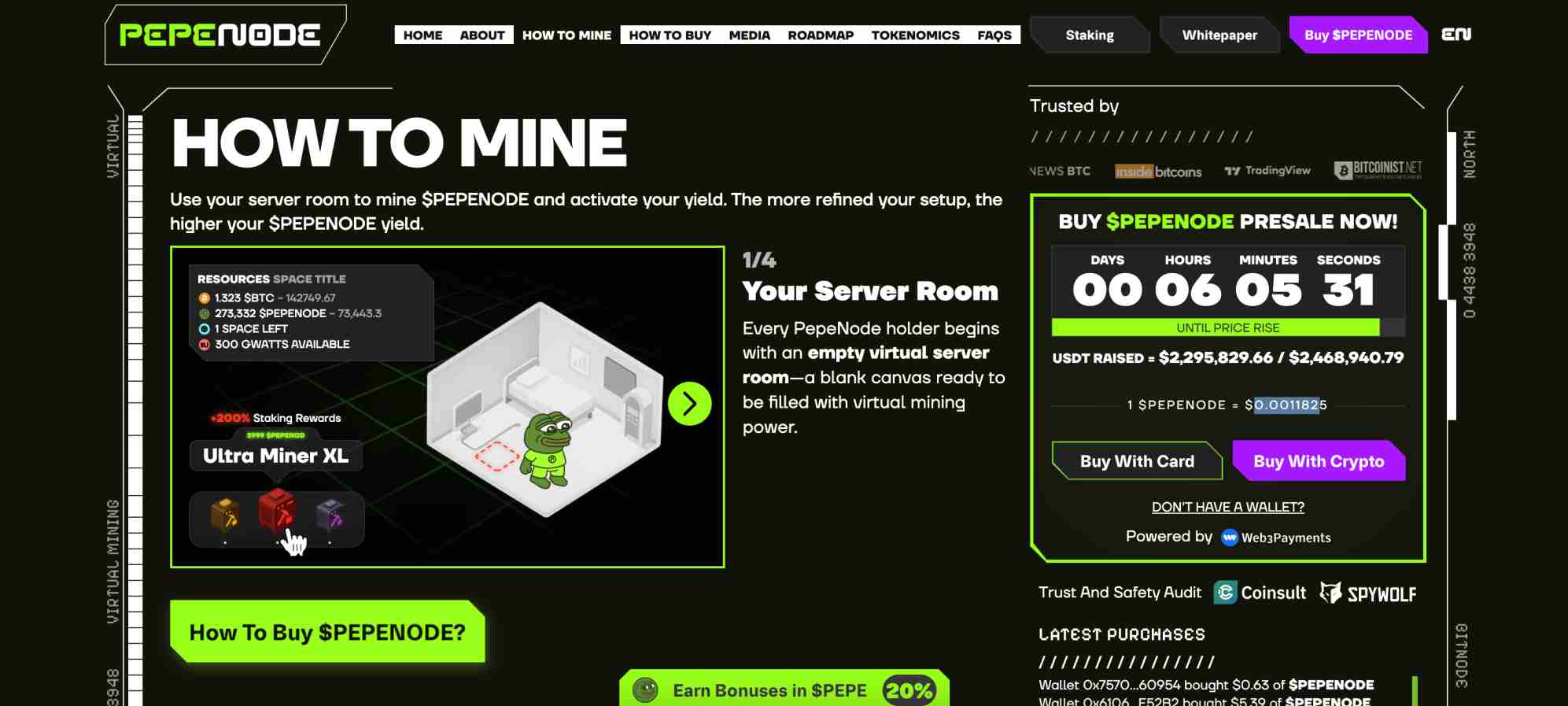
Pepenode is a gamified simulation concept themed around traditional crypto mining. Instead of buying expensive hardware, platform users create and customize virtual mining rooms. They purchase affordable nodes to generate mining power, and each node yields varying specifications, including hash rates, energy costs, and reward outputs.
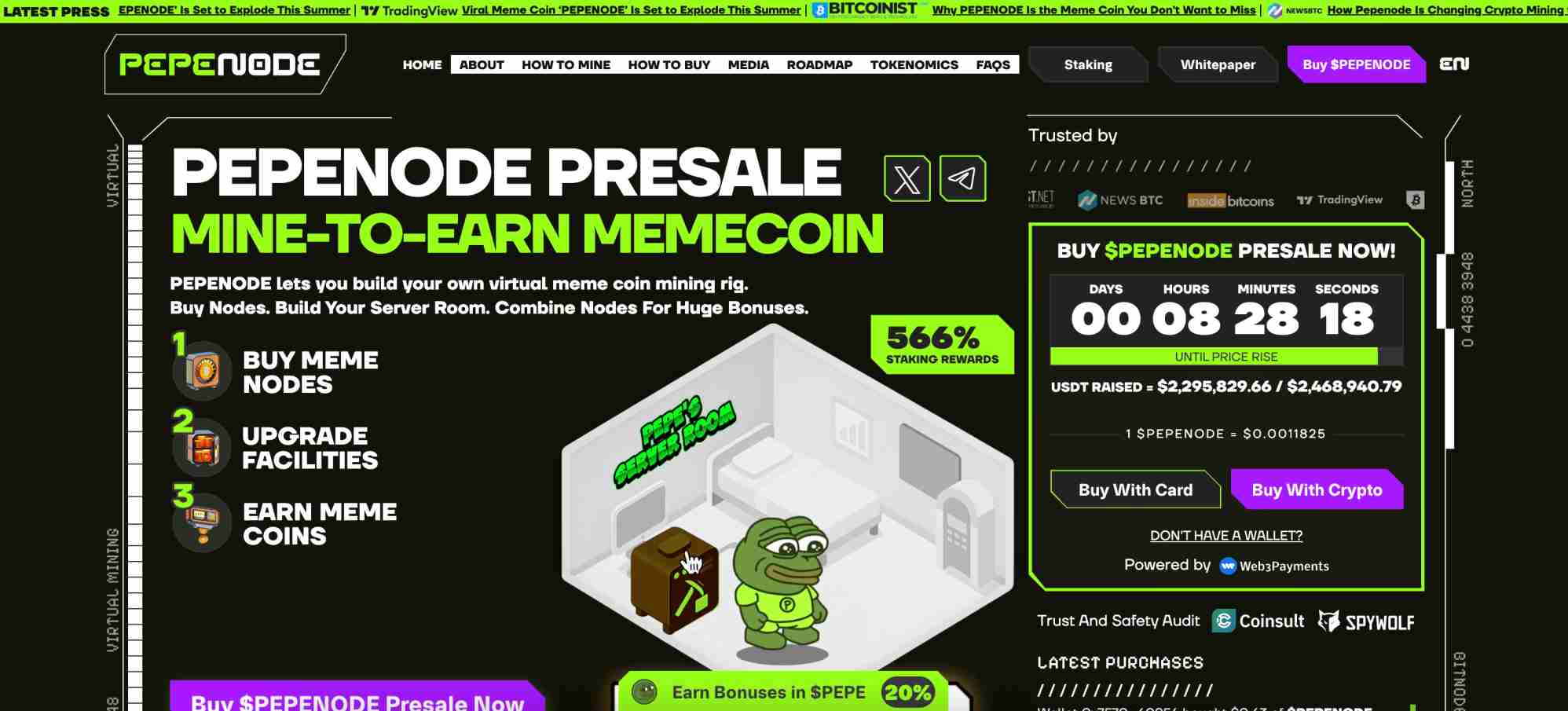
Interactive experiences include in-game assets, where players upgrade their facilities to amplify hash power. Digital items may feature cooling units, larger servers, and hash rate boosters. Regarding payouts, users receive mining rewards in the native token, PEPENODE, as well as top meme coins such as PEPE and Fartcoin (FARTCOIN). The team plans additional meme coin partnerships to expand payout options.
To ensure credibility, smart contracts govern the mine-to-earn ecosystem. Ethereum-based contracts handle mining outcomes, calculate rewards, and distribute payouts autonomously. This framework prevents human error and manipulation risks.
- Mining meets gamification: Pepenode offers solutions to address existing mining challenges. Large-scale entities dominate the Bitcoin (BTC) mining industry, and entrants require extensive resources, including powerful ASICs, high energy consumption, and ongoing maintenance. Although cloud mining lowers startup costs, the industry is notorious for scams. Pepenode’s gamification solution makes mining more accessible, while its decentralized infrastructure eliminates fraudulent practices.
- Strong economic model: Pepenode uses the same revenue mechanics as mobile games like Candy Crush. Players increase their mining hash power and rewards by upgrading their facilities. As users purchase in-game assets, such as node multipliers, it generates income for the ecosystem. People need PEPENODE tokens for payment, so it drives demand. This economic model creates long-term sustainability and helps push the token price.
- Transparent tokenomics: PEPENODE tokens are based on Ethereum, with a total supply of 210 billion. The founders created a finite supply dynamic, which prevents them from minting additional tokens. The website confirms that the team receives no tokens from the supply. This framework reaffirms Pepenode’s commitment to decentralization and fairness.
- Presale opportunity: To help product development, the project sells PEPENODE tokens to presale participants. Because investors commit money before the mainnet release, they receive a discounted price. The event spans multiple stages, and the presale dashboard increases the price gradually to reward early buyers. To participate in the presale, you must contribute a supported digital asset, such as Ethereum (ETH) or Tether (USDT).
Pepenode’s Use Cases & Technology: Are They Legitimate?
We thoroughly researched the project’s technical claims to evaluate the question: Is Pepenode legitimate? Read on to discover more about the gamified ecosystem and its various token use cases.
Mine-to-Earn
As one of the best gaming cryptocurrencies in 2026, Pepenode uses a mine-to-earn model to incentivize players in the virtual mining game. The objective is to build a successful mining business in a virtual environment.
Users customize server rooms, buy nodes, and upgrade facilities to generate hash power. As they scale their output, players boost mining revenues. The concept rewards skill and effort, and smart contracts ensure a safe and fair payout system.
Prospective investors should note that the gaming project is still in development. While no MVP or early demo currently exists, presale participants secure the lowest valuation.
Rewards Model
After the gaming ecosystem launches, players initially earn mining rewards in PEPENODE. The tokenomics confirm that 7.5% of the supply is allocated to fund node payouts from meme coin mining.
The team’s economic strategy relies on in-game purchases, where players use PEPENODE tokens to upgrade their mining operations. Holders may also stake PEPENODE to generate passive income. Both models help stabilize the token supply, as users engage with the ecosystem rather than cash out on exchanges.
Later in the roadmap, the rewards system expands into top meme coins. The project specifically mentions PEPE and FARTCOIN, with additional tokens also planned. These cryptocurrencies have significant market capitalizations, so when Pepenode users sell their mining income, it won’t affect the PEPENODE supply
Token Use Cases
PEPENODE offers additional use cases besides mining rewards.
Tokens serve as a transaction currency within the gamified platform, since users purchase in-game assets with PEPENODE. They also unlock staking income. The dynamically adjusted protocol determines staking APYs by real-time demand. Presale investors currently earn massive APYs of 566%, yet the system reduces the rate as more people stake tokens.
Pepenode Tokenomics & Presale Details
Pepenode created 210 billion tokens on the Ethereum blockchain. The smart contract audit reveals that the founders cannot create additional tokens, which helps holders avoid inflationary risks due to the fixed supply.
The project allocates 35% to the economics and treasury department, which funds business development and community activations. The same allocation is also applied to protocol developments. These funds enable product development and ongoing improvements to create the ultimate gaming experience.
Ecosystem rewards, which include mining payouts and staking, require 7.5% of the PEPENODE supply. The team reserves another 7.5% for exchange growth, including platform liquidity and listing applications. The long-term goal is to secure major exchange listings, thereby increasing market exposure.
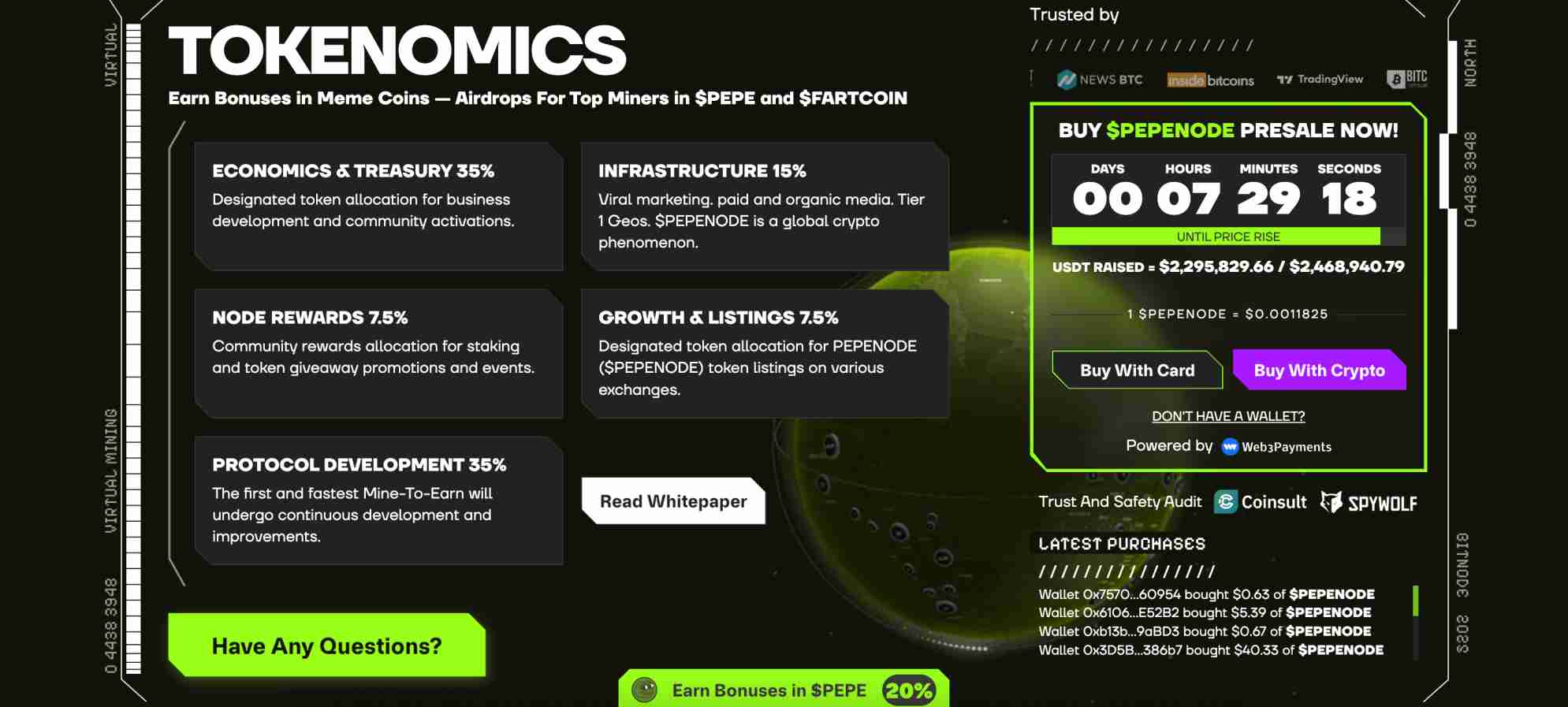
The infrastructure division, which largely focuses on marketing, receives the remaining 15%. The marketing strategy includes paid and organic media, as well as viral social media campaigns.
As with any ERC-20 token, PEPENODE holders store assets in an Ethereum wallet. They must hold a small amount of ETH to cover Ethereum network fees.
Pepenode reserves a percentage of the supply for the presale event. It enables investors to purchase tokens at the lowest valuation and earn staking rewards before the exchange listing event. No minimum purchase requirements apply, and investors may contribute four cryptocurrencies: ETH, USDT, BNB, and USDC.
To date, participants have invested nearly $2.3 million. The event spans multiple stages with a tiered pricing structure, and to ensure fairness, the team made no private allocations. Those who purchased PEPENODE in the initial presale stage paid $0.001 per token, while the current price is $0.00121610.
Although the whitepaper confirms Uniswap as the first exchange partner, it offers no information about the listing price. Centralized exchange (CEX) listings typically follow the token generation event (TGE), although ongoing negotiations often restrict specific platform announcements.
Here is what investors should know about the Pepenode presale:
| PEPENODE Presale Launch Date | August 2025 |
| Initial Presale Price | $0.001 |
| Current PEPENODE Price | $0.00121610 |
| Exchange Listing Price | TBA |
| Number of Stages | Not stated |
| Raised to Date | Approx. $2.3 million |
Pepenode’s Roadmap: Is it Realistic?
The development team published four roadmap phases.
The presale launch enters the first phase, during which individuals can invest in the project at a discounted price. It also includes staking rewards activation and community building on social media.
The second phase includes the TGE, where the team launches PEPENODE on Uniswap. We anticipate a PEPENODE/USDT pair, so the project will also deposit equal amounts of USDT. Although the roadmap does not include deadlines, the whitepaper states that the TGE is scheduled to occur by the end of Q1 2026.
During the same phase, Pepenode opens its virtual server room builder and node marketplace. These features unlock access to the mine-to-earn concept. As early adopters secure the most valuable nodes, incentivization accelerates platform growth.
The third and fourth roadmap phases, which we expect in Q2 or Q3 2026, increase ecosystem utility. The virtual mining simulator enhances interactivity, and the global leaderboard allows users to compete against other players. The roadmap also introduces new node types and strategy levels to increase user retention. It launches meme coin rewards, too, starting with PEPE and FARTCOIN.
These roadmap goals appear realistic, although investors must closely monitor the development progress.
Who’s the Team Behind Pepenode?
The whitepaper provides some information about the project founders. Neuriki LTD is the British Virgin Islands company that issued the whitepaper, and Fahim Rahman, the sole person listed, serves as the firm’s Managing Director.
Despite providing its address and business registration number, we discovered no other information about Neuriki LTD. The British Virgin Islands has strict privacy laws that prevent public disclosures without legal proceedings.
Although Pepenode retains its anonymous setup, the listed company information provides some traceability.
Auditing & Compliance: Is Pepenode Safe?
Experts recommend investing in new cryptocurrencies only when auditors confirm that a secure smart contract has been implemented. Nefarious terms allow founders to commit various scams, and common tactics include wallet address blacklisting and unlimited token mints.
Our research shows that Pepenode hired two leading security companies to complete its contract audit: Coinsult and SpyWolf. These firms evaluated the contract extensively to identify potential threats. Both audits found no vulnerabilities, ensuring a safe trading environment.
The security audits reveal that the Pepenode team renounced ownership of the native contract. This essential feature creates a decentralized and immutable environment for PEPENODE holders, as the project cannot add or adjust contract terms.
We suggest readers review both smart contract audits at the following links:
Referring to various European Union (EU) regulations, the whitepaper states that Neuriki LTD complies with relevant investor laws, including MiCA. It follows a 14-day cooling-off period, during which presale buyers must receive a full refund if they change their mind. The 14-day timeframe expires at the TGE and does not include network fees.
In our view, full compliance with EU rules builds investor confidence and raises project credibility.
Is Pepenode a Good Investment? PEPENODE Forecast
Pepenode is a utility asset that unlocks ecosystem features, yet some people purchase tokens as an investment vehicle. A wide range of factors drives the PEPENODE price, including roadmap progress. Currently, presale investors gain exposure to the new meme coin project before it releases the simulated mining game.
Since this roadmap objective arrives in phase three, investors face a higher risk profile but also secure a lower entry price. This investing dynamic works similarly to traditional startups, which offer reduced valuations to venture capital firms. According to some analysis, as the development team achieves its roadmap targets, investor demand for PEPENODE could rise.
Platform adoption also matters. Pepenode’s economic structure relies on real player engagement, as users need PEPENODE tokens to purchase nodes and enhance mining facilities. As more players join the ecosystem, PEPENODE demand increases, and investors may experience price appreciation.
We also expect exchange listing partners to impact the project growth cycle. The founders initially listed PEPENODE on Uniswap, which is the largest decentralized exchange (DEX) on Ethereum. Yet, Uniswap trading volumes are tiny compared with major platforms like Binance and Coinbase. Securing listings with Tier 1 exchanges gives exposure to a much larger pool of traders.
Some analysts cite the growth of the gamification sector as a key pricing indicator. A Mordor Intelligence report estimates that gamification revenues could rise to $92.51 billion by 2030, reflecting a 26.02% compound annual growth rate (CAGR). Precedence Research is also bullish on gamification. It predicts a 27.9% CAGR through 2034, which values the market at $190.87 billion. As a gamification pure-play, these revenue projections benefit Pepenode considerably.
Given these factors, our Pepenode price prediction for 2026 is a potential all-time high of $0.0049644. If the tokens achieve this price forecast, it resembles a 4x gain from the current presale rate. Full functionality is expected to be available by 2027, and with significant user growth, the PEPENODE price may reach $0.013002 by Q4. Those who plan to hold for the long term could experience the highest growth potential. We predict a potential all-time high of $0.037824 by the end of the decade.
PEPENODE’s potential highs:
- 2026: $0.0049644
- 2027: $0.013002
- 2030: $0.037824
How to Buy Pepenode
The best way to invest in the Pepenode presale is on the Best Wallet app. The beginner-friendly wallet allows users to buy cryptocurrencies directly from their balance. It also accepts instant crypto purchases with PayPal, Skrill, debit and credit cards, and more. When Pepenode distributes tokens after the presale, it sends them directly to Best Wallet.
Follow these steps to buy Pepenode in under five minutes:
- Step 1: Download Best Wallet: Download the free iOS or Android app from the Best Wallet website. When you download the app, it automatically stores encrypted private keys on the mobile device.
- Step 2: Set up the Wallet: Open the Best Wallet app and choose a PIN. Then enable two-factor authentication, and for additional security, use biometrics instead of a PIN login.
- Step 3: Transfer or Purchase Assets: Transfer ETH, USDT, BNB, or USDC to your Best Wallet address. Ensure you use the correct network standard to avoid costly mistakes. To buy cryptocurrencies for the Pepenode presale, tap “Trade” and then “Buy”. Enter the purchase amount and deposit method, then provide the payment details.
- Step 4: Go to Upcoming Tokens: Tap the “Home” icon and select “Upcoming Tokens”. Best Wallet lists several top crypto presales, so choose “Pepenode” from the list of events.
- Step 5: Buy PEPENODE Tokens: Fill out the presale investment form. Best Wallet requires the payment asset and amount, and whether you want to stake tokens during the presale. Review the information entered and confirm your Pepenode purchase.
If you prefer to use a different wallet provider, such as MetaMask or Trust Wallet, you can complete the presale investment on the Pepenode website. The process follows that of most other presale events, where you connect a wallet and exchange an accepted cryptocurrency. Return to the Pepenode website to claim your tokens when the presale ends.
Conclusion: Is Pepenode a Scam or Legit?
We examined the question in great detail: Is Pepenode legit? Our findings indicate that Pepenode is a credible presale project with strong fundamentals. It develops a mine-to-earn platform with significant adoption potential, especially considering the growth of gamification.
The utility-driven model requires players to purchase nodes and upgrades with PEPENODE, which increases token demand over time. Although presale participants risk capital before the product launch, they secure the lowest possible token price. Evaluate the investment thesis carefully before proceeding, as new cryptocurrencies carry substantial risk.
FAQs
What is the Pepenode presale?

Pepenode, a new gamification project that merges mining rewards with simulated experiences, is a presale event that offers a reduced token price. By joining the presale, you can purchase PEPENODE tokens at a discounted price.
Is Pepenode legit and safe?
Yes, Pepenode is a legit crypto startup with clear use cases, a fair presale process, and an audited smart contract. Independent research is essential, as Pepenode launches its gamification platform after its presale event.
Is Pepenode audited for regulatory compliance?
Yes, Coinsult and SpyWolf audited the PEPENODE contract, and they confirm no security threats. The whitepaper complies with EU regulations, including its 14-day withdrawal rights.
- Pepenode whitepaper (PDF)
- Markets in Crypto-Assets Regulation (MiCA) (European Securities and Markets Authority)
- Gamification Market Size & Share Analysis – Growth Trends And Forecast (2025 – 2030) (Mordor Intelligence)
- Gamification Market Size, Share, and Trends 2025 to 2034 (Precedence Research)

Why you can trust 99Bitcoins
Established in 2013, 99Bitcoin’s team members have been crypto experts since Bitcoin’s Early days.
Weekly Research
100k+Monthly readers
Expert contributors
2000+Crypto Projects Reviewed