








In This Article
JPYR (JPYR) is a new stablecoin pegged to the Japanese yen. Built on the Ethereum blockchain, it provides a hedge against traditional USD-denominated assets and unlocks decentralized finance (DeFi) opportunities like staking and liquidity provision. Our JPYR review explains everything you need to know about the up-and-coming stablecoin project.
We researched JPYR extensively to produce this review, including a deep dive into its whitepaper, token supply, and pegging mechanisms. Read on to explore JPYR use cases, where and how to buy it, and whether the token offers a viable alternative to Tether (USDT), USDC (USDC), and other popular stablecoins.
Key Takeaways on JPYR
- As a stablecoin pegged to JPY, JPYR provides exposure to the Japanese yen in a decentralized environment.
- The whitepaper confirms that real asset reserves back JPYR, which helps it retain its 1:1 exchange rate with the Japanese yen,
- The JPYR price fluctuates on cryptocurrency exchanges because platforms typically display valuations in USDT or USDC. This dynamic means JPYR holders hedge against USD/JPY exchange rate movements.
- While JPYR is a new project, its roadmap highlights several use cases within DeFi ecosystems. Similar to other stablecoins, JPYR powers DeFi initiatives like liquidity provision, lending, and staking.
- The best way to buy JPYR is on the BTSE exchange. It accepts fiat payments like Visa and MasterCard, and spot trading pairs include JPYR/JPY and JPYR/USDT.
What is JPYR Coin?
JPYR is a stablecoin asset that runs on the Ethereum blockchain. As a stablecoin, its primary function is to maintain a peg against the underlying currency, the Japanese yen. This mechanism means that 1 JPYR token should always equal 1 JPY.
As such, people buy JPYR for stability and exposure to yield opportunities, rather than price appreciation like other cryptocurrencies.
To achieve its peg to the Japanese yen, the stablecoin holds real asset reserves. The whitepaper provides limited detail on JPYR’s reserve composition, but the project likely holds an equivalent amount of JPY. This infrastructure ensures JPYR retains its 1:1 ratio with the yen and that holders can always convert their stablecoins for real currency.
In terms of use cases, people buy JPYR for several reasons. Some people use JPYR as “Dry Powder“, which enables them to easily capitalize on new trading opportunities without volatility risks. Rather than offloading existing cryptocurrency investments to fund positions, traders use their JPYR reserves.
JPYR also offers an alternative to mainstream stablecoins like USDT and USDC, since these assets are pegged to U.S. dollars. It provides holders with exposure to JPY currency dynamics, such as the central bank interest rates and the broader Japanese economy.
The roadmap shows that JPYR will also power yield-earning opportunities in the DeFi sector. Due to its 1:1 peg, JPYR holders generate income through staking, liquidity provision, and lending without constant price fluctuations.
Our JPYR review also confirms that the stablecoin supports non-custodial ownership. When you buy JPYR and transfer tokens to a decentralized cryptocurrency wallet, you keep full control of your stablecoin assets. With no reliance on centralized intermediaries such as banks or exchanges, holders freely send, receive, and store JPYR with complete autonomy.
Visit JPYRTechnology Behind JPYR Token
JPYR leverages blockchain technology and smart contracts to ensure transparency, security, and seamless transactions. Per the whitepaper, the token operates on the Ethereum blockchain, although the team plans additional ecosystems in the future.
Expanding to popular networks like Solana, BNB Chain, and Base increases liquidity and encourages Web 3.0 developers to build innovative use cases and applications.
As the Ethereum blockchain records transactions on the public ledger, stakeholders can verify each JPYR transfer. They can also verify the total supply on-chain and compare token issuance with reserve data.
Regarding the pegging mechanism, JPYR claims that real assets back each token. Although audited reserves appear later in the roadmap, the project likely holds JPY and cash equivalents (like short-term Japanese government bonds) to maintain its peg. These requirements instill trust in the broader market, a core factor to maintain long-term stability.
Is JPYR Safe & Legit?
Available project data includes the JPYR website and whitepaper only. Limited information hinders a true assessment of legitimacy, so we strongly advise you to conduct due diligence before proceeding.
According to our research, the stablecoin issuer claims to have a 100% reserve backing to maintain its peg to JPY. In theory, this means that for every JPYR crypto token issued, the company holds 1 JPY in cash or bonds. Once JPYR publishes its audited reserve reports (like USDT and USDC do), stakeholders can transparently evaluate these holdings.

We analyzed on-chain data via Etherscan for a deeper analysis of the JPYR supply. Etherscan confirms a total supply of 10 billion tokens. Based on the current USD/JPY exchange rate, this supply converts to approximately $65 million. This fully diluted valuation (FDV) is small compared with the leading USD stablecoins, which issue billions of dollars worth of tokens into the markets.
To track the JPYR supply, search the project’s smart contract address on Etherscan: 0xaf5d2cf39f2d4e2f5900d6cf37ab3596866347e4
Is JPYR a Good Investment?
A JPYR investment differs from top cryptocurrencies like Bitcoin (BTC) and Solana (SOL). These digital assets experience price fluctuations, leading to profit or loss depending on the original cost basis. Since JPYR is pegged to the Japanese yen, investment opportunities arise from other angles.
DeFi Yields Without Volatility Risk
Stablecoins remain the best cryptocurrency type to earn DeFi yields. Because of their pegging system, holders can generate predictable passive income without volatility. If a DeFi product yields 9% annually, investors increase their stablecoin holdings by 9%, regardless of broader cryptocurrency sentiment.
Although JPYR is a new stablecoin initiative, it plans to expand into multiple DeFi ecosystems. Some analysts expect that JPYR will operate in Ethereum-based applications like Aave, where users lend their stablecoins to borrowers. Decentralized lending platforms require borrowers to deposit collateral, which helps reduce risk in the event of non-payment.
The best DeFi staking platforms could also list JPYR. Holders deposit their JPYR tokens into staking pools with variable interest rates and choose between flexible or fixed terms.
As JPYR adoption increases, it could also feature on decentralized exchanges as a popular pair denomination. Holders who provide JPYR liquidity for these pairs earn a share of trading fees.
The best practice is to diversify across multiple DeFi ecosystems and tools to mitigate risk. DeFi pools are never 100% safe, so diversification ensures adverse events have a smaller impact on the portfolio value.
USD/JPY Exposure
Most cryptocurrency investors rely on U.S. dollars or stablecoin equivalents like USDT. The currency enables seamless access to thousands of cryptocurrency markets without constant conversions. However, holding USD-denominated assets creates valuation risks, especially considering the U.S. dollar declined by 9% in 2025.
By holding JPYR, you effectively hold a position in the Japanese yen. If you believe the USD’s value will continue to decline against JPY and other major currencies, JPYR allows you to profit from these exchange rate fluctuations.
Hold Yen On-Chain Anonymously
Most people store fiat currencies in centralized accounts, such as banks or e-wallets. These institutions use custodial models, where they hold and control client-owned assets. This framework creates counterparty risks; institutions can freeze balances, reject transactions, or demand an unprecedented set of know-your-customer (KYC) documents.

When you buy JPYR and transfer the stablecoins to a private, non-custodial wallet, you eliminate many of these pain points.
The best decentralized cryptocurrency wallets let users control their private keys, which prevents third parties (including the wallet provider) from accessing the funds. Since you store JPYR on the Ethereum blockchain, intermediaries cannot block transactions.
You also avoid KYC requirements when you store JYPR on-chain, allowing you to send and receive stablecoins anonymously.
Ideal for Global Remittance
Our JPYR review confirms that the stablecoin supports seamless remittance payments. Holders can transfer JYPR tokens to any wallet address via the Ethereum network. Etherscan gas data shows that even high-priority transactions cost under $0.01.
These ultra-low fees apply regardless of the JYPR transfer size. Transactions are fast too, as the Ethereum blockchain typically confirms transfers in about 12 seconds.
JPYR Roadmap & Future Outlook
The JPYR team outlines the following roadmap objectives:
- Technical Upgrades: The development team will upgrade JPYR’s smart contract infrastructure to enable even faster and cheaper transactions. These upgrades help JPYR become a global stablecoin powerhouse for daily remittances.
- Ecosystem Expansion: Once JPRY achieves significant adoption in the Ethereum ecosystem, the project will expand into other blockchains. Millions of users on Solana, BNB Chain, Base, and other popular ecosystems seek reliable yields without volatility risk. As those users engage with JPYR pools, they help increase liquidity and reduce transaction friction.
- Enhanced Security: Institutional-grade security remains a critical roadmap goal. Robust security mechanisms reduce smart contract risks like exploits and hacks, raise credibility, and support stability in the wider JPYR ecosystem.
- Payment Services: In addition to third-party applications that Web 3.0 developers build, JPYR will also launch a suite of payment products linked to the Japanese yen. Potential use cases include native DeFi applications, on and off-ramp gateways, and cross-currency conversions.
How to Buy JPYR
To ensure regulatory compliance, JPYR does not sell stablecoin tokens directly to investors. Instead, you buy JPYR on public exchanges.
We found that BTSE is the best altcoin exchange to purchase JPYR. The established platform launched in 2018 and lets users purchase USDT with fiat money. You then trade USDT for JPYR instantly at competitive fees and withdraw your tokens to a non-custodial wallet.
Our JPYR review explains the purchase process in the following sections.
-
Download and Install a Cryptocurrency Wallet
You need a safe cryptocurrency wallet to store JPYR tokens in a non-custodial environment. As JPYR uses the ERC-20 token standard, the wallet must support the Ethereum blockchain.
We suggest the IZAKA-YA DeFi ecosystem and wallet for beginners who prefer simple user interfaces alongside security features like two-factor authentication and biometrics.

It takes minutes to set up an IZAKA-YA Wallet. Visit the IZAKA-YA website, and sign up by entering your email address.
Other popular non-custodial wallets include Exodus (desktop), MetaMask (browser extension), Trust Wallet (mobile), and Nano (hardware).
Visit IZAKA-YA Wallet -
Swap Altcoins for JPYR via IZAKA-YA
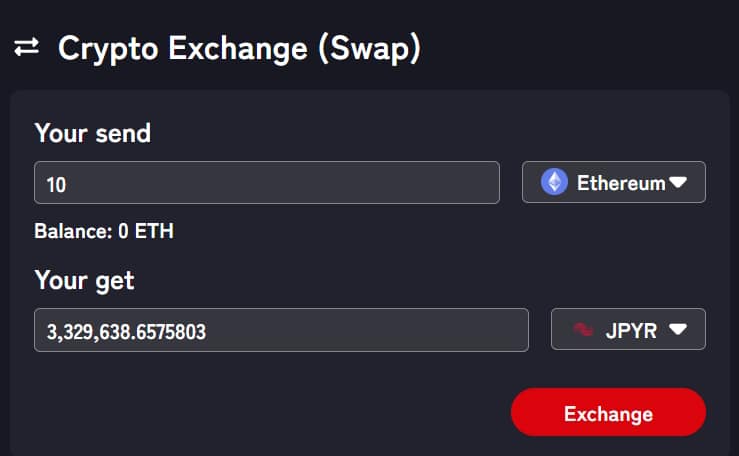
Open the Swap section of the IZAKA-YA DeFi ecosystem and choose an altcoin to swap for JPYR. In the example below we used ETH.

Once you’re happy with the amounts to swap tap on ‘Exchange’.
Visit IZAKA-YA

JPYR Review Conclusion: A Promising Future Ahead?
JPYR offers an alternative investment vehicle for stablecoin exposure. Unlike USDT, USDC, and most other stablecoins, the digital asset maintains a peg to the Japanese yen rather than the U.S. dollar. JPYR holders unlock various use cases, including DeFi yields, USD/JPY hedging, and the ability to hold JPY in a non-custodial environment.
To buy JPYR with fiat money, use an exchange like BTSE. Uniswap also lists JPYR, which suits traders who prefer decentralized markets.
Remember to diversify your stablecoin purchases and DeFi investments to reduce counterparty and market risk. Do your own research before you proceed, and never invest more than you can afford to lose.
Visit JPYROur Methodology: How We Reviewed JPYR Token
The information outlined in this JPYR review initially relied on primary sources, including the project website and whitepaper. We also analyzed Etherscan and other aggregation websites to verify JPYR’s token supply and on-chain transactions.
To evaluate whether JPYR reflects a viable purchase, we analyzed its roadmap and technical objectives. This process enabled us to explore potential use cases, such as DeFi yields, currency hedging, and cross-border payments.
As with any stablecoin, we strongly recommend that you do your own research. Examine the issuer’s reputation and historical track record, and verify its JPY reserves through independent sources.
FAQs
What is JPYR coin?


JPYR is an Ethereum-based stablecoin pegged to JPY. The issuer’s asset reserves help the pegging mechanism maintain a 1:1 ratio with the Japanese yen.
How many JPYR tokens are there?
Etherscan confirms a total supply of 10 billion JPYR tokens. This supply reflects a $65 million fully diluted valuation, per the USD/JPY exchange rate.
What can you do with JPYR tokens?
As JPYR always converts to 1 JPY, holders do not purchase tokens for price appreciation. Holders typically buy JPYR to unlock DeFi opportunities, gain exposure to the Japanese economy, or hedge the USD/JPY currency pair.
What exchanges list the JPYR crypto stablecoin?
BTSE, a centralized exchange that supports fiat money, lists JPYR pairs with USDT and JPY. The decentralized exchange Uniswap also supports the token via JPYR/USDT liquidity pools.
- JPYR website
- JPYR whitepaper (PDF)
- Chart of the Week: Is the US Dollar in structural decline? (Morginstar)
- Stablecoins 101: Behind crypto’s most popular asset (Chainalysis)
- JPYR contract address and on-chain data (Etherscan)

Why you can trust 99Bitcoins
Established in 2013, 99Bitcoin’s team members have been crypto experts since Bitcoin’s Early days.
Weekly Research
100k+Monthly readers
Expert contributors
2000+Crypto Projects Reviewed