







Zero-Knowledge Proof is a new blockchain presale that focuses on building privacy-preserving AI infrastructure for developers and companies.
One of ZKP’s core ideas is a privacy-first data marketplace where users can monetize datasets in tokenized form while maintaining their ownership. To access the marketplace and utilize this new blockchain, you require ZKP tokens, which led, in November 2025, to the commencement of the ZKP token presale.
However, controversy has surrounded the partnership between ZKP and the football club Barcelona, leading investors to question whether ZKP is legitimate or a scam. Let’s dive deeper to find out.
What is ZKP Token?
- The ZKP token presale officially launched on November 27, 2025.
- Unlike most presales that use a linear price increase, the ZKP presale uses an auction system, in which 200 million tokens are sold each day. As a result, the amount of tokens you receive fluctuates based on the daily amount invested.
- Given the presale’s auction format, it’s difficult to see how much has been raised so far. However, we do know that 35% of the total token supply is allocated to the presale, which amounts to 90 billion tokens.
- ZKP’s founders are anonymous, but they announced on their website that they will unveil their core team on June 1, 2026. If someone finds proof of the team’s identity on the ZKP blockchain, they can submit it to earn $1,000 in ZKP tokens.
- The team has launched limited functionality of their testnet, enabling users to swap tokens, get ZKP tokens from the faucet, check the block explorer, and more.
Is ZKP Legit? Our Verdict
ZKP has already launched its Proof Pod validator hardware and its testnet, which shows something is being built behind the scenes. However, there has been some controversy worth knowing about to decide whether ZKP is legit or a scam.
- ZKP Auction System: As mentioned before, ZKP runs an auction system for its presale, where investors use cryptocurrency to bid in a pool. At the end of each day, 200 million tokens are distributed in proportion to each investor’s amount. This means the ZKP price changes daily, which may not be suitable for investors seeking price certainty during the presale.
- Anonymous Team: The team is anonymous, but they have announced on their website that they will reveal their core team on June 1, 2026.
- Barcelona Partnership Controversy: ZKP and the football club Barcelona announced a three-year partnership on November 14, but after a backlash, Barcelona had to distance itself from ZKP, claiming it didn’t know about the ZKP token sale (which launched on November 27). Since some investors may be led to believe that Barcelona endorses the token, the football club issued an official statement on the issue.
- Developer Activity: The project’s developers have released the Proof Pod, which is a validator hardware device that you can plug into the network to passively “mine” ZKP tokens. They have also released a testnet with some functionality, including a block explorer, token swaps and liquidity pools, a token faucet, and the Integrated Development Environment (IDE). Users can also browse the ZKP Wiki for more details on the testnet.
- Community: ZKP’s official X account has fewer than 1,000 followers, while the Telegram community exceeds 7,000 members. The project’s Discord server has fewer than 300 members, indicating low community activity at the moment.
- No Audit: The Zero-Knowledge Proof project hasn’t undergone a smart contract audit at the time of writing. Legitimate projects typically have one or two audits from major security companies to demonstrate to their investors that the smart contract is secure. However, audits are likely to come with time.
Who’s the Team Behind ZKP?
The team behind ZKP is anonymous, but they say that’s the goal of zero-knowledge cryptography. According to the project’s website, the core team will be formally unveiled on June 1, 2026. If they fail to do that, or if they only partially reveal the team, it could have a negative impact on the project.
The project also offers $1,000 in ZKP tokens for those who provide proof that they know who is building the project based on information hidden within the blockchain.
ZKP’s Technology: Is it Legitimate?
The concept of Zero-Knowledge Proofs isn’t new. It was first conceptualized in 1985 and has now gained popularity in crypto circles (and beyond), for clear reasons: It proves something is true (identity, dataset, or a completed task) without revealing any private details.
The project has already launched its testnet, featuring various functionalities. Developers can check the project’s Wiki page and access resources, including the JSON-RPC API and a smart contract example.
Additionally, the team is already delivering Proof Pods, which are small hardware devices that passively “mine” ZKP tokens when connected to the network. The Proof Pod generates proofs, contributing to the blockchain. These devices cost $299 each and can be upgraded 300 times for higher output.
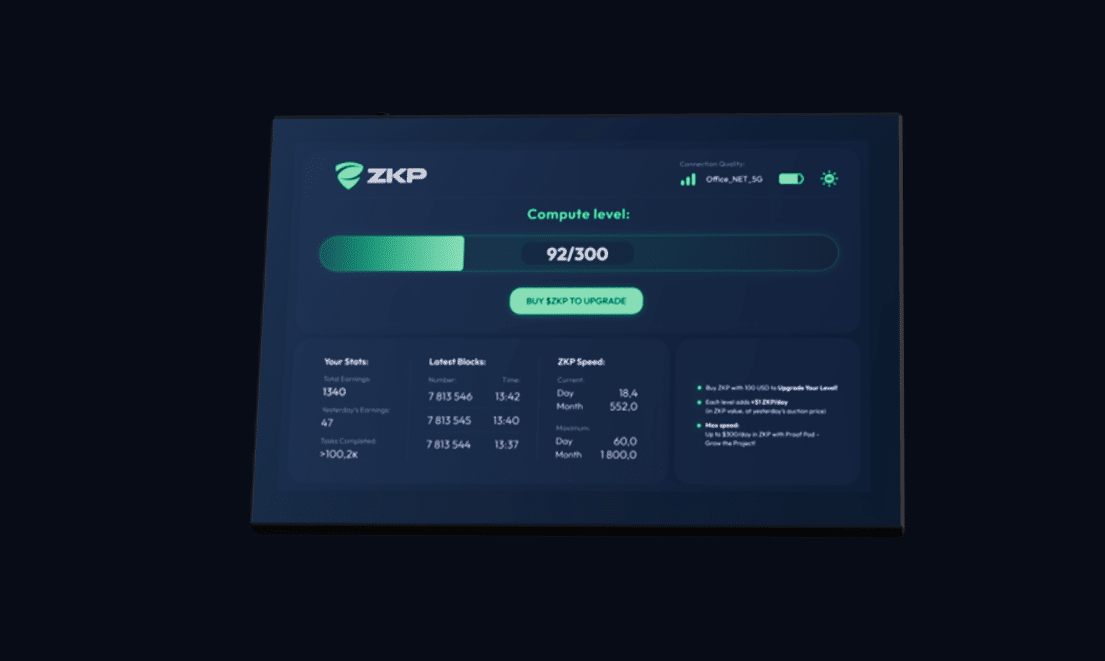
However, each Proof Pod upgrade costs $100. Note, this is a simple software upgrade; you don’t physically change anything on the device. To fully max a single Proof Pod, you’d have to shell out $30,000, which is steep.
For comparison, running a validator on Solana costs between $15,000 and $50,000 per year for the hardware alone. Solana is already an established top 10 blockchain by market cap, with a vast developer community and Wall Street ETFs. Upgrading the Proof Pod feels like paying Solana validator levels of money for a device running on a testnet with no real economic activity and no proven demand.
ZKP’s Tokenomics
The ZKP token has a fixed supply of 257 billion coins. Out of those, 35% (90 billion) are allocated for the presale, and a massive 55% (141 billion) are allocated for the Proof Pod mining rewards. The remaining amount is distributed for community and ecosystem (10 billion), liquidity (8 billion), and team and advisors (8 billion).
Using an auction system for its presale, ZKP aims to get a fair and participation-based allocation to ensure all contributors, whether by investing, participating in the testnet, or mining via the Proof Pods, are adequately rewarded.
The presale itself gets 90 billion tokens, distributed in batches of 200 million each day at a dynamic price. Within a 24-hour period, investors can spend from a range of 24 cryptocurrencies into a pool, and at the end of the day, the 200 million tokens are distributed to participants based on their invested amount.
This can result in a higher token price one day and a lower one the next. Some investors may consider this unfair, especially if they invest in the project early when there’s more risk involved and end up paying more per token than someone who invests later.
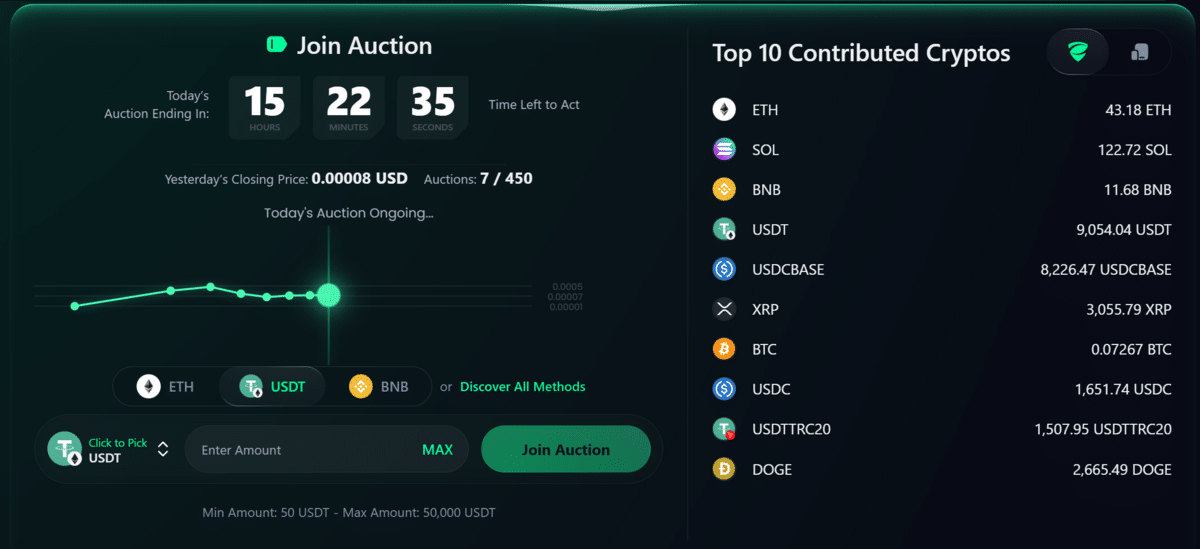
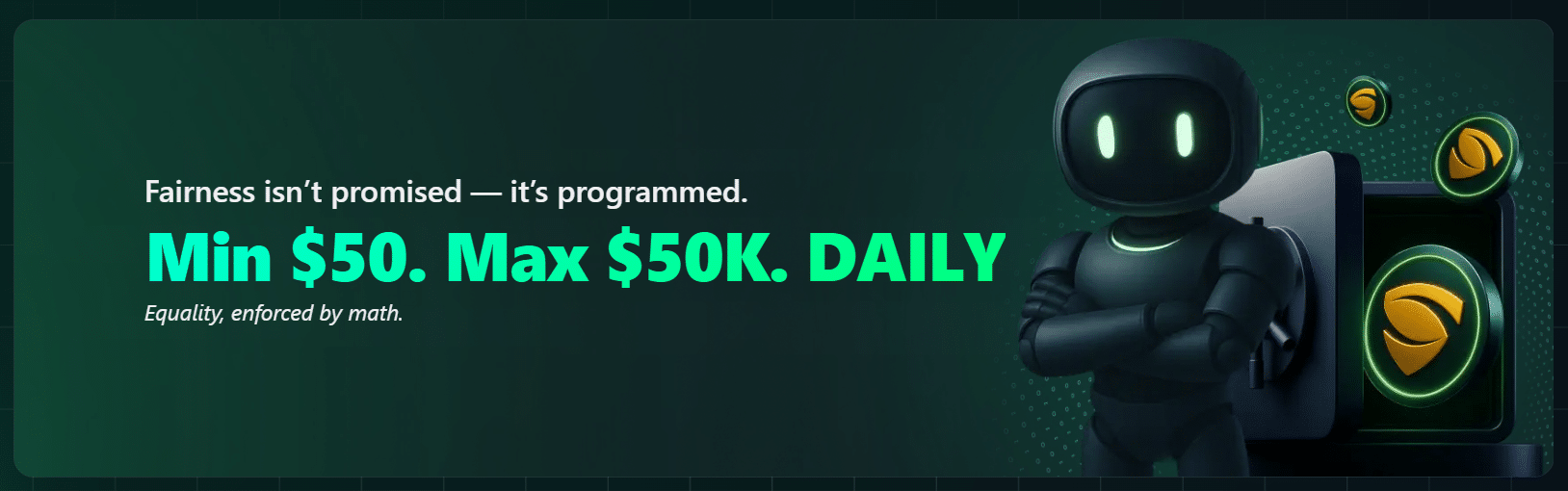
ZKP has limited the investment amounts to a minimum of $50 and a maximum of $50,000 to prevent whales from dumping large amounts and scooping up massive numbers of ZKP tokens. But it’s unclear what is stopping whales from using multiple wallets to achieve their goal each day.
Once the presale ends, the token’s price will be calculated using the following formula: total money raised during all auctions ÷ total number of tokens sold. We have separately explored ZKP price predictions.
At launch, 50% of the purchased tokens will be immediately unlocked, while the remaining 50% will be vested linearly over a five-month period. Starting from month two, 10% of the tokens will be released monthly. After the ZKP blockchain goes live, ZKP tokens will be used for paying gas fees, staking tokens for passive rewards, voting in the project’s governance, and more.
ZKP’s Roadmap: Is it Realistic?
The project’s roadmap goes from 2025 to 2029, covering major milestones:
- January 2025 – June 2025: The ZKP roadmap for this phase included creating a core team of 40 specialists, publishing a technical whitepaper, establishing a technical advisory board, and starting to build the ZKP blockchain. While we can’t confirm the advisory part and the core team numbers, the technical whitepaper is available for download, and the project has already launched its testnet.
- July 2025 – December 2025: Key milestones for this phase include expanding the Proof Pod distribution, increasing the number of testers, launching the ZKP token presale, and achieving various technical objectives. Again, we can’t confirm that 7,000 Proof Pods have been distributed as claimed in the roadmap; however, these devices are available for purchase at this time.
- January 2026 – June 2026: During this phase, the team plans to ship an additional 7,000 Proof Pods to investors, launch meetings, and begin developer grants with a total of $250,000 in prizes for building on the testnet. On the technical side, the project aims to expand the number of internal testers and implement Proof of Space integration among many other planned features. Reaching over 50,000 community members is one of the goals for this phase, and funding 10 developer teams through the grants.
From the second half of 2026 through 2029, the ZKP team has ambitious goals, including reaching 30,000 active Proof Pod devices on the testnet in 2026 and over 1 million users by December 2029. Additionally, the team aims to achieve $100 million in revenue by then and scale to 1,000 transactions per second (TPS).
These goals seem overly ambitious. Granted, the project is giving itself five years to reach these goals and has so far launched the testnet, the Proof Pods, and the token presale, which can be a source of income while the team is building. However, the competition in the zero-knowledge proof space is fierce. Zcash already boasts a market cap of $5 billion and offers private payments. Additionally, there are Layer 2 rollups that use zk-SNARKs like Starknet, Loopring, Immutable X, and Mantle, which address the privacy issue on Ethereum.
By the time ZKP launches its full product suite, it may be too late to enter the race. Another aspect that could deter some investors during the early phase is the expensive upgrades of the Proof Pod, which can cost up to $30,000.
Auditing & Compliance: Is ZKP Safe?
The ZKP token doesn’t have a smart contract audit yet, and we can’t determine its safety.
Alternative Presales to ZKP
While the ZKP token lacks a smart contract audit, offers unreliable token pricing during its presale, and sells a hardware device that can cost up to $30,000 to upgrade, hindering potential growth, other presales have a greater potential for growth.
We selected two presales that have completed smart contract audits and have predictable token pricing that increases linearly as certain milestones are reached.
Bitcoin Hyper (HYPER)
Bitcoin was initially designed as a peer-to-peer electronic cash system, but after a decade, it has evolved into a store of value, characterized by slow and relatively expensive transactions during periods of high congestion. Bitcoin Hyper aims to change that. This is a Layer 2 blockchain that uses the Solana Virtual Machine (SVM) to enable Solana-style fast and inexpensive transactions on the Bitcoin blockchain.
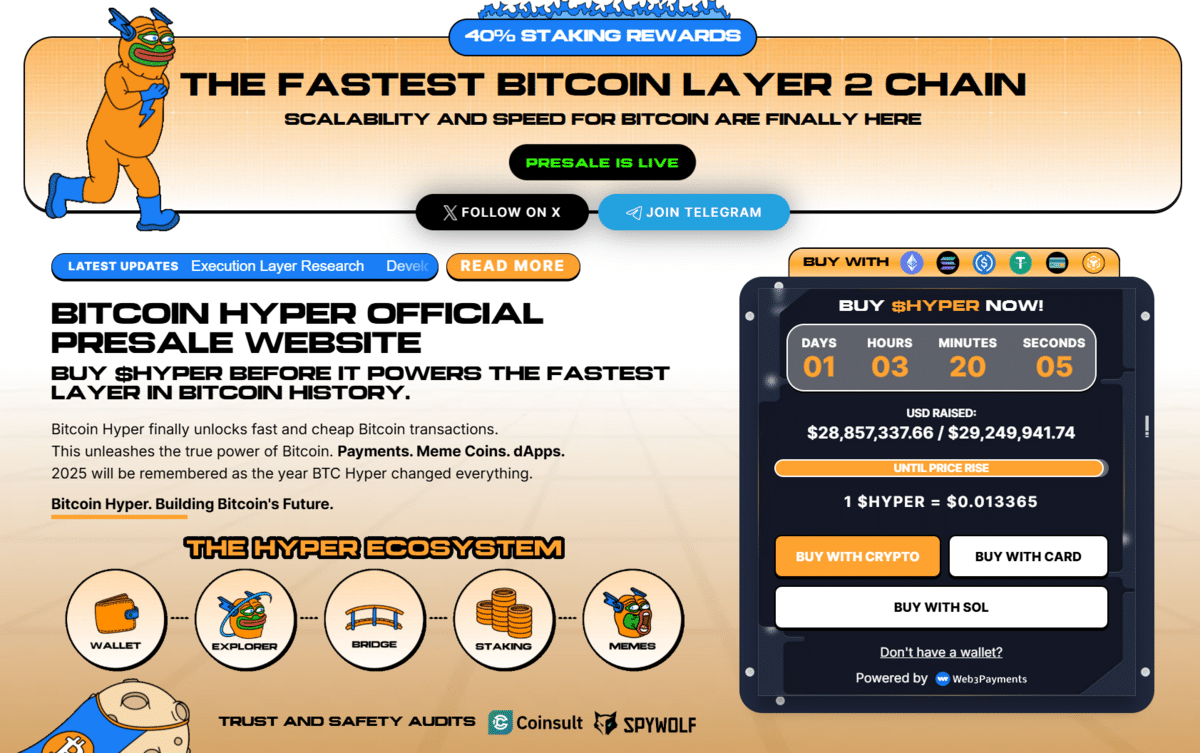
Using the SVM enables Hyper to process transactions quickly and affordably, unlocking complex applications for DeFi, meme coins, and even Web3 games. Moreover, Hyper also uses zero-knowledge proofs for transaction validity.
The project is audited by Coinsult and SPYWOLF and has raised over $28 million to date, demonstrating significant investor interest. Investors can earn a 40% dynamic APY by staking their HYPER tokens during the presale.
SUBBD
SUBBD is a unique project that uses AI to enhance the relationships between creators and fans. Holding the SUBBD token unlocks premium AI-enhanced and influencer-approved content, offers discounts on content and subscriptions, and more.
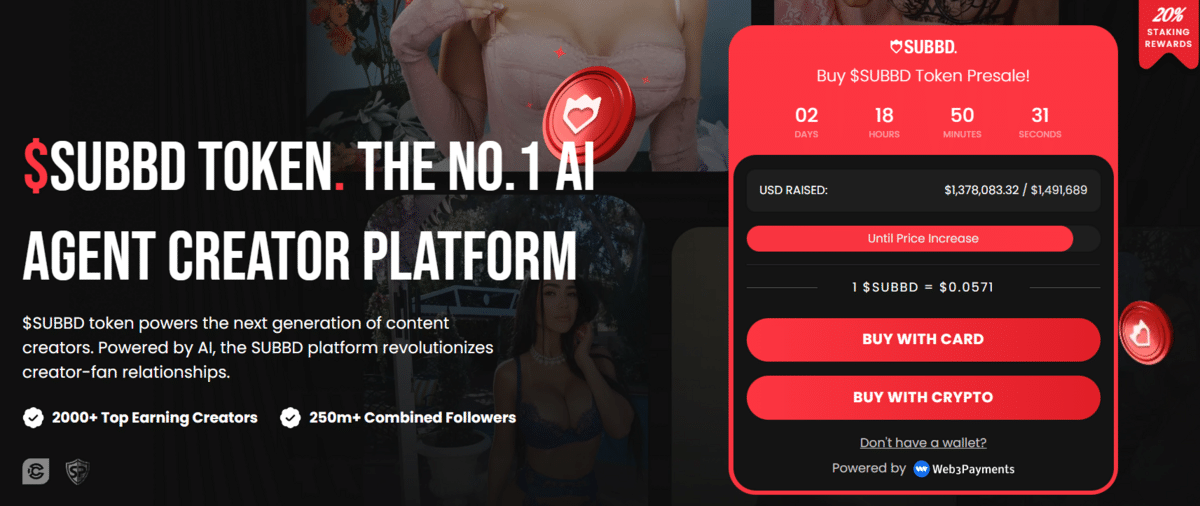
The platform aims to disrupt the $85 billion content industry by bringing fans closer to their favorite creators, while providing creators with AI tools to automate specific tasks, enabling them to focus on content creation.
While this AI project is still in development, interested investors can participate in its presale and buy SUBBD tokens at a discounted price. Moreover, investors who decide to stake their tokens can earn a fixed 20% APY.
Conclusion: Is ZKP a Scam or Legit?
It’s clear that the ZKP project is building a blockchain with the testnet and Proof Pods launched. However, there are some red flags to be aware of. First, the Proof Pods cost $299, and users can upgrade the software for an additional $30,000. This is very expensive, considering that a one-year hardware cost for Solana, a top 10 blockchain, averages $30,000, while ZKP is still in testnet with no real economic activity.
Next, the controversy surrounding the Barcelona partnership doesn’t bring confidence, as it appears that ZKP wanted to capitalize on the club’s popularity before launching their token presale. The biggest drawback is probably the auction-style presale, where the token price changes daily. Even though the team behind ZKP claims this is a fair way to distribute tokens, some investors may not agree, especially if they are early to the project but pay more per token than someone who joins a few weeks or months later.
If you want to invest regardless of this, ensure you do your own research, and don’t invest more than you can afford to lose. If you are still interested, check out our guide on how to buy ZKP.
FAQs
What is ZKP?


ZKP is the native token of the Zero-Knowledge Proof blockchain. Its main use case is to pay for gas fees on the network and to vote on the governance. Users can buy the token in an auction system at prices that fluctuate daily, and can mine the token via Proof Pod devices, which can cost up to $30,000 to fully upgrade. Given that the project is still in testnet, paying so much for a mining device seems steep.
Is ZKP legit?
The ZKP project has already launched its testnet and the Proof Pod mining devices. However, some red flags include controversy with the Barcelona football club’s partnership, expensive mining devices during testnet, and fluctuating token prices each day.
Is ZKP audited?
No, as of December 2025, the ZKP token isn’t audited.
Does ZKP have sound tokenomics?
The bulk of the ZKP tokenomics revolves around the presale (35%) and the mining rewards (55%). During the presale, investors get 50% of their tokens unlocked at TGE, with the remaining tokens unlocked linearly at 10% per month starting in the second month. This could stop the token price from dropping early on, but unless the ZKP blockchain goes live and attracts a massive user base that will actually use the token to pay gas fees, the ZKP token price is likely to keep going down once it launches.

Why you can trust 99Bitcoins
Established in 2013, 99Bitcoin’s team members have been crypto experts since Bitcoin’s Early days.
Weekly Research
100k+Monthly readers
Expert contributors
2000+Crypto Projects Reviewed