





In This Article
Crypto is best known for its wild price swings that can mint millionaires overnight. But for many people, the real crypto riches come more slowly and steadily through passive crypto income.
In this guide, we’ll cover 9 ways to earn passive income on crypto you already own. Keep reading to learn how to put your tokens to work to earn money for you around the clock.
The Best Methods to Make Passive Income with Crypto
Here are the best methods to earn passive income with crypto in 2026:
|
Method |
Main Benefit |
Main Drawback |
Best For |
|---|---|---|---|
|
Crypto interest accounts |
Very easy with flexible withdrawals |
Often requires giving up custody of your crypto |
Passive crypto income you don’t have to think about |
|
Staking |
Available for a huge range of altcoins and stablecoins |
Can involve lockups and long unstaking periods |
Investors with a highly diversified crypto portfolio |
|
Lending |
Above-average APYs |
Can suffer losses due to borrower defaults |
Investors comfortable with more risk for higher returns |
|
Liquidity pools |
Very high yield potential and trading pair flexibility |
Risk from tokens in your pair moving relative to one another |
High-risk, high-reward passive income seekers |
|
Yield farming |
Leverage returns with staking on liquidity rewards |
Highly exposed to risk of exchange tokens losing value |
Experienced DeFi users comfortable with more active income management |
|
Cloud mining |
Doesn’t require purchasing or maintaining any mining equipment |
Profits are highly dependent on fees and mining difficulty |
Individuals who want to earn passive income in BTC or DOGE |
|
Dividend tokens |
Regularly scheduled payments based on real-world project value |
Losses in dividend token price can offset gains |
Investors interested in specific, fast-growing ecosystems like Neo |
|
Masternodes |
Large, regular rewards without a need for mining equipment |
Requires a lot of crypto and technical knowledge |
Individuals with large crypto holdings and strong technical skills |
We’ll explore each of these methods in more detail to help you maximize your crypto income with the least amount of work.
Using a Crypto Interest Account
Crypto interest accounts are centralized or decentralized accounts where you can store your crypto and earn interest payments in return. They work somewhat like traditional fiat savings accounts: the platform lends out the tokens in your account, and in return you get a cut of the interest rates it charges. All you have to do to earn interest is open an account and deposit tokens, so there’s very little work and no active management involved.
Yields for crypto interest accounts vary by platform and token, but they can be quite generous. For example, it’s common to see APYs over 20% for popular tokens like BTC, ETH, and USDT. Some platforms pay out interest daily or weekly, enabling you to compound returns quickly. In addition, many crypto interest platforms allow you to withdraw your tokens at any time.
The major drawback to crypto interest accounts is that they require giving up custody of your crypto. That comes with the risk of losing your tokens if the platform you use runs into financial trouble. For example, Celsius offered crypto interest accounts before its collapse in 2022 and depositors have been forced to try to recoup their tokens through the bankruptcy process. So, it’s crucial to use a trusted platform and ideally one that insures your deposits.
Pros:
- Very easy with little upfront work required
- Can earn interest on a variety of popular tokens
- May offer flexible withdrawals with no lock-up period
- Interest can be paid out daily or weekly
Cons:
- Requires giving up custody of your crypto
- Many crypto interest accounts are not insured
Best Crypto Interest Platform
If earning interest on your crypto sounds like the right approach for you, we recommend taking a look at CoinDepo. It offers high-yield crypto interest accounts that pay up to 18% APY for BTC and major altcoins and up to 23% APY for stablecoins like USDT and USDC. CoinDepo offers multiple compounding options including daily, weekly, monthly, quarterly, semi-annually, and annually.
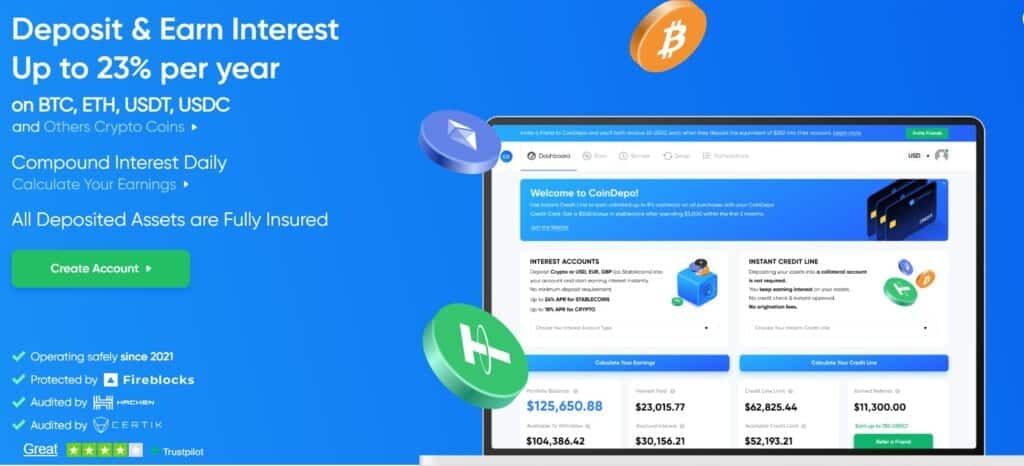
There’s no minimum deposit requirement to start earning at CoinDepo, making it a good choice for investors with any size wallet. You also won’t pay any fees for your account and you can withdraw your tokens at any time.
Most important, CoinDepo is highly secure and trustworthy. The company fully insures all crypto deposits. It also uses the latest security technology such as MPC-CMP encrypted private key protection and an automated policy engine to prevent fraudulent transactions. It’s a reliable choice if you want both interest and peace of mind that your crypto is safe.
Here’s how to make passive income with crypto on CoinDepo:
- Create a CoinDepo account: Visit CoinDepo and click Create Account. Enter your email and a password, then click Sign Up.
- Complete KYC checks: CoinDepo requires all users to complete Know Your Customer (KYC) checks. You’ll need to verify your email and phone number, then upload a photo of your ID and take a selfie. Verification is fully automated and only takes a few minutes.
- Select a Compound Interest Account: CoinDepo offers six different interest accounts with different interest rates and compounding frequencies. Choose the one that’s right for you based on your holding timeline.
- Deposit tokens: Select the token you want to earn interest on, then transfer it from your wallet to your CoinDepo Compound Interest Account wallet using the QR code displayed.
- Earn interest: Tokens held in your Compound Interest Account will start earning interest immediately. You can monitor your earnings in the CoinDepo app and withdraw your tokens at any time without fees.
Staking
Crypto staking involves locking your tokens to a blockchain network in order to help secure transactions on the network. Individuals known as validators “stake” tokens as collateral, essentially promising that they’ll act faithfully when approving transactions. If they do their job well, the blockchain returns their stake and rewards them with newly minted tokens. If they act unfaithfully, the blockchain will take their staked tokens as punishment.
Staking is available for many major altcoins including Ethereum, Solana, Cardano, and others. And you don’t have to be a validator yourself in order to participate in staking. Many crypto exchanges and decentralized finance (DeFi) platforms allow you to lend your tokens to a validator for staking. You get a share of the staking reward without having to directly participate in validating transactions.
Returns for staking are usually expressed as an APY, like an interest rate, but beware they can be highly variable. Validators do lose their stake on occasion and rates can change frequently as token prices and network use vary. Staking rates can also vary widely between tokens and there’s often (but not always) a lock-up period during which you cannot withdraw your tokens. It’s also important to keep in mind that staking with a third-party validator is often custodial, meaning you must transfer custody of your tokens to the validator in order to earn.
Pros:
- Available for most altcoins and stablecoins
- Relatively low risk of losing tokens
- Several different lock-up periods are often available
- Small minimum deposit required
Cons:
- Rates can be highly variable
- It can take up to several days to unstake tokens
Best Crypto Staking Platform
We recommend Best Wallet as the best platform for earning income through crypto staking. Best Wallet is a highly secure self-custody crypto wallet, and it brings the self-custody approach to staking. You maintain full control over your tokens at all times, so there’s no risk of a validator walking off with them or your staking platform taking your coins to stave off bankruptcy. It’s a level of control and safety that few other staking platforms can match.

On top of that, Best Wallet uses a built-in staking aggregator to help you find the best staking rate for every token. You can choose from several different APYs, lock-up periods, and fee options to get staking that works for you. Best Wallet also lets you know upfront how long it takes to unstake tokens, so there are no surprises later.
Best Wallet supports 1,000+ coins for staking across 60+ blockchains, so it’s great if you have a whole crypto portfolio that you want to stake without switching between platforms. Typical APYs range from 3%-9% on altcoins 13%-14% on stablecoins. Best Wallet is completely free to download for iOS and Android and there are no account fees.
Lending Crypto
Crypto lending involves lending your tokens out to other crypto traders, investors, and institutions. Typically, you deposit tokens into a lending pool, which is then used as the source of funds for borrowers on the platform. Interest paid on all loans from the pool is distributed to depositors.
Crypto lending is slightly riskier than depositing tokens in a crypto interest account since you’re not guaranteed a specific interest rate. Losses to the lending pool due to borrower defaults are spread among lenders, which could cause your APY to be lower than advertised. However, many crypto lending platforms require borrowers to over-collateralize their loans, which helps to reduce the risk to individual lenders.
Lending platforms often support a limited range of popular tokens and stablecoins, and they may require a minimum deposit or lock-up period. You can find both centralized and decentralized lending platforms, but both require giving up custody of your tokens to deposit them into lending pools.
Pros:
- Potentially higher APYs than crypto interest accounts
- Many loans are over-collateralized for protection
- Both centralized and decentralized options available
- Smart contracts help manage lending risk
Cons:
- Only certain altcoins and stablecoins are supported
- Deposits typically have lock-up periods or withdrawal fees
Best Crypto Lending Platform
Aave is the best crypto lending platform in 2026 for investors looking to earn passive income on their tokens. This decentralized lending platform operates across 12 blockchains, allowing it to support a wider range of tokens for lending than most comparable lending networks. Rates vary by token but are often up to 3% APY for stablecoins and average 3.24% APY for ETH.
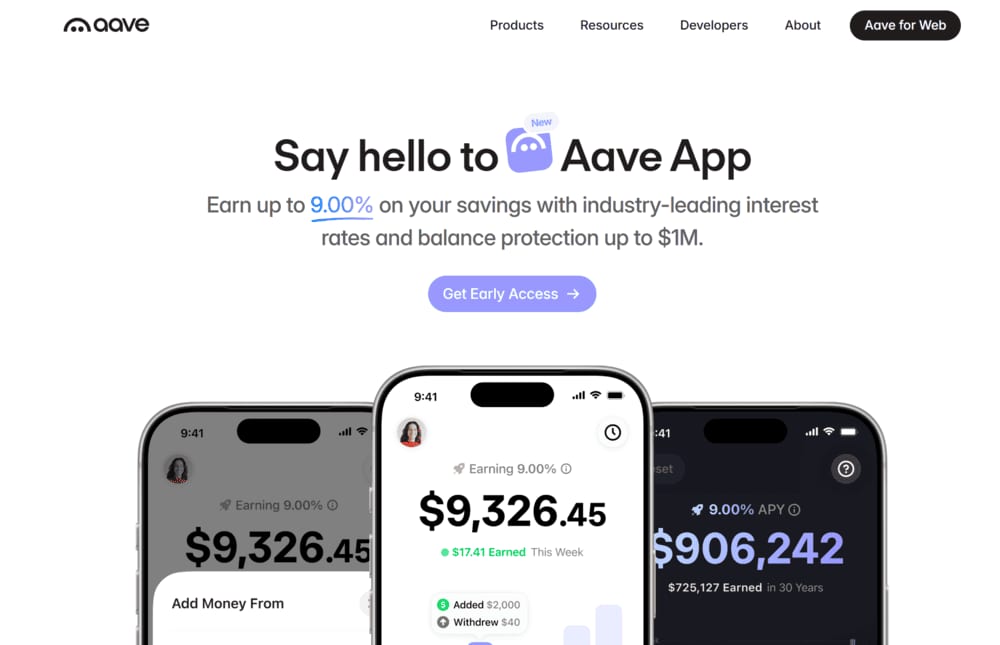
What’s great about Aave is that it’s safer than a lot of other decentralized lending platforms. The protocol has a built-in backstop to protect depositors and insure balances up to $1 million. Loans are over-collateralized by an average of 245%. Aave has been around since 2017 and has more than $27 billion in total value locked.
Another key benefit to Aave is that tokens aren’t locked. You can withdraw funds from lending pools at any time. That significantly reduces lending risk, especially when volatility in the crypto market increases.
Contributing to Liquidity Pools
Providing liquidity to decentralized exchanges (DEXs) is a more high-risk, high-reward approach to earn passive income from cryptocurrency. In short, it involves depositing both tokens in a trading pair (like BTC/USDT) to a liquidity pool on the DEX. Traders then trade that pair and pay trading fees, a portion of which are distributed to the yield farmers who contributed to the liquidity pool.
Rewards from providing token pairs to a liquidity pool can be much higher than for depositing tokens in a crypto interest or savings account or for staking. Most DEXs pay out a fixed portion of trading fees in the form of a native exchange token, which can then be converted to any other cryptocurrency to cash out.
Risk stems from the fact that you typically have to deposit token pairs, not individual tokens. If one token makes a large price move relative to the other token in your pair, your returns could be lower than if you simply held the tokens in your wallet. You also need to give up custody of tokens you’re contributing to the liquidity pool, so it’s important that you trust the platform you’re using.
Pros:
- Can offer very high passive returns
- Rewards increase as crypto trading activity increases
- Providing stablecoin pairs (e.g. ETH/USDT) reduces risk
- Many platforms offer bonuses for larger deposits
Cons:
- Risk from tokens in your pair moving relative to one another
- Requires giving custody of your tokens to the liquidity pool
Best Liquidity Pool Platform
Uniswap is our top pick for earning passive crypto income from liquidity provisioning. Uniswap is the largest DEX on the Ethereum blockchain, so it has enormous trading volume and is highly trustworthy. Trading volume means stability in liquidity pool action, which makes for more consistent returns and lower risk.

Uniswap’s size means that it has a huge selection of trading pairs and liquidity pools, so you can perfectly customize your risk and return potential through careful pair selection. Its UNI exchange token is also widely traded and easy to convert to other cryptocurrencies.
Uniswap has strong smart contracts that allow for permissionless deposits and withdrawals with zero delay. So, anyone can contribute to the liquidity pools and you can pull your tokens at any time.
Yield Farming
Yield farming takes the concept of liquidity provisioning to the next level by combining two passive income strategies: liquidity provisioning and staking. The idea is that after contributing liquidity to a DEX and getting paid in exchange tokens, you stake that exchange token to earn even more yield from it.
The benefit of yield farming is that the returns can be extraordinarily high. It’s common to see advertised APYs over 1,000% if you provide liquidity for in-demand trading pairs or for newer DEXs that are offering staking bonuses to attract liquidity.
However, bear in mind that yield farming is very complex and very risky. On top of the risk that comes from providing liquidity for trading, you have all the risks of staking. And often, the token you’re staking is from a newer DEX, so it could experience high volatility. Ultimately, your returns from yield farming depend heavily on the price performance of the exchange’s token.
Pros:
- Can offer APYs over 1,000%
- Earn from both liquidity provisioning and staking
- Can move between DEXs to take advantage of bonus offers
- Stablecoin farming can somewhat reduce risk
Cons:
- Highly complex and risky in volatile market conditions
- Returns depend on price performance of exchange token
- Potential for total loss if the DEX goes bankrupt
Best Yield Farming Platform
We recommend Curve if you’re interested in earning passive income through yield farming. The APYs on this platform aren’t as high as those on newer DEXs, but Curve is well-established in the DeFi landscape and is more trustworthy than a lot of smaller platforms with higher advertised yield farming rates.

Another reason we like Curve is that you don’t have to be a DeFi expert to use the platform. Anyone can deposit stablecoins like USDT or USDC into Curve’s liquidity pools to start yield farming, without having to dive too deep into specific trading pairs. You can maximize your yield using Curve-specific automated yield farming tools like Convex Finance and Yearn Finance.
Rewards are paid in Curve’s CRV token, which is itself highly liquid and easy to convert to other cryptocurrencies. Lockup periods for CRV staking vary, but you’ll typically earn the highest returns by locking your CRV tokens to the protocol for at least several years.
Cloud Mining
Cloud mining is an approach to cryptocurrency mining that involves renting your mining hardware from a third-party provider over the internet. With cloud mining, you can mine Bitcoin, Dogecoin, Litecoin, and other tokens without having to purchase or maintain any of your own mining equipment.
The way this typically works is that you purchase cloud mining contracts and, in exchange, receive a share of the tokens mined using the computing power you purchased. Your cloud mining provider simply transfers the earned tokens to your wallet on a regular basis.
Just be very cautious of scams, since there have been many fake cloud mining operations in the past that have taken investors’ money. It’s also important to read your contract carefully. Maintenance fees or surging Bitcoin difficulty can significantly reduce your return on investment from cloud mining.
Pros:
- Opportunity to earn BTC, DOGE, LTC, or other mined tokens
- Doesn’t require purchasing or maintaining any mining equipment
- No crypto mining experience or knowledge required
- Can produce very strong returns as Bitcoin price increases
Cons:
- The cloud mining space has a lot of scam companies
- Maintenance fees can significantly reduce earnings
- Profits can fluctuate widely based on mining difficulty
Best Cloud Mining Platform
If you’re interested in cloud mining, we recommend NiceHash. NiceHash is an established cloud mining platform that offers services for both DIY miners and cloud miners. Its EasyMining program allows you to buy hashrate on an as-needed basis and start mining Bitcoin immediately.

What’s nice about NiceHash’s EasyMining is that it’s fully customizable, but also ready to run out of the box. You can choose the default mining settings to get started right away if you’re new to Bitcoin mining. If you’re more experienced and want to run a different mining algorithm, you can do that, too.
EasyMining’s pricing is also fully transparent, making it easy to see the cost of computing power versus the likelihood of mining a block and earning a reward. That makes it easy to monitor your potential return and eliminates hidden fees that can make mining less profitable.
Owning Dividend Tokens
Dividend tokens are a type of utility token that make regular payouts to holders, similar to dividend stocks. Payouts can be in the same token, in other altcoins, or even in stablecoins. Payouts are typically funded from the project that created the token, such as a crypto exchange using trading fees to fund its dividend.
Dividend tokens can be nice because they pay out on a regular, predictable schedule. Payouts are often recorded on the blockchain, so you can easily see a project’s entire payout history. In addition, your dividend is sized according to your holdings of the dividend token, so it’s easy to scale up and down over time.
The drawback to these tokens is that the size of the dividend is often tied to something unpredictable, like exchange trading volume. In addition, the value of the dividend token itself can fall, offsetting any gains from the payouts.
Pros:
- Regularly scheduled payments
- Dividend payments are visible on the blockchain
- Payouts can increase over time as a project grows
Cons:
- Dividend payments can fluctuate over time
- The dividend token’s price can fall, offsetting gains from the dividend
- Some dividend tokens may be classified as unregistered securities
Best Dividend Token
We think the best dividend token in 2026 is NEO, the native token of the Neo blockchain. NEO acts as a dividend token by rewarding every holder with GAS tokens, which are required to pay for transactions on the Neo blockchain.
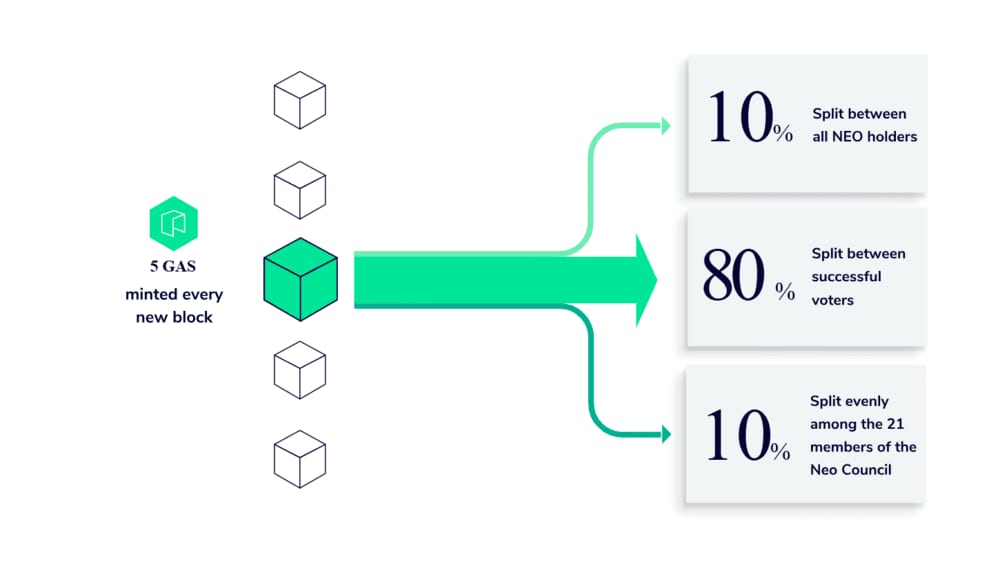
10% of the GAS tokens released from each new block on the Neo blockchain are distributed to NEO holders as a dividend. While the GAS token’s utility is primarily to use the Neo network, it can easily be converted to other cryptocurrencies to cash out your dividend rather than keep it within Neo.
Crucially, since NEO yields GAS rather than more NEO, it’s less likely to be considered a security by the US Securities and Exchange Commission. That’s important since a security designation could significantly harm the project’s long-term value.
Operating a Masternode
A crypto masternode is a high-performance server that offers operational support for a blockchain network. It might keep a current copy of the blockchain so that anyone can view it. Or it might be involved in facilitating transactions or voting by governance token holders.
Whatever the specific function, masternode operators are required to lock up a significant amount of cryptocurrency as collateral to ensure they’ll act faithfully. In return for this collateral and operating a server, masternode participants receive a portion of block rewards. It’s a lot like crypto mining, but with far less competition for rewards and less demand for parallel processing power.
Operating a masternode comes with steep costs since you need to build, maintain, and operate a server. You also need to have a large amount of cryptocurrency to use as collateral for your masternode. However, the rewards from operating a masternode can be large enough to offset these costs.
Pros:
- Large block rewards on a regular basis
- Can be run on a VPS instead of building your own server
- Offers leverage on price gains in underlying cryptocurrency
Cons:
- Requires a lot of technical expertise
- Large upfront cost and collateral required
- High risk if price of underlying token drops
Best Masternode Chain
If operating a masternode appeals to you, we recommend looking at Dash as the blockchain to focus on. Dash is a proof-of-work blockchain that uses masternodes to facilitate instant transactions, transaction privacy, and governance voting.

What’s nice about operating a Dash masternode is that you only need 1,000 DASH to get started. That’s around $30,000 based on Dash’s average price over the last several months. You also get to keep your DASH tokens in your wallet while using them as collateral, so you don’t have to give up custody of your crypto.
Dash masternodes earn around 45% of block rewards, which comes out to nearly 2 dash every couple days. Before accounting for DASH token appreciation, that yields an expected return of around 5-10% per year.
Key Considerations for Earning Income from Crypto
There’s a lot to consider when deciding which approach to earn passive income on crypto is right for you. Here are some of the key things to keep in mind:
- Risk vs. return: A common theme in crypto passive income is risk vs. reward. Generally, you’ll earn higher APYs for methods that involve more risk. So, you need to decide how much you want to earn and how much risk you’re willing to take with your crypto.
- Upfront cost: While many passive income methods don’t require a minimum crypto balance to participate, some do. Make sure the approach you’re using is suitable for the amount of crypto you have and enables you to maximize your returns on a per-token basis.
- Token custody: Who controls your crypto is a crucial security consideration. If you give up custody, you’re potentially at risk of losing your crypto if your platform goes out of business.
- Lock-ups: Locking up your crypto for a defined period can allow you to earn higher returns. But it also reduces your flexibility when volatility rises or the price of your tokens moves suddenly. Think carefully about your investment horizon and make sure it lines up with your lock-up requirements.
- Stablecoins vs. altcoins: Stablecoins often reduce risk because you can be confident the price of your tokens won’t change. But altcoins offer greater income potential because of their added risk and potential for price gains.
- Diversification: Never invest all your crypto with a single platform. If possible, spread your holdings across multiple tokens to protect yourself against price changes in individual coins.
Tax on Crypto Passive Income
Passive income from cryptocurrency is taxed in two ways in the U.S.
First, you must report any crypto you receive as income and pay regular income taxes on it. As an example, say you receive ETH through Ethereum staking. You must pay income tax on the ETH you received. The value of those tokens is calculated based on the price of ETH at the moment you received it. Similarly, you must pay income tax on any crypto you receive from a savings account, dividend token, masternode, or most other forms of passive income.
Second, you must pay capital gains tax whenever you convert a cryptocurrency from one token to another or from crypto to fiat. As an example, say you received ETH through Ethereum staking and paid income tax on it. Then you convert the ETH to USDT. You must calculate your capital gain on that ETH from the time you received it to the time you swapped it for USDT and report it to the IRS.
Given the complexity of this, we highly recommend using crypto tax software to help. Koinly is our overall top pick, while ZenLedger is a strong choice for managing taxes for DeFi transactions.
Our Conclusion: Which is the Best Way to Earn From Crypto?
There’s no single best way to earn passive income from crypto. The right approach depends on your investing goals and style.
If you prefer a low-risk method with little upfront work required, we recommend using a crypto interest account, crypto savings account, or staking your tokens. If you’re comfortable with risk if it means higher potential rewards, consider lending tokens, providing liquidity, or yield farming. If you have strong blockchain skills, cloud mining or operating a masternode could be right for you.
For a straightforward way to get started, crypto interest platforms like CoinDepo provide a simple way to earn passive income via interest on a range of different cryptocurrencies.
Visit CoinDepo
Why you can trust 99Bitcoins
Established in 2013, 99Bitcoin’s team members have been crypto experts since Bitcoin’s Early days.
Weekly Research
100k+Monthly readers
Expert contributors
2000+Crypto Projects Reviewed