




In This Article
Close your eyes: you’re walking through a city where lampposts talk to scooters, refrigerators snitch on your milk levels, and pet trackers beam out your dog’s location without ever touching Wi-Fi. No, this isn’t the plot of a budget sci-fi flick; it’s the promise of Helium. So, what is Helium (HNT), really?
In this Helium crypto review, we’re not going to insult your intelligence with “Top 10 reasons HNT will 10x.” You’ll get the Helium blockchain explained for beginners without the sugar, without the jargon. From the overview of HNT token utility to whether or not this gas has any lift left in the tank, this is your no-BS guide to Helium.
Key Takeaways
- Helium is a decentralized network powered by user-run hotspots and used for IoT data transmission.
- It uses a Proof-of-Coverage mechanism to verify real-world wireless activity and reward participants.
- HNT is the native token used for rewards and to burn data credits required for IoT devices to transmit.
- The Helium blockchain migrated to Solana to improve scalability, speed, and developer tooling.
- Helium offers real-world utility and is one of the few crypto projects bridging physical and digital infrastructure.
Helium Review: Summary
Helium is a decentralized wireless protocol that incentivizes individuals to build and maintain a global network for Internet of Things (IoT) devices. It uses a unique Proof-of-Coverage (PoC) mechanism to verify that hotspots are providing real wireless coverage and to reward users in HNT, while transaction consensus now runs on Solana’s proof-of-stake blockchain.
Well, after migrating to the Solana blockchain in April 2023, Helium is positioning itself as a high-utility, community-powered infrastructure play.
Terms You Need to Know Before Understanding Helium
Let’s decode the helium-filled glossary:
What is Helium?
Helium is what happens when crypto stops screwing around and starts paying rent. It’s a decentralized wireless network, designed not for humans, but for machines. Your pet tracker, your smart thermostat, that sensor buried in a Kansas cornfield measuring soil moisture. They’re all whispering to each other, and Helium is the network making sure those whispers get heard.
But this isn’t your dad’s Wi-Fi. Helium uses LoRaWAN, a low-power, long-range wireless protocol that’s optimized for small data packets, perfect for IoT devices that don’t need to stream Netflix but do need to chirp “Hey, I moved an inch” every 10 minutes.

Now here’s where it gets spicy. Instead of building cell towers or digging fiber, Helium said, “Screw it, let’s crowdsource the whole thing.” So they let you be the telecom. You buy a hotspot (basically a fancy walkie-talkie), plug it in, and boom, you’re part of the network. You provide coverage, you earn HNT.
That HNT token is the grease in this machine. Devices pay for usage in Data Credits, which are created by burning HNT. It’s a deflationary loop with real-world demand (imagine that).
So when people ask, “What is Helium (HNT)?” It’s a live, breathing infrastructure protocol that dared to give big telecoms the middle finger and hand the keys to the people. Still think it’s a meme coin? Ask the United States, Qatar, and Algeria, countries with real Helium network coverage, how meme-worthy it feels when your farm sensor pings through a device on your neighbor’s roof.
History of Helium Crypto
Helium was forged in the fires of Wi-Fi frustration, back when IoT connectivity was either too expensive, too centralized, or just plain nonexistent.
The Helium project was founded in 2013, yes, a full eight years before the term “DePIN” (Decentralized Physical Infrastructure Networks) became a VC buzzword. Its mission? Simple, absurd, and brilliant: build a global wireless network that anyone could contribute to and profit from. A decentralized mesh of machines, routers, and antennas not owned by Comcast, but by you.
The first version of the Helium network launched in 2019. Instead of spinning up a blockchain for the sake of it, they built one to do something. It came with its own consensus model: PoC.
Think of it as Pokémon Go for antennas; you earn HNT crypto by proving your device is actually providing wireless coverage in a physical location.

Then came the migration. In 2023, Helium ditched its homegrown Layer 1 and went full throttle into Solana. Why? Because trying to scale a high-throughput wireless network while maintaining your own blockchain is like juggling flaming swords blindfolded. Solana had the throughput, dev ecosystem, and pain tolerance Helium needed.
Today, Helium has onboarded close to one million hotspots in total and maintains hundreds of thousands of active hotspots across more than 170 countries. The Helium blockchain and its dusty old test kits? Now it’s all running on Solana’s high-speed rails, enabling faster transactions and deeper integrations. From a startup idea buried in pitch decks to a global decentralized telco backed by real coverage.
About the Helium Team
AKA: Who dared to take on Big Wireless?
Helium wasn’t dreamed up by some pseudonymous Twitter degen with a frog avatar and a whitepaper written in Comic Sans. This project was co-founded by a group of serious technologists, real people with real résumés and an actual office.
The brains behind the machine? Amir Haleem, the CEO and co-founder, is also known as ‘The Guy Who Actually Gave a Damn About IoT Before It Was Cool’. Haleem came from the video game world, having worked on Battlefield 1942. From blowing up tanks to blowing up centralized networks, what a character arc.
The original founding team also included Shawn Fanning (yes, the Napster Shawn Fanning) and Sean Carey, a pair of internet infrastructure OGs. Not exactly your average DAO moderators.
Under the banner of Nova Labs (formerly Helium Inc.), the team built out the core tech and spun off the protocol into The Helium Foundation, the nonprofit that now governs the ecosystem.
This structure keeps the protocol open-source, while Nova Labs continues to build commercial tools around it. Think of it as the Ethereum/Foundation split, but without the pretentious manifesto.
Vision of the Helium Blockchain Project
If you’ve ever screamed at your phone for dropping to “1 bar” while standing in downtown Manhattan, you’ll get Helium’s vision immediately: Replace top-down telecom infrastructure with a bottom-up network built by the people, for the machines. As per Helium Whitepaper,
The Helium network is a decentralized wireless network that enables devices anywhere in the world to wirelessly connect to the Internet and geolocate themselves without the need for power-hungry satellite location hardware or expensive cellular plans.
Helium aims to become the default wireless backbone for IoT without relying on corporations that lock you into overpriced data plans or force firmware updates that brick your router.
Instead, Helium wants individuals around the world, from a rancher in Texas to a cab driver in Algeria, to participate in this new kind of wireless economy.
They’re not stopping with IoT. With expansions into 5G and Wi-Fi (via Helium Mobile), the endgame is nothing short of flipping the telecom industry on its head. A new element, not just in chemistry, but in connectivity.
What Problems Does Helium Solve?
Wireless coverage, but make it decentralized. Scalable. And cheap. The problem with wireless infrastructure? It’s centralized, expensive, and monopolized by legacy giants whose customer service hotlines are psychological warfare.
Helium looked at this mess and asked the one question that rewrites entire industries: What if we let regular people build the network and paid them for it? Let’s break it down:
Bottom line: Helium solved the “nobody wants to build network infrastructure” problem by turning it into a crypto-native game. And it’s working, ask any city blanketed in Helium IoT coverage while legacy carriers are still arguing about 5G rollout timelines.
Helium (HNT) Key Features
The gas that keeps on giving. Helium (HNT) is packing real tech, real incentives, and a growing footprint. These are the core features that make the Helium network more than just vaporware:
Pros & Cons of HNT Token
Because even helium can leak. Helium (HNT) isn’t perfect. No project is. But unlike 90% of cryptocurrencies, it’s not promising the moon and delivering rug burns. Below are the legit upsides and real drawbacks. No marketing spin, just a grounded take on the token that powers the People’s Network.
Pros
-
Backed by real-world usage and infrastructure
-
Unique Proof-of-Coverage model with hardware integration
-
Deflationary tokenomics via HNT burn mechanism
-
Hundreds of thousands of active hotspots worldwide
-
Expanded support for 5G, Wi-Fi, and cellular use cases
Cons
-
Relatively complex setup and hardware costs for newcomers
-
Hotspot rewards have decreased over time as the network matures
-
Migration to Solana alienated some early community purists
Helium Tokenomics
We dug into the official docs to make sure we don’t get our numbers from some random Reddit post. Here’s the clean, accurate breakdown from Helium’s own playbook :
Launch & No Pre‑Mine: Helium coin was minted first on July 29, 2019, at block 93. No pre‑mine. Total shoutout to fairness
Max Supply & Halving Schedule: Started with ~5 million HNT/month emission. They follow a two‑year halving cadence under HIP‑20, capping maximum HNT at 223 million. Here’s the breakdown:
This structured slowdown ensures scarcity while still feeding network growth.
Burn & Mint Economics: Want Data Credits? Burn HNT. DCs are pegged to USD and used to pay for actual IoT data. It’s a burn‑and‑mint equilibrium. Meaning: the more the network is used, the more HNT gets burned, nudging overall supply.
Net Emissions & Re‑Minting: Introduced August 2021, if less HNT is burned than earned, the network re‑mints that amount (capped at ~1% of epoch emission, around 1,644 HNT per day). If it’s more, the excess is permanently burned. This ensures both incentivization and long‑term deflationary pressure.
NHT Token Supply & Distribution
Helium Coin Utility & Use Cases
Most tokens are like overpriced Chuck E. Cheese tickets. Fun to collect, but useless outside the arcade. HNT, on the other hand, was designed to grease the gears of a real wireless network.
HNT moves data, drives incentives, and governs the whole system. Here’s how HNT shows up in the real world:
- Rewards for Hotspots & Governance Participants: Hotspots earn HNT through Proof-of-Coverage and data transfer, and HNT is also distributed to protocol treasuries and governance participants according to the network’s emission parameters.
- Data Credits Creation: Businesses and IoT apps buy DCs (USD‑pegged) by burning HNT. DCs pay for device data; there’s the real‑world tie.
- Governance Staking with veHNT: Lock HNT to gain veHNT (voting rights). veHNT holders can delegate their voting power toward the IoT or Mobile networks, influence HIPs, and earn a share of HNT-based rewards tied to those subnetworks.
- Sub‑Network Tokens (Historic): IOT and MOBILE tokens were introduced in 2022 and used through early 2025 to reward IoT and Mobile infrastructure. After HIP-138 was implemented in January 2025, new emissions of IOT and MOBILE stopped, and hotspot rewards returned to a single token, HNT, while existing IOT and MOBILE tokens remain in circulation.
Governance & Protocol Control
In most crypto projects, governance is just vibes and drama. A bunch of anonymous crypto wallets voting on Discord polls while insiders pull strings behind the curtain.
But with Helium, governance is as real as the routers people are plugging into their walls, and it’s got skin in the game. Here’s how the Helium decision-making machine actually works:
veHNT: Vote-Escrowed Power Moves
Want a say? Lock up your HNT. That gives you veHNT, the ticket to Helium governance. The longer you lock, the more influence you have. It’s a mechanism that rewards long-term conviction.
Governance isn’t just about cosmetic tweaks either. These votes shape:
- Reward allocations between network contributors (like IoT vs Mobile)
- Subnet token integrations (and sunsets, RIP IOT and MOBILE)
- Major protocol upgrades (like the Solana migration)
- Treasury decisions and dev fund allocation
You know, real stuff, not just whether the logo should be blue or teal.
HIPs (Helium Improvement Proposals)
The network evolves through a formal process called HIPs. Anyone can draft one. Proposals go through community feedback, voting by veHNT holders, and if approved, they get implemented.
Some major HIPs you may have heard of:
- HIP 20: Introduced HNT halving
- HIP 70: Triggered the migration to Solana
- HIP 51–53: Created the modular subnetwork architecture
- HIP 138: Returned all hotspot rewards to HNT as the single reward token and ended new emissions of IOT and MOBILE.
These HIPs actually move the protocol forward, and the Helium Foundation oversees implementation, not direction.
How Does Helium Work?
Most crypto projects live entirely in the cloud, sipping soy lattes and pretending their APIs will change the world. Helium? It gets dirt under its nails.
It’s a real-world network powered by physical devices, radio waves, and incentives engineered to make machines talk and humans rich, if they play their cards right. Let’s walk through how this decentralized telecom Frankenstein actually works:
Architecture Behind the HNT Coin
At the center of Helium’s economic engine is HNT, a token with actual responsibility. It’s what makes the network go. It’s what you earn when you deploy a hotspot, what gets burned when devices send data, and what governs the protocol if you lock it up for veHNT.
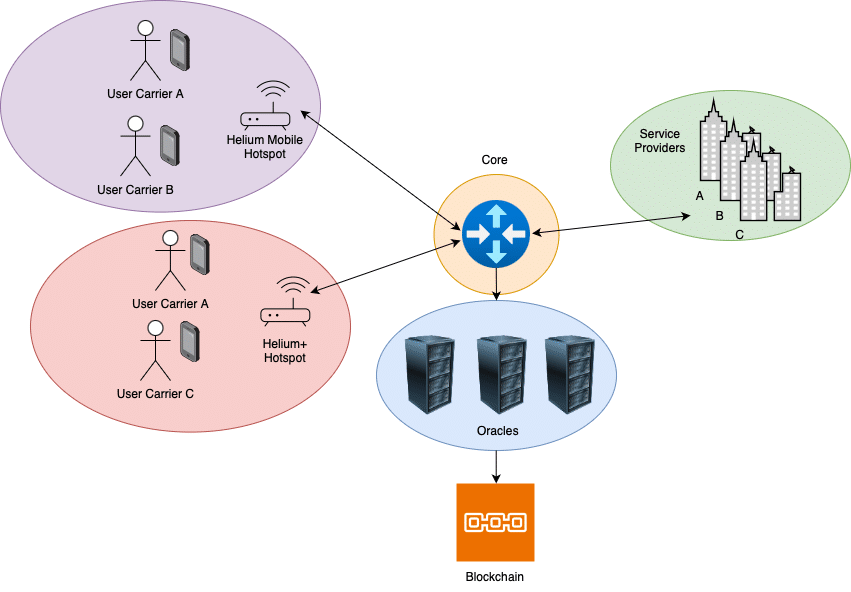
Hotspots provide wireless coverage via LoRaWAN and get rewarded in HNT for doing so. But here’s the kicker: devices don’t pay in HNT, they pay in Data Credits.
Those DCs are minted by burning HNT, permanently reducing supply and keeping the tokenomics grounded in real demand. It’s like building a gas station where fuel disappears every time someone drives. Supply down, value up. That’s Helium’s version of monetized connectivity.
HNT’s Blockchain Structure
Out with the old chain, in with the speed. Originally, Helium ran on its own custom-built Layer 1. It was cute. It worked. Until it didn’t. As hotspot growth exploded, that chain turned into a bottleneck, and the devs knew it.
Rather than duct-tape patches, they made a bold move: full migration to Solana.

Why Solana? It’s fast. It’s cheap. It has the developer firepower Helium needed. Since the move, Helium’s data transmission, validator coordination, and governance have all been running on Solana’s high-throughput rails.
HNT is now a native SPL token on Solana, with wrapped versions available on Ethereum if you need cross-chain exposure. The move to Solana was structural. The blockchain isn’t the main character anymore. The network is. And that’s the point.
Token Standards & Smart Contracts
On Solana, HNT follows the SPL token standard, making it fully compatible with Solana wallets, DeFi apps, and any smart contract infrastructure already live on the network.
But unlike DeFi farming tokens that need 20 contracts just to distribute yield, Helium’s on-chain logic is purpose-built:
- Burn HNT → Mint Data Credits
- Lock HNT → Receive veHNT
- Vote with veHNT → Influence HIPs
No overengineered complexity. Just mechanisms that tie token behavior directly to the physical infrastructure. The HNT token is funding and securing a global mesh of devices in the real world.
Scalability & Performance
Hotspots were growing fast. Too fast. And the original chain couldn’t keep up. That’s why Helium migrated to a chain with high throughput, low latency, and battle-tested performance: Solana.
Now, Helium can handle:
The result? A wireless protocol that can scale like software, while still being rooted in real hardware. It’s already live, powering devices in Qatar, Kansas, and that one guy mining next to a periodic table poster in his garage lab.
Is Helium a Good Investment?
Look, this isn’t investment advice, and anyone who claims they can “guarantee” 10x returns on some altcoin deserves to be thrown into a helium tank at high pressure. But here’s the real question: Should you buy HNT? Let’s lay it out.
Helium is one of the few crypto projects actually doing something in the physical world. It’s not another JPEG collection. It’s a functioning network with decentralized infrastructure, global scale, and real scientific research and industrial use cases. Devices are using the network. Tokens are being burned. People are being paid.
That said, this is not a pump-and-dump playground. It’s a long play and an infrastructure bet. HNT’s price may not moon overnight because it doesn’t rely on meme hysteria. It relies on device adoption, usage, and data transmission, aka real-world metrics.
The upside? If Helium becomes the standard for low-power IoT connectivity or expands deeper into 5G, Wi-Fi, and maybe even nuclear fusion-era mesh nets, it could quietly become one of the most important under-the-radar projects in crypto.
The downside? You’re betting on hardware growth in a crypto market that mostly rewards speculative fluff. And the rewards for running a hotspot today are smaller than they were in the early days. Small amounts of HNT, divided across large quantities of participants.
Still, if you believe crypto should fund real infrastructure, not just digital casinos, Helium might be one of the few bets that actually makes sense. Well, if you plan on buying HNT, we would suggest going to any of the reputable exchanges listed below.




Conclusion
Helium is the crypto project that looked at centralized telecom giants, their billion-dollar towers, and their decades of gatekeeping and laughed. Then it built a working, decentralized wireless network using hotspots, radio waves, and the single most underappreciated force in crypto: incentive design. It’s not here to LARP decentralization. It’s running it.
The HNT token is a tool. A heartbeat for machines quietly exchanging packets of data across rooftops, farm fields, and dense city blocks. It’s the connective tissue behind an IoT movement that doesn’t wait for government funding or billion-dollar telcos to “roll out 5G in your area.”
With every packet sent, with every byte transmitted, Helium is flipping the periodic table on its head and making wireless infrastructure something you can own.
See Also:
FAQs
What is a Helium hotspot?


A Helium hotspot is a physical device that provides wireless network coverage using LoRaWAN. It earns HNT tokens by transmitting data and validating nearby network activity through Proof-of-Coverage.
How can I mine Helium (HNT)?
You “mine” HNT by running a hotspot and proving it’s providing legitimate wireless coverage. Instead of solving math problems, you’re broadcasting and witnessing radio signals, earning tokens for supporting the network.
What is Proof-of-Coverage in Helium?
Proof-of-Coverage (PoC) is Helium’s consensus mechanism that rewards hotspots for physically verifying one another’s location and wireless signal strength. It’s crypto mining meets geolocation.
What devices can connect to the Helium network?
Any low-power IoT device that uses LoRaWAN can connect. Think pet trackers, environmental sensors, scooter fleets, agricultural monitors, and smart infrastructure systems.
Can I stake Helium (HNT)?
Yes. You can lock up your HNT to receive veHNT, which grants voting power in Helium governance. Stakers also earn a share of rewards by backing subnetwork validators (like IoT or Mobile).
Why did Helium migrate to Solana?
Helium moved to Solana for better scalability, faster transactions, and access to a robust developer ecosystem. Its original chain couldn’t keep up with growing network demand, but Solana could.
References:
- “Cryptocurrency and the Future of Your Money.” Columbia Magazine, https://magazine.columbia.edu/article/cryptocurrency-and-future-your-money
- “What Are Digital Currencies.” Reserve Bank of Australia, https://www.rba.gov.au/education/resources/explainers/cryptocurrencies.html
- “Should You Invest in Crypto?” School of Public Policy and Urban Affairs, Northeastern University, https://cssh.northeastern.edu/policyschool/should-you-invest-in-crypto-northeastern-economic-experts-lay-out-pros-and-cons-of-the-digital-currency/
- Helium. “Mobile Network Architecture.” Docs.helium.com, https://docs.helium.com/mobile/network-architecture
- Helium. “HNT Token.” Docs.helium.com, https://docs.helium.com/tokens/hnt-token

Why you can trust 99Bitcoins
Established in 2013, 99Bitcoin’s team members have been crypto experts since Bitcoin’s Early days.
Weekly Research
100k+Monthly readers
Expert contributors
2000+Crypto Projects Reviewed