






In This Article
Cryptocurrency is still struggling to gain a fully mainstream presence in the physical world, especially for making purchases. However, crypto debit cards are slowly changing that, with more and more reputable crypto exchanges and wealth platforms launching their own cards.
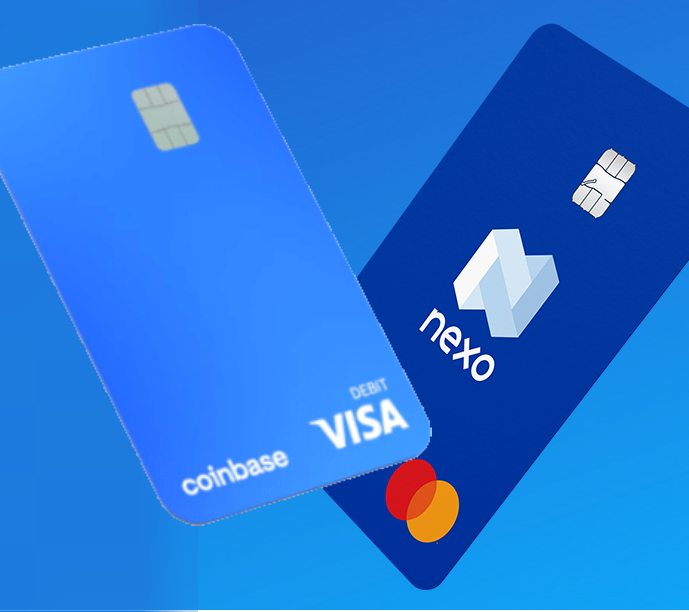
Coinbase and Nexo are two of the major players in this sphere. The Coinbase Card, a Visa debit card, is dominating the US market, while the Nexo Card, a Mastercard solution, is very popular in the EU and the UK. But which one is better?
I take a closer look at that in my Nexo Card vs Coinbase Card comparison. Read on to learn about the two cards, how and where you can use them, what fees and costs they come with, and compare them for spending/rewards in 2026.
Nexo Card Review: Nexo Card in a Nutshell
Backed by Mastercard, the Nexo Card is Nexo’s solution to bridging the gap between the world’s goods and services and your crypto funds. It’s designed to allow you to spend your crypto assets without actually selling them first.
Many Nexo crypto card benefits stem from the other crypto wealth services Nexo offers and fully integrates, like interest earning on your balance. However, the main advantage is the up to 2% cashback on purchases in Credit Mode.
And yes, the card works in both Nexo Credit Card and Nexo Debit Card modes. The former stems from Nexo’s Credit Lines, a Bitcoin loan service, which allows you to borrow both crypto and fiat without spending your assets.

When it comes to Nexo card fees and rewards, you don’t have to worry about monthly or annual fees, as there are none. There’s only an ATM withdrawal fee of 2% if you exceed the monthly limit for your Nexo Loyalty Tier. There are no exchange fees on EUR and GBP, but there is a 0.2% to 2% fee for other currencies, with an added 0.5% weekend fee.
As for rewards, you get cashback on purchases made in Credit Mode. The cashback is up to 2% in NEXO tokens or up to 0.5% in BTC.
The card is linked to the Nexo app, so you can instantly top up and borrow funds, while also tracking your balance and the rest of your Nexo portfolio.
The card can be virtual or physical, and you can connect it to your Apple Pay or Google Pay wallet. You can spend over three fiat currencies and more than a hundred cryptocurrencies that Nexo supports.
Coinbase Card in a Nutshell
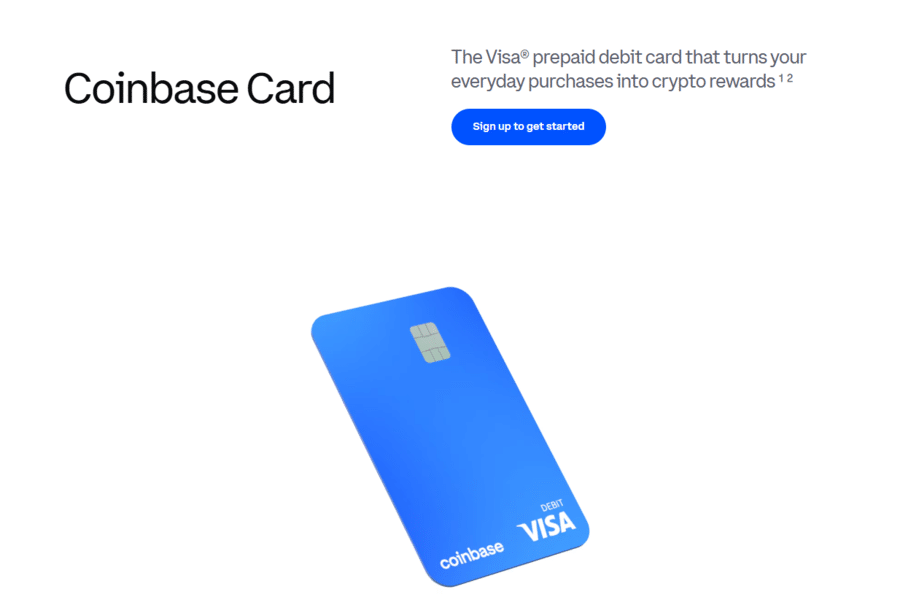
The Coinbase Card is a Visa debit card made for crypto-to-fiat spending. It supports more than 250 cryptocurrencies, and you get to pay for both fiat and crypto transactions wherever Visa is accepted. However, certain goods and services, like those related to gambling and wire transfers, aren’t allowed.
As expected, it’s connected to your Coinbase wallet balance, so you get to spend funds directly from it. It’s also linked to your Coinbase app, which makes monitoring your balance easier, while you can also install it in your Apple Pay or Google Pay wallet. You can order either a virtual card instantly or a physical one. There are no credit checks or other significant requirements to get the Coinbase Card.
When it comes to Coinbase crypto card benefits, Coinbase constantly offers various tokens you can earn by making purchases with your Coinbase Card. Once obtained, the rewards don’t expire, but the offers themselves do, so it’s important to follow what’s available in your Coinbase account on the web or through the app.
As for Coinbase Card cashback and fees, the main thing to know is that there are no transaction fees, but there is a spread in the price for buying and selling crypto. Coinbase also converts all crypto into USD (or the local currency where the card is issued) when you pay or make ATM withdrawals. Speaking of ATM withdrawals, Coinbase doesn’t charge a fee here, but the ATM operator might.
There’s no fixed cashback at all times, but Coinbase is launching a new Coinbase One Card in the fall of 2025 for US-based Coinbase One members, which comes with up to 4% BTC cashback.
We’ve already compared the Coinbase Card in our Uphold Card vs Coinbase Card guide, so check it out to learn more about it and see how it stacks up against a different crypto debit card.
Nexo Card vs Coinbase Card: A Head-to-Head Comparison
Let’s thoroughly compare the duo’s fees, costs, supported cryptos and fiat currencies, rewards, cashback, ease of use, accessibility, user experience, and customer support.
Nexo vs Coinbase Fees & Costs
We’ve already covered the Nexo and Coinbase Card cashback and fees, but we need to dig deeper and compare the two.
The important thing is that neither has a subscription, monthly, annual, transaction, or inactivity fees. Nexo is in the lead here with cashback of up to 2%, while Coinbase doesn’t offer cashback at all times. The slight downside with the Nexo cashback is that it’s tied to your collateralized crypto loans, because you can only get it on purchases in Credit Mode.
However, as for ATM withdrawal fees, Coinbase is in the lead, as it has none, while Nexo Card offers free withdrawal up to a monthly limit that’s set at €200 by default, €400 for Silver, €1,000 for Gold, and €2,000 for Platinum members. Once you go over, you need to pay a 2% fee, with the minimum being €1.99. Naturally, this does not include the costs that the ATM operator may charge, which apply to both cards.
When using either card in a specific fiat or cryptocurrency, a fee will likely be added to the cost of the purchase. However, Coinbase and Nexo approach this differently.
Coinbase charges a spread for crypto-to-fiat conversions, and it converts all crypto to USD, except for USDC. In most cases, the spread fee, or better said, the crypto liquidation fee, is 2.49%.
Nexo is more specific here, charging a fee whenever you’re paying for something in a local currency that isn’t EUR or GBP. You get charged a 0.2% conversion fee if you’re using an EEA, UK, or CH currency. If you’re using another one, there will be a 2% fee. In both cases, there’s an added 0.5% fee if the conversion occurs on a weekend.
Supported Cryptocurrencies & Fiat Options
Nexo supports the use of over 100 cryptocurrencies, including major stablecoins like USDT, USDC, DAI, and TUSD. If you don’t want to spend crypto with a debit card, know that it also supports three fiat currencies, or more specifically, their virtual representations, which make it possible to spend both crypto and fiat on the Nexo Card. These are EURx, GBPx, and USDx.
Through its connection to your Coinbase account, the Coinbase card can support all assets on the Coinbase exchange, so over 250 coins. It doesn’t support fiat like Nexo, but you can still pay for things in almost any fiat store in the world; you’ll just have to pay for the spread, as Coinbase will convert your assets. Naturally, this doesn’t mean that Nexo is the inherent winner in the Nexo vs Coinbase debit card race, because it still charges the conversion fee I mentioned earlier.
It’s worth adding that Nexo also lets you use crypto as collateral to spend fiat whenever you need to, as long as you’re using the Nexo Card in Credit Mode with an active crypto credit line on the Nexo platform.
Nexo vs Coinbase: Cashback and Crypto Rewards Cards Comparison
Nexo enjoys a significant advantage when it comes to cashback, offering it on all purchases in Credit Mode. As for Coinbase, it’s focused on various rewards that change constantly, and it’s not a given that you’ll get cashback every time.
To get Nexo cashback rewards, you need to have at least $5,000 in your balance. The cashback goes up to 2%, and the exact percentage depends on your loyalty level and the crypto in which you’re receiving the cashback:
- All members get 0.1% in BTC and 0.5% in NEXO up to $50 per month.
- Silver members get 0.2% in BTC and 0.7% in NEXO up to $100 per month.
- Gold members get 0.3% in BTC and 1% in NEXO up to $150 per month.
- Platinum members get 0.5% in BTC and 2% in NEXO up to $200 per month.
Moreover, Nexo Card also allows you to earn interest on idle crypto balances, which can go up to 16% with some cryptocurrencies.
As for Coinbase Card rewards, these are comparable in quality to the Nexo Card cashback. That’s especially true when you consider the fact that the Nexo cashback comes only on purchases in Credit Mode, not Debit Mode.
Unfortunately, the 2.49% spread Coinbase charges means that every cashback is automatically smaller, and nonexistent if the cashback percentage isn’t higher than 2.49%.
The FX fee Nexo charges isn’t as much of a problem, as it doesn’t exist if you’re using EUR or GBP, only for other currencies.
If you want to know about how to earn crypto rewards on other crypto platforms, check our guide on the best crypto bonuses.
Ease of Use & Accessibility
If your primary concern is ease of use and accessibility, either of the two can be the best card for spending crypto.
Both are used like you would with any bank account, and you can even add them to your preferred wallet app and pay with your phone. The platforms that support them are also easy to use, geared towards beginners, but accommodating crypto traders and investors as well.
The verdict is the same for the Nexo vs Coinbase app comparison. Both brands offer apps for iOS and Android users, designed to facilitate the use of all services the duo provides, not just tracking the balance of your card.

The Nexo Card is less accessible than its counterpart because it requires at least $50 in your account for the virtual and $5,000, and a Gold membership for the physical card. Coinbase Card doesn’t impose such a requirement.
Even though you can use either card throughout the world, owing to the fact that these are Visa and Mastercard solutions, only people from select countries can obtain a card:
- Nexo Card: Made for users from specific European countries, the EEA, and the UK
- Coinbase Card: Made for users from EEA countries, the UK, and the US (except Hawaii)
In essence, most Europeans can choose between the two, while people from the US can only use the Coinbase Card.
Security and Privacy
With Nexo using Mastercard and Coinbase using Visa as their card providers, you know security is not an issue. The two companies are effectively the default payment network providers for most of the world. So, there’s no need to wonder whether the Coinbase Card or Nexo Card is legit.
The Nexo platform offers biometric identification, two-factor authentication (2FA), real-time notifications on account activity, and is fully compliant with the latest global standards on security and privacy. Nexo also allows you to freeze your card if you’ve lost it or feel it’s compromised.
The Coinbase crypto card security is the same as the security on all other Visa cards. The Coinbase platform itself is also highly secure and provides safety features like 2FA and fraud monitoring. You also have the option to lock the card if it’s stolen or compromised, and you can do that quickly from the Coinbase app.
Customer Support and User Experience
Coinbase offers a detailed Help Center with a long list of articles explaining the various functions and features of the platform. There’s also a specific section just for the Coinbase Card, and you can reach out to the agents via an embedded form. The platform is equipped with a virtual assistant you can access at any time, while human support is offered through live chat or phone for select countries, but you have to schedule it.
Nexo has a similarly robust Help Center, but its articles are a lot more detailed than Coinbase’s. There’s a separate and very detailed section for the Nexo Card as well. Nexo also has a 24/7 live chat feature. Private and institutional clients get dedicated support agents.
Nexo maintains a very high rating on Trustpilot, with almost every Nexo debit card review being fairly positive. You can also find more detailed user feedback and opinions on the Nexo subreddit, which boasts over 43,000 users. The Nexo app also has high ratings on the Apple App Store (4.0 ⭐) and the Google Play Store (4.2 ★).
If you want a detailed Coinbase debit card review, you should look at the same sites. The platform has a similar number of reviews on Trustpilot, albeit with a somewhat lower rating, at 3.9 compared to Nexo’s 4.5. The only problem is that nearly half the ratings are 1-star. You can find more detailed feedback on Reddit, where several subreddits are dedicated to Coinbase, while the main one has over 420,000 users. The Coinbase app enjoys an excellent rating on the Apple App Store (4.7 ⭐), but an average one on the Google Play Store (2.9 ★).
Nexo vs Coinbase Debit Card: Pros and Cons of Each
Nexo Card Pros
- Dual debit and credit card mode
- Earning interest on assets in debit mode
- Up to 2% cashback on payments in credit mode
- Support for three fiat currencies
- No exchange fee on EUR and GBP
- High withdrawal and spending limits
Nexo Card Cons
- Requires collateral in credit mode
- Unavailable for US users
- FX fee on non-EUR and non-GBP currencies
- $5,000 portfolio requirement for physical card
Coinbase Card Pros
- Excellent rewards and cashback percentages
- No FX fee or spread on USDC payments
- No requirement to obtain a virtual or physical card
- Great for US-based users
- Supports over 250 cryptocurrencies
- Doesn’t charge its own ATM withdrawal fee
Coinbase Card Cons
- Spread of 2.49% on all non-USDC cryptos
- You can’t hold fiat currencies
- Cashback isn’t guaranteed
- No interest earned on idle balances
- No credit card mode
Nexo Card vs Coinbase Card: Who Should Use Which?
If you’re wondering whether to use Coinbase or Nexo for crypto spending, there’s no easy answer here. Both have their advantages in that regard, as that’s their primary function. However, there are specific types of users who will benefit more from one over the other. If you’re one of these types of users, then you’ll know which is the best card for spending crypto:
- Nexo Card: Existing Nexo users, EU and UK residents who want to get cashback without spending crypto, investors looking to borrow crypto and still use it for payments, and high-net-worth individuals who want higher limits on spending and ATM withdrawals.
- Coinbase Card: Existing Coinbase users, US residents, people looking for rewards and bigger cashback, crypto users who want a simple debit card that lets them pay with crypto, and heavy USDC users.
Conclusion
Nexo Card is made by Mastercard and operates both as a credit and debit card, while the Coinbase Card is a Visa debit card. Nexo Card has ATM withdrawal fees but lower conversion fees. Coinbase Card supports more cryptos, while Nexo Card also uses fiat. The Coinbase Card features frequent and high rewards, while Nexo only offers cashback.
The card you choose should depend on these differences, but mainly on your location, rewards preference, and fee tolerance.
If you’re not from the US, we advise the Nexo Card, which features no conversion fees for EUR and GBP users, making it the obvious choice compared to the Coinbase Card. Deposit at least $50 in crypto or fiat on Nexo and you can start with a virtual Nexo Card to try it for yourself.
FAQs
Is Nexo better than Coinbase?


If you’re already a user of one of the two, that brand’s card is the better choice for you. Otherwise, the Nexo Card is more suited for high-net-worth individuals and people interested in earning interest on their holdings. The Coinbase Card is best for people looking for constant rewards and those who normally use USDC, because that way, there’s no spread on conversions.
Is the Coinbase Card worth it?
If you already have an account on Coinbase and want to start paying with your crypto assets, it definitely is. It’s also suitable for other users interested in paying for goods and services with crypto, but you need to consider the drawbacks, most notably the spread.
Is the Nexo Card good?
Yes, definitely. It lets you pay wherever Mastercard is accepted, and you can use both crypto and fiat. It also comes with up to 2% cashback.
Is the Coinbase Card legit?
Yes, without a doubt. It’s an official product of Coinbase, one of the top crypto exchanges on the planet. Plus, it’s a Visa debit card, operating like any bank card you normally use.
What are the benefits of the Coinbase Card?
You can get various rewards from using the Coinbase Card, including cashbacks. It’s easy to use and accepted wherever Visa works, and you get the benefit of real-time conversion so you can pay for anything with your crypto balance.
References
- Coinbase Card (Coinbase)
- Nexo Crypto Card (Nexo)
- Understanding Crypto Debit and Credit Cards (Ledger)

Why you can trust 99Bitcoins
Established in 2013, 99Bitcoin’s team members have been crypto experts since Bitcoin’s Early days.
Weekly Research
100k+Monthly readers
Expert contributors
2000+Crypto Projects Reviewed