



Bitcoin price jumped today after a strange moment for markets. The Federal Reserve found itself at the center of a political storm, and the US dollar immediately felt the pressure. Comments from Fed Chair Jerome Powell about a possible criminal probe tied to the central bank’s headquarters renovation sent us scrambling to reassess risk.
And boy, just how quickly confidence shifted. The Federal Reserve looked vulnerable, the US dollar softened, and investors leaned into assets that sit outside direct political reach. In this setting, Bitcoin didn’t hesitate, pushing its price higher as uncertainty took place.
The threat of criminal charges is a consequence of the Federal Reserve setting interest rates based on our best assessment of what will serve the public, rather than following the preferences of the President”
Federal Reserve in Trouble? Will Bitcoin Price Run Continue?
Powell said the threat of charges stems from the Federal Reserve choosing policy based on economic data, not presidential preference. Markets took that explanation at face value. The US dollar slid to around 0.2%, pulling the dollar index toward 99, while the Bitcoin price ran to above $92,000.
Political pressure on the Federal Reserve has been building for some time. It is known that President Trump has repeatedly argued for lower rates and faster money creation, and with talk growing around a possible leadership change at the Fed later this year, we are beginning to price in instability. Betting markets now show about a 20% chance of Jerome Powell being out as Federal Reserve chair by March.
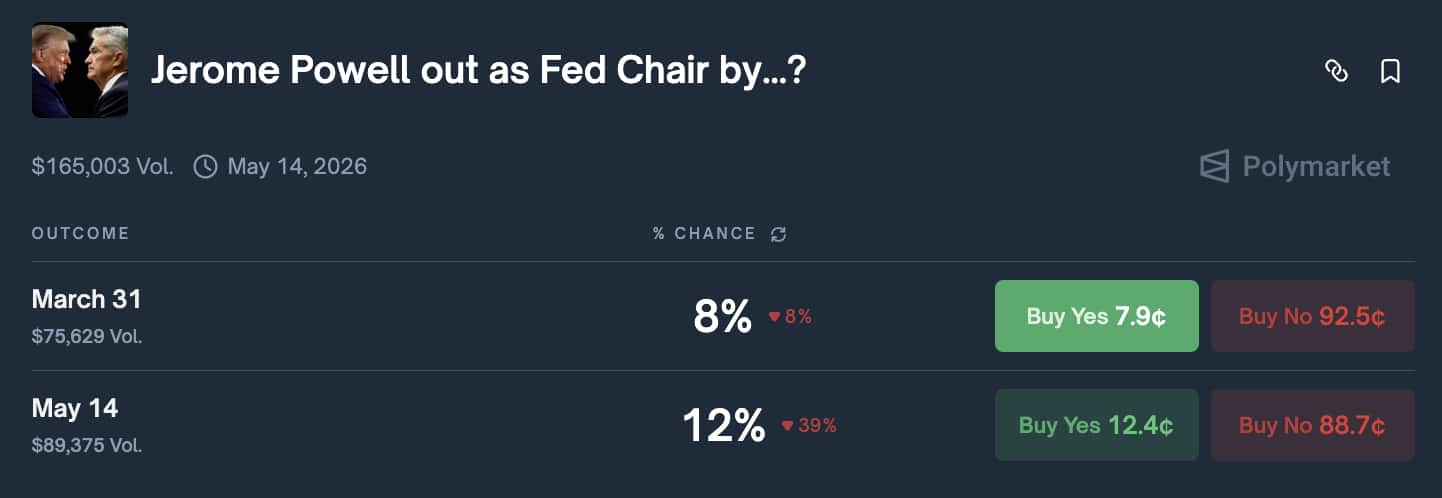
(source – Polymarket)
From a chart perspective, Bitcoin price spent most of last week moving sideways between $90,000 and $91,000, with the exception of a superb run to $94,000 on the 6th of January. Buyers have been stepping in consistently, and today’s break above $92,000 confirmed a technical breakout. Momentum indicators, including an RSI near 60, show that the move still has room without looking stretched. And yeah, Michael Saylor’s Strategy is still buying.
₿ig Orange. pic.twitter.com/VmFz8nI1uq
— Michael Saylor (@saylor) January 11, 2026
DISCOVER: 10+ Next Crypto to 100X In 2026
Liquidity, FED’s Policy, and The Weakening of the US Dollar to Shape Markets?
Away from the headlines, liquidity remains a powerful force. Global liquidity is sitting at record highs as the Federal Reserve continues Treasury bill purchases and quietly expands its balance sheet. Additional stimulus measures, including large mortgage bond programs, have only added pressure on the US dollar.
Global Liquidity is skyrocketing.
Bitcoin will follow! pic.twitter.com/oQOsajXbss
— Mister Crypto (@misterrcrypto) January 11, 2026
Regulatory tone has also shifted. Progress toward clearer crypto rules and expectations of future Federal Reserve rate cuts have helped support sentiment. As the US dollar loses ground, Bitcoin is increasingly viewed as a practical alternative, and the price will follow.
Altcoins still followed Bitcoin’s move, though unevenly. Ethereum hovered at $3,200, while Solana pushed above $140. Although the market is still, at the moment, focused firmly on the Bitcoin price, which, like it or not, mirrors investor confidence.
DISCOVER:
Follow 99Bitcoins on X For the Latest Market Updates and Subscribe on YouTube For Daily Expert Market Analysis.

Dubai just drew a hard line on crypto privacy. On January 12, the Dubai Financial Services Authority (DFSA) banned privacy tokens and rewrote its crypto approval process. Privacy-focused coins like Monero (XMR)
and Zcash (ZEC)
have surged in response to the news, up +14% and +2% over the past 24 hours, respectively. This move aligns with a broader global shift. Regulators worldwide, from Europe to Hong Kong, now prioritize strict identity verification over anonymity in crypto markets. In typical crypto fashion, privacy tokens such as Monero and Zcash have outperformed the broader market, defying the privacy crackdown. Dubai’s financial regulator has banned privacy tokens across the Dubai International Financial Centre (DIFC), citing AML and sanctions risks. The updated rules also bar mixers like Tornado Cash.$ZEC $ZEN $DASH $XMR pic.twitter.com/6DyrS5WiM4 — Block_Diversity v.8 ™️ (@i_bot404) January 12, 2026 Read about it here. South Korea has upended nearly a decade of crypto policy by allowing listed companies and professional investors to place part of their balance sheets into digital assets. The shift stands in contrast to tightening rules in Japan and Hong Kong. Asia no longer appears aligned on crypto regulation, and the divergence is becoming clearer. For the first time since 2017, South Korea’s Financial Services Commission (FSC) has finalized South Korea crypto rules that allow public firms and licensed investors to allocate up to 5% of equity capital to cryptocurrencies. The scope is intentionally narrow. Only the top 20 cryptocurrencies by market capitalization listed on Korea’s five regulated exchanges qualify under the new framework. SOUTH KOREA HAS ENDED ITS 9-YEAR CORPORATE CRYPTO BAN! 📢 COMPANIES CAN NOW INVEST UP TO 5% OF THEIR EQUITY IN THE TOP 20 CRYPTO ASSETS! pic.twitter.com/LWJ7Gk4cwc — The Moon Show (@TheMoonShow) January 12, 2026 Read the in depth coverage here. Ethereum co-founder Vitalik Buterin has warned that today’s decentralized stablecoins still fail in ways most users don’t expect and that there is an overreliance on USD-pegged digital assets. In an X reply to MetaLeX founder @lex_node yesterday (January 11), Buterin highlighted three key issues: finding a better index to track than the USD price, building a decentralized Oracle that is not capturable by a large pool of money, and addressing the problem that staking yield represents competition. His comments came as Ethereum USD opened Monday’s trading session flat over the past 24 hours, trading around $3,100, as stablecoin transfer volumes on the network continue to surge, as I discussed here last week. The backdrop matters because stablecoins now act as Ethereum’s cash layer, not a side feature. Read the full story here. On Pump.fun and similar platforms, meme coins are continuously churned as if someone is firing a machine gun. Even now, as you read this, there is a funny meme coin being deployed, not to solve a problem but for entertainment. For this reason, it came as no surprise that over 11.5M crypto tokens “died” in 2025. CoinGecko analysts say that, given the sheer number of token deaths, it is evident that 2025 was a deadly year for new crypto projects. (Source: Coingeck0) Despite the carnage, the Bitcoin price barely moved. The resilience in the BTC USDT price action also had a positive impact on Solana, the host network for the millions of shit coins minted every hour. SOL USDT is presently firm, trading above $120. Read the full story here. US senators are preparing to vote on a long-awaited crypto market structure bill that would spell out who regulates what in crypto. After years of piecemeal enforcement actions and uncertainty, Congress is moving toward a unified federal framework for regulating crypto markets. Lawmakers in the Senate are preparing markups and votes on a crypto market structure bill early in 2026, with key committees, the Senate Banking Committee and the Senate Agriculture Committee, scheduled to advance competing versions of the legislation. News in PBN Texts: The Senate Agriculture Committee will ALSO hold its markup of crypto market structure legislation on Thursday, Jan. 15. Next week shaping up to be massive for bipartisan crypto policy in 2026. Senate Banking will markup its portion the same day. pic.twitter.com/nWgukxgpvl — Brendan Pedersen (@BrendanPedersen) January 7, 2026 The framework under consideration draws heavily from the Digital Asset Market Clarity Act of 2025 (often called the CLARITY Act), which the House of Representatives passed with strong bipartisan support in July 2025. That bill was designed to establish clear statutory definitions for “digital commodity” and “digital asset,” and specify how the SEC and CFTC share regulatory duties. Until now, U.S. crypto regulation has largely relied on enforcement actions and agency interpretations rather than explicit statutory rules, leaving many platforms and projects uncertain about which laws apply. Read the full story here. BitMine hit a major milestone after a three-week staking spree of more than 1 million ETH
, according to on-chain data tracker, @lookonchain. The Tom Lee-headed DAT (Digital Asset Treasury) has continued its Ethereum yield strategy with another 109,504 ETH being staked as of this morning (January 12). In the past three weeks, Bitmine has staked over $3.7Bn in Ethereum. At a current staking APY of 2.81%, BitMine is projected to earn approximately $103M in Ethereum yield rewards annually. https://twitter.com/lookonchain/status/2010513205920153655 This move is significant because it indicates that Ethereum no longer relies on mining. It operates on a staking model, converting idle ETH into a digital bond. For everyday investors, this raises a simple question. Is Ethereum becoming the go-to yield-bearing asset for institutions? ETH USD has held steady over the weekend and is trading up +0.5% as news spreads, suggesting the market has already priced in increased institutional demand. This aligns with a broader trend in which large firms now treat ETH less as a tradable asset and more as a yield-producing asset. Read the full story here. Senior Labour MPs have urged the UK government to ban political donations made in cryptocurrency, citing risks around anonymity and foreign interference. The news has made a splash across Britain, as Bitcoin continues to range between $90,000 and $92,500 following an overnight surge. BTC USD is flat over the past 24 hours, up just 0.1%, trading at $90,700 as market indecision continues. Until Bitcoin closes the day below $90,000 or above $94,000, we remain firmly locked in a tight consolidation range. The lack of price response to the UK political donation story shows that traders are focused on macro data rather than UK politics. Still, the story fits a wider trend: governments tightening rules wherever crypto touches on established, real-world points. For everyday users, this is not merely about the price of crypto today. It is more about how lawmakers see crypto when it intersects with elections, influence, and trust. This story shows that the old guard still views digital assets as shady and untrustworthy. 1/. Seven Select Committee Chairs have written to the PM urging a ban on cryptocurrency donations to political parties in the #ElectionsBill. Crypto is opaque, hard to trace, vulnerable to foreign interference & a growing risk to democratic integrity. We should make clear NOW… pic.twitter.com/9XOXllixtu — Liam Byrne MP (@liambyrnemp) January 12, 2026 Read the full coverage here. If you’ve noticed less crypto-related content in your feed, you’re correct. Crypto YouTube engagement has recently fallen to its lowest level since early 2021, this even as Bitcoin trades near cycle highs. Viewership data aggregated across major crypto channels shows a three-month decline in average daily views, returning to levels last seen during the 2021 bear market. Creators note the drop isn’t limited to one platform but reflects a broader decline in social engagement across YouTube, X, and other video platforms. (Source: TradingView) This trend suggests that many everyday investors are more cautious and fatigued than in past cycles. Creators attribute part of the pullback to recurring pump-and-dump schemes, market scams, and unimpressive returns in 2025, which have eroded confidence in crypto content. Commentators describe current engagement as “bear market levels of social interest,” and some observers argue that institutional involvement, rather than retail enthusiasm, has been a key driver behind recent price stability. Read the full story here. Sentiment for the number two digital asset, ETH, just reached levels that 99Bitcoins analysts say often precede major price runs. The Ethereum price is currently trading between $3,100 and $3,200, up +2% in the past 24 hours as traders step in to buy following last week’s minor pullback. The Ethereum price movements come as the broader crypto market cap reclaimed $3.2 trillion, surging +1.2% in the past 24 hours. Bitcoin briefly topped $92,000 before slipping to $91,500 as European markets opened on Monday morning. However, market fear remains significant, as the fear-and-greed index fell to 27 from 29 yesterday. In past cycles, deep pessimism has marked moments when sellers run out of steam. I still remember June 2022, when sentiment around ETH had never been lower after it slipped below $1,000, before it more than doubled over the eight months that followed. That matters now as investors debate whether Ethereum lags or quietly resets for another move. Macro pressure still shapes the backdrop. Rate uncertainty and rotation toward faster chains keep short-term nerves high.
Read the full story here. The total market cap stabilised with Bitcoin dominance around 58%, while 24-hour trading volumes on major platforms reached record peaks exceeding $150 billion. However, the rally remains fragile. Analysts note selective rotation into liquid majors rather than broad altcoin euphoria, with caution lingering from late-2025 corrections. Institutional adoption continues to grow, supported by ETF inflows and tokenised assets, though volatility persists due to geopolitical factors and supply events like token unlocks. And now, a new wave of altcoin tokens reportedly hit the market this week, adding fresh supply to several popular projects. Prices reacted fast, with some newly unlocked tokens sliding 5–7% within days. This fits a wider 2025–2026 pattern where scheduled unlocks keep shaking altcoins even during calm market periods. Read the original article here.Dubai Bans Privacy Coins With Monero and Zcash Unbothered by the Crackdown
South Korea Lets Companies Buy Crypto as Japan, Hong Kong Pull Back
Vitalik Buterin Sends Ethereum Stablecoin Warning: ‘What Happens if USD Hyperinflates?’
11.5M Crypto Tokens Died in 2025: Why Meme Coins Fail Fast
US Crypto Market Structure Bill Nears Vote: Bullish?
BitMine Locks Up 1M ETH: Why Institutions Want Ethereum Yield
UK MPs Push to Ban Crypto Political Donations: Here’s Why
Crypto YouTube Views Hit 2021 Lows as Retail Walks Away
Ethereum Price Sentiment Sinks Again: History Says That’s When Rallies Start
Crypto Fear and Greed Chart
Altcoin Token Unlocks Are Back: Which Coins Face Sell Pressure?
Why you can trust 99Bitcoins
Established in 2013, 99Bitcoin’s team members have been crypto experts since Bitcoin’s Early days.
Weekly Research
100k+Monthly readers
Expert contributors
2000+Crypto Projects Reviewed