




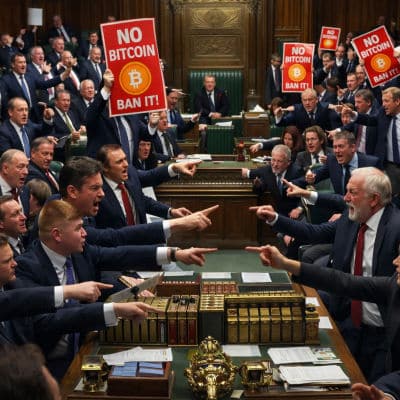
Senior Labour MPs have urged the UK government to ban political donations made in cryptocurrency, citing risks around anonymity and foreign interference. The news has made a splash across Britain, as Bitcoin continues to range between $90,000 and $92,500 following an overnight surge.
BTC USD is flat over the past 24 hours, up just 0.1%, trading at $90,700 as market indecision continues. Until Bitcoin closes the day below $90,000 or above $94,000, we remain firmly locked in a tight consolidation range.
The lack of price response to the UK political donation story shows that traders are focused on macro data rather than UK politics. Still, the story fits a wider trend: governments tightening rules wherever crypto touches on established, real-world points.
For everyday users, this is not merely about the price of crypto today. It is more about how lawmakers see crypto when it intersects with elections, influence, and trust. This story shows that the old guard still views digital assets as shady and untrustworthy.
1/. Seven Select Committee Chairs have written to the PM urging a ban on cryptocurrency donations to political parties in the #ElectionsBill.
Crypto is opaque, hard to trace, vulnerable to foreign interference & a growing risk to democratic integrity.
We should make clear NOW… pic.twitter.com/9XOXllixtu
— Liam Byrne MP (@liambyrnemp) January 12, 2026
What Are Crypto Political Donations: and Why Are MPs Alarmed?
A crypto political donation works like a normal campaign donation, except that the money arrives in Bitcoin or another digital asset rather than GBP. Labour MPs argue that this creates a problem. Crypto wallets do not show names the way bank transfers do, which makes it harder to confirm who really sent the money.
According to The Guardian, MPs fear foreign states could hide behind small, repeated donations that stay below disclosure thresholds. The argument from Labour MPs is that political funding relies on traceability, and if voters cannot see who funds a party, trust will break fast.
The letter to the Prime Minister is being spearheaded by MP for Hodge Hill & Solihull North, Liam Byrne, who said on X: “Crypto is opaque, hard to trace, vulnerable to foreign interference & a growing risk to democratic integrity. We should make clear NOW this loophole will be closed.”
DISCOVER: The 12+ Hottest Crypto Presales to Buy Right Now
UK Regulation Tightens Where Crypto Meets Politics
🇬🇧💷 Political funding in the UK just hit a new record.
Reform UK has received its largest ever single donation, courtesy: a crypto investor.
Apparently, there are no strings attached and the £9 million donor wants "absolutely nothing" in return.
Who is he, what are his ties… pic.twitter.com/4KELuuAxGf
— blocmates news (@blocmatesnews) December 8, 2025
The push for a ban is not random. UK ministers already flagged crypto donations as a weak spot in election security, and the Electoral Commission warned that current technology makes oversight difficult.
Only a handful of UK parties accept crypto donations today, and just two have confirmed they receive any, according to the House of Commons Library. Reform UK drew attention last year when it became the first European party to accept crypto via a licensed payment provider.
When crypto touches politics, regulators react faster and more aggressively than they do to crypto native trading apps or NFTs. The UK Prime Minister, Kier Starmer, has yet to publicly respond to the letter from seven different Labour MPs, but with Britain’s track record in stifling crypto innovation, there is a good chance a blanket ban on digital asset political donations is put into effect.
How Could This Affect Everyday Crypto Users?
This proposal is isolated and, on the face of it, would not prevent anyone from buying crypto or using a digital wallet. It specifically targets a narrow use case: political funding.
Still, it contributes to a broader pattern, especially in the UK. Governments want full visibility when money influences public life. We see the same logic in UK crypto tax rules and in stricter policy debates around stablecoins globally.
For an everyday crypto investor like you and me, this story tells us something important. Digital privacy works well for personal investments such as XMR and ZEC. However, it draws scrutiny when applied to real-world politics.
The Counterpoint: Is a Ban Even Practical?
🚨BREAKING: 🇬🇧UK to start regulating crypto by 2027.
Starting 2027, crypto will be regulated like traditional financial assets under new UK Treasury rules.
Officials are also considering a ban on political donations made using crypto. pic.twitter.com/5gY5izi5II
— Coin Bureau (@coinbureau) December 15, 2025
UK officials admit a full ban is hard to enforce. Crypto can pass through payment processors, exchanges, or conversion services that obscure the trail.
Supporters of crypto donations argue that licensed providers already run identity checks, known as ‘Know Your Customer’, similar to those used by banks.
They say better enforcement beats an outright ban, and that digital assets with an open, public blockchain that traces all transactions provide more transparency than the closed ledgers held by banks and financial institutions.
For now, this debate remains a political one. No law has been passed yet, but the direction is clear. If you use crypto, expect stricter rules anywhere it touches taxes, voting, or public power. Personal investing stays open. Political money draws red flags, especially in the UK.
EXPLORE: 99Bitcoins’ Q4 2025 State of Crypto Market Report
Follow 99Bitcoins on X For the Latest Market Updates and Subscribe on YouTube For Daily Expert Market Analysis.

Why you can trust 99Bitcoins
Established in 2013, 99Bitcoin’s team members have been crypto experts since Bitcoin’s Early days.
Weekly Research
100k+Monthly readers
Expert contributors
2000+Crypto Projects Reviewed