






In This Article
As the crypto market grows, investors are no longer just focused on buying and holding digital assets; they’re looking for ways to make those assets work for them. One of the most popular approaches today is using a crypto savings account, which lets you deposit Bitcoin, Ethereum, stablecoins, and other cryptocurrencies and earn interest over time. In many ways, this is the digital version of a high-yield savings account, but with greater flexibility and potentially higher returns.
These accounts let long-term holders generate passive income without selling their assets. Whether your goal is to earn Bitcoin, earn yield on Bitcoin, or diversify by choosing to earn Solana or earn Ton Coin, savings accounts can unlock consistent returns while you continue to benefit from future price growth. For coins that don’t support staking (such as Bitcoin) they can be one of the most effective ways to generate yield.
Among the providers in this space, MEXC has emerged as the leading choice. MEXC offers a broad selection of supported assets, daily interest payouts, and flexible yield products that make it simple to earn interest on Bitcoin and other crypto holdings. It also offers stablecoin yields, with flexible USDT plans and competitive rates on assets like ETH, XRP, and TON.
But there are many ways to earn outside of trading and, if you’re holding cryptocurrency as a long-term investment, this guide will walk you through how to put those holdings to work. We’ll explain how you can earn interest on crypto, break down the pros and cons of different methods, and show you which platforms stand out today.
Key Takeaways
- A crypto savings account works like a high-yield savings account, letting you deposit assets and earn daily interest.
- MEXC is the leading choice, offering daily payouts, flexible yield products, and support for a wide range of cryptocurrencies.
- You can earn Bitcoin, Ethereum, Solana, Toncoin, XRP, and stablecoins without selling your holdings.
- Beyond savings, MEXC provides a built-in crypto exchange platform with low trading fees and broad asset coverage.
- Always balance rewards with risk—higher yields often mean greater exposure to volatility or less established platforms.
How to Earn Interest on Crypto Summary
There are several ways you can make money with crypto. For those already holding crypto for the long term, you may want to consider earning a return on those holdings via staking, crypto interest accounts, DeFi, and yield farming. Finally, it’s important to research each method properly before putting any of your crypto to work.
Don’t like to read? Watch our video instead:
Crypto Interest Accounts
A crypto interest account is one of the simplest ways to put idle digital assets to work. You can leave your coins untouched in your wallet, earning nothing, or deposit them with a provider and earn a return, which is usually quoted as APR or APY. This works more like a yield product than native staking, and the provider generally uses those deposits for lending, liquidity management, or other capital allocation strategies, then passes most of the return back to the user.
So if your goal is to earn on long-term holdings without actively trading or fiddling around with DeFi strategies by yourself, a crypto interest account can be the right middle ground. The model is especially relevant for assets like Bitcoin and stablecoins, where native staking is not always available.
The trade-off is that you are relying on the platform’s custody, risk controls, and business model, and you may need to keep your coins locked up for a period.
For investors who want a more yield-focused option, CoinDepo is an excellent and reliable option, as we found in our full CoinDepo review. CoinDepo is built around structured crypto interest products rather than trying to be an all-purpose exchange, and it supports popular assets like BTC, ETH, USDT, USDC, DAI, and XRP, with returns of between 12% to 23% APR depending on the selected term and product. You can also earn an additional 3% APR if you hold the platform’s token, COINDEPO.
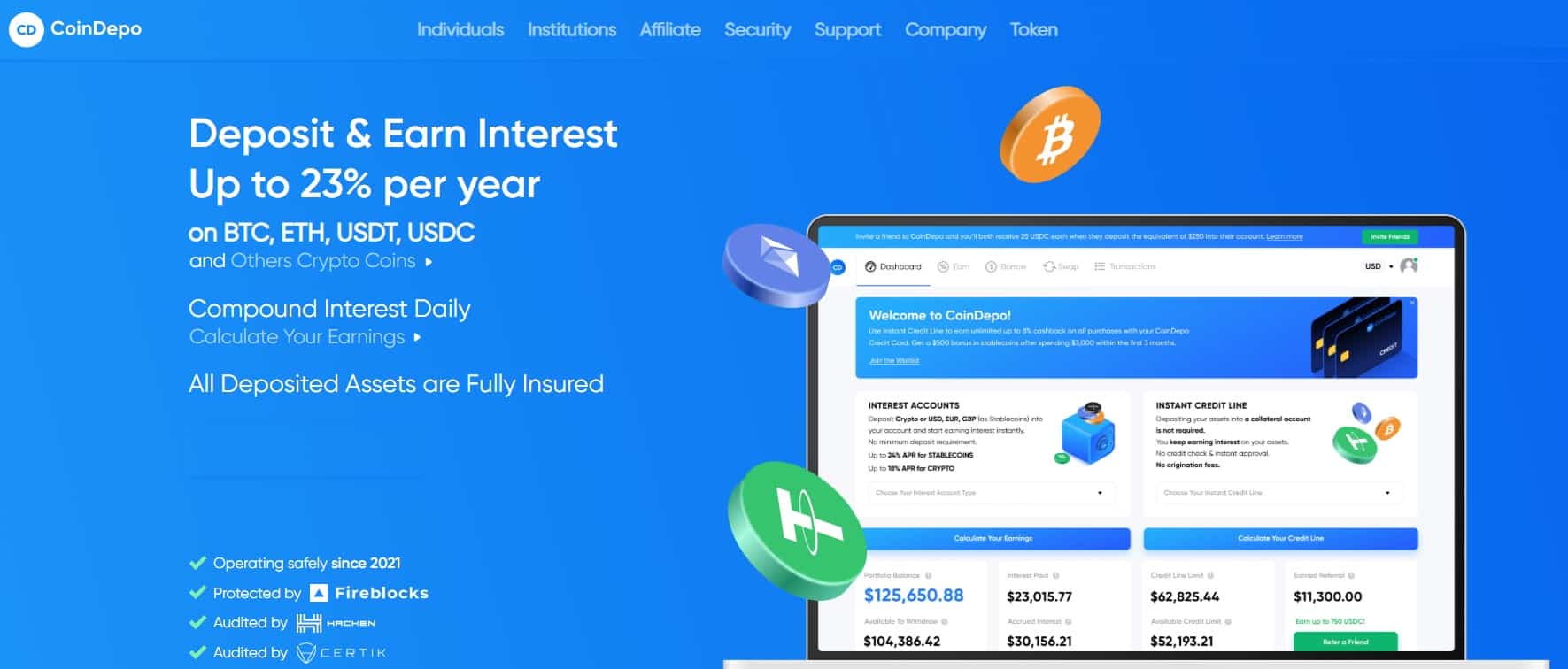
Many interest accounts look attractive on paper but only offer high rates on obscure tokens or limited promotional balances, whereas CoinDepo’s product focuses on popular coins and offers high but sustainable rates, and does so without chasing volatile and short-lived DeFi pools.
Visit CoinDepoStaking Cryptocurrencies
Put simply, staking is the act of locking up or “parking” a portion of your cryptocurrency for a period of time to help run and maintain a specific network. These networks are generally Proof-of-Stake (PoS) blockchains such as Ethereum 2.0, Cardano, Cosmos, Solana, and Polkadot.
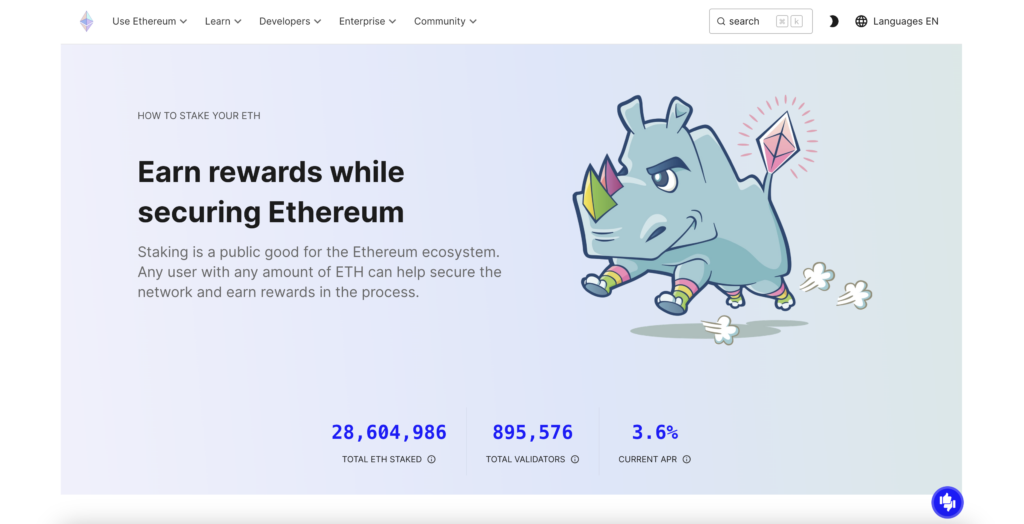
In return for locking your coins to help maintain the network, you receive a staking reward in the form of interest. The annual interest rate, in the form of either APR or APY, varies a lot between coins and can range anywhere from 0.05% to 100%+ per year. The Ethereum.org website is one good resource for information.
A higher interest rate often means additional risks, so you’ll want to research before deciding which coin you’ll want to stake. Another important aspect of staking is that each coin has different rules. For example, different coins and platforms have requirements for how long you need to lock up your coins. Certain coins require long periods, while others allow for short periods. There is also the aspect of unstaking, which, in some cases, can take hours, days, or even weeks for your coins to be returned to you.
While staking can be done directly from your computer without the need for any dedicated equipment, this process is fairly technical, has a lot of limitations, and isn’t advised for beginners. The easiest way for a beginner to stake would be through an exchange or a wallet.
Most popular exchanges like Kraken, Bitstamp, Binance, Coinbase, and MEXC allow you to stake a variety of coins. Rocket Pool is another popular choice. Aside from ease of use, the minimum amount to stake on an exchange will usually be fairly low, and in some cases, there won’t even be a minimum lock-up period.
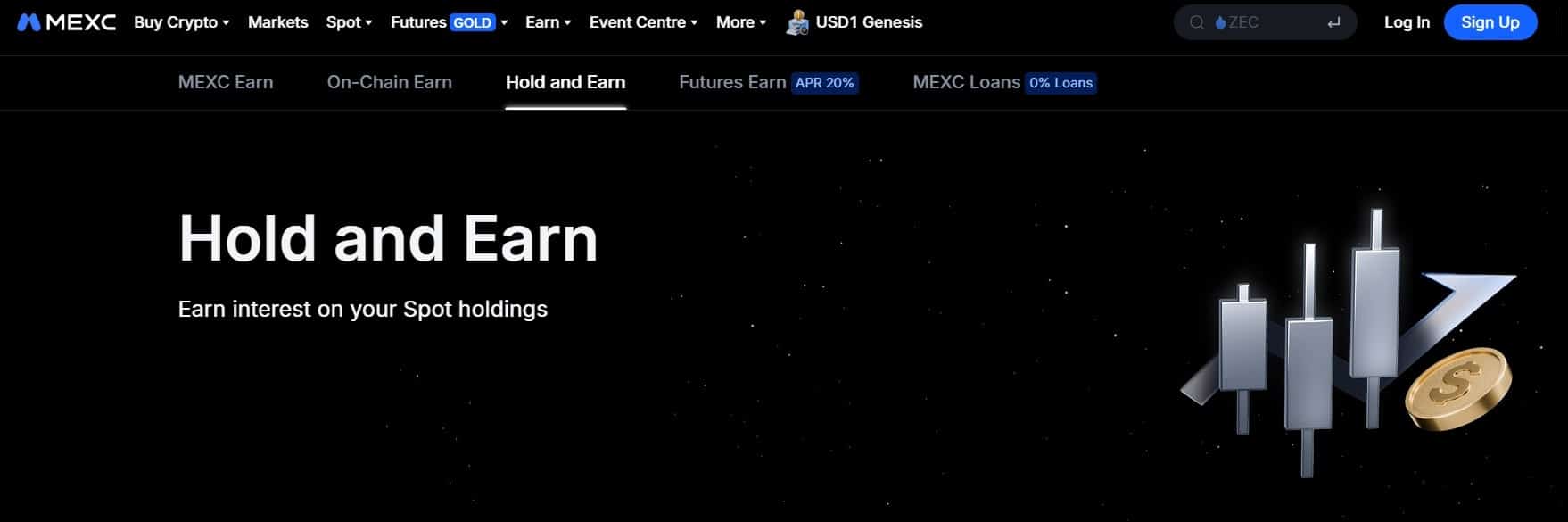
For beginners in particular, MEXC is worth considering because it has simple access with a wide range of cryptocurrencies and great rates. The platform also offers stablecoin yield products, which is something not every exchange handles especially well. For example, MEXC offers flexible USDT plans, meaning you can withdraw at any time, although the highest rates apply only to smaller balances because the platform uses a tiered rewards system. Highest rates at the time of writing are on USDD at 5% APR.
A good alternative for people who don’t want to give control over their funds would be to stake through a wallet. There are a number of staking wallets: Ledger, Exodus, Trust Wallet, and Zengo, just to name a few.
Make sure you take a look at what fees each wallet charges: you may find some that don’t charge any staking fees at all. Remember that in most cases, wallets will offer a smaller variety of coins they make available for staking.
If you do decide to stake on an exchange, always do your research before committing funds so you don’t accidentally find them locked up longer than expected. In practice, that means checking the unstaking period, whether the rate is fixed or tiered, how often rewards are paid, and whether the platform makes a clear distinction between flexible earn products and true on-chain staking.
DeFi and Yield Farming
Finally, we come to our most complicated option, which is DeFi. DeFi stands for Decentralized Finance – a term given to financial services that aren’t controlled by a central authority but by a network of independent computers using predefined rules.
Many decentralized services allow you to lock up your holdings and earn interest in return. The locked-up funds can be used for different purposes, such as lending, staking, supplying liquidity to decentralized exchanges, and farming.
It would be impossible to cover the whole theory behind all of this here, so suffice it to say that in return for the interest you’re receiving, your funds will be used for other purposes while they are locked up.
Let’s go over some of the more reputable DeFi services that are worth checking out:
Aave and Compound
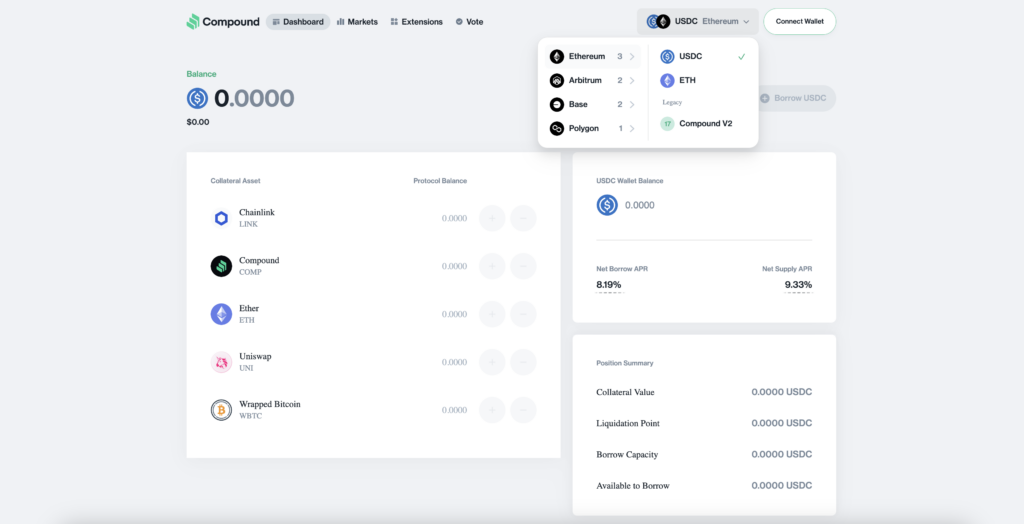
Aave and Compound are two leading DeFi networks that allow for decentralized borrowing and lending. You can earn interest on your crypto holdings by depositing any of the supported coins to their platform.
Uniswap
Uniswap is a leading decentralized exchange that we’ve covered in depth in our “What is Uniswap?” post. By providing liquidity to Uniswap, you can earn interest on your holdings. This comes from the fees that traders pay to use the protocol, part of which is distributed to liquidity providers.
Yearn Finance
Yearn Finance is a yield optimizer for maximizing DeFi returns by automatically switching your holdings between DeFi networks, so you don’t have to manually look for where you can get the most returns at any given moment.
It works by depositing stablecoins, cryptocurrencies that have a constant value, into the Yearn network and receiving Yearn tokens in return. For example, if you deposit the stablecoin DAI to the Yearn network, you receive yDAI in return.
These tokens then start accumulating interest as your deposited funds are constantly moved around to maximize returns. Whenever you wish to cash out, you can just trade your yDAI back to your original DAI stablecoin.
Aside from simply depositing coins to a limited range of lending protocols, Yearn also supplies an advanced service called “Vaults,” which manages the funds with more complex and somewhat riskier strategies.
Vaults are an actively managed deposit. Money placed in vaults can be used for trading, borrowing, or supplying liquidity. Vaults also support a wider variety of coins than the standard Yearn service.
DeFi Downsides
While the DeFi space holds a lot of opportunities to earn interest, it’s not without its downsides.
First, earning interest with DeFi usually works through using specific coins that support the network you’re looking to use. This means that, in some cases, you’ll need to convert your holdings into a different type of coin.
Additionally, decentralized services are usually much less intuitive for the average user and can require that you understand some additional technical jargon. Therefore, we advise using them only after doing extensive research and understanding how the service works completely.
If you’re not sure exactly what you’re doing, you may want to use a centralized service that will allow you the same functionality and yield through an easier interface.
Finally, DeFi is an emerging technology, and just like with any new technology, there is always the risk that there are bugs or flaws in the programming. Millions of dollars have already been lost in DeFi, especially in the early stages, but it is still a somewhat emerging area of cryptocurrency.
The DeFi subreddit maintains a complete list of helpful projects, guides, and resources. You can find a lot of information about DeFi there. You can also post and ask questions. Or browse through and read other users’ questions and the answers they received.
Note: When dealing with any crypto forum (like Reddit), be aware of scammers: anyone messaging you privately or asking you to reveal anything about your seed phrases or private keys.
Getting Started with Earning Interest
By now, you might be totally confused by the endless options available for generating interest on your crypto, and you’re probably asking – how do I choose where to put my money?
Our first guideline here at 99Bitcoins is always “Better safe than sorry.” This means that because crypto is still such a new and exciting but also risky space, we always try to minimize this risk as much as possible.
This means that we won’t lock up an amount we can’t afford to lose or that we need to have available at hand. A good rule of thumb for us is to use 10% of our crypto holdings to generate interest.
Of course, this can change depending on your risk tolerance and overall strategy, but if you’re just starting out, this is a good starting point while you get familiar with the options we covered.
Additionally, it’s always about what currency we’re looking to keep on holding and not how much interest we can make. This means that if we hold BTC, we won’t convert it to another currency in order to generate higher interest. Instead, we’ll look for a service that allows us to generate interest on our BTC.
Important Things to Consider Before Investing
First, take a look at the company or network supplying the service. Perhaps there’s a specific coin that you really like and want to support its network; therefore, staking that coin makes the most sense to you.
Additionally, check to see if the company you’re planning to use is centralized or decentralized. Centralized companies pose the risks of fraud, mismanagement, and theft, while decentralized companies pose technical risks and usually have more complex interfaces that aren’t very beginner-intuitive.
It’s up to you what type of company you prefer, but personally, we believe that simplicity trumps everything else in this case.
Other things to look at are lockup periods, service fees, frequency of interest payouts, minimum lock-up amounts, and, of course, the annual interest rate, either the APR or APY.
Finally, we prefer to lock up funds only in established networks and exchanges that have been running for some time without any major issues. Of course, this usually means a lower interest rate, but as I said earlier, better safe than sorry.
One thing you’ll want to avoid at all costs is crypto HYIPs (high-yield investment programs) and doublers. These are sites that promise unusually high yields or claim to double your coins and pretend to be legit decentralized companies, while in fact, they are just Ponzi schemes in disguise.
If you’re not sure whether or not a company is legit, make sure to take your time when doing your research; never rush into an investment. Ask around in the different community forums and on Reddit. There are several Reddit groups devoted to learning crypto. We linked the DeFi subreddit above. Another good one is Bitcoin Beginners.
Conclusion
As we’ve explored, there are several ways to generate passive income from your crypto holdings, from staking and lending to DeFi and yield farming. Each method has its benefits and risks, but for most investors, exchange-based earn products remain one of the simplest and most accessible entry points.
Among the broader platforms, MEXC stands out as one of the strongest all-around options. It combines flexible yield products, daily payouts, and broad asset support with one of the deepest altcoin selections in the market. It is also especially strong for stablecoin users, with flexible USDT products and competitive yields on coins like ETH, XRP, and TON, while still functioning as a full-featured exchange with low trading fees.
While advanced users may still explore staking directly or DeFi protocols like Uniswap or Yearn Finance, these approaches come with higher complexity and risk. For most people, MEXC offers a strong balance of accessibility, asset coverage, and yield opportunities, making it a sensible choice for anyone who wants to earn and trade crypto confidently in 2026.
FAQs
What is the best way to earn interest on crypto?

The best way is through a crypto savings account with a trusted provider like Nexo. It offers daily payouts, flexible and fixed-term options, and support for 60+ assets.
Is Nexo the best platform to earn interest on Bitcoin?
Yes, Nexo is widely considered the best option because of its security, competitive rates, and all-in-one ecosystem. You can earn interest on Bitcoin without selling it while accessing loans and card services.
Are crypto savings accounts safe?
They are generally safe when using established providers like Nexo that are regulated and transparent. However, as with any centralized service, there is always some counterparty risk.
Can I withdraw my crypto anytime from a savings account?
With Nexo’s flexible savings account, you can withdraw anytime without penalties. Fixed-term accounts offer higher yields but require you to lock up your funds for a set period.
What are the risks of earning interest on crypto?
The main risks include price volatility of your collateral, potential liquidation if using lending, and relying on the provider’s solvency. Always research the platform and never deposit more than you can afford to lose.
References
- Department of Insurance, Securities and Banking. Cryptocurrency Interest-Bearing Accounts. Government of the District of Columbia, 22 Aug. 2022, https://disb.dc.gov/publication/cryptocurrency-interest-bearing-accounts.
- Perkins, David W. Cryptocurrency: The Economics of Money and Selected Policy Issues. Congressional Research Service, 9 Apr. 2020, https://www.congress.gov/crs-product/R45427.
- Azar, Pablo D., et al. The Financial Stability Implications of Digital Assets. Economic Policy Review, vol. 30, no. 2, Federal Reserve Bank of New York, Nov. 2024, https://www.newyorkfed.org/medialibrary/media/research/epr/2024/EPR_2024_digital-assets_azar.pdf
- Library of Congress. Cryptocurrency & Blockchain. Fintech in the 21st Century, Library of Congress, https://guides.loc.gov/fintech/21st-century/cryptocurrency-blockchain

Why you can trust 99Bitcoins
Established in 2013, 99Bitcoin’s team members have been crypto experts since Bitcoin’s Early days.
Weekly Research
100k+Monthly readers
Expert contributors
2000+Crypto Projects Reviewed