







In This Article
SafeMoon gained popularity during the 2021 bull run, but ended up in a saga of volatility, leadership changes, technical migrations, and then legal scrutiny. Our deep dive guide details the history of SafeMoon, the launch of SafeMoon V2, and the roles of its various founders and executives.
We also discuss the newer (Solana-based) SafeMoon token, launched by the community, and its role within the SafeMoon story.
Let’s begin with a brief overview before exploring SafeMoon in more detail.
Key Takeaways
- SafeMoon rose to fame in 2021 but later collapsed amid fraud allegations and leadership scandals.
- The project’s tokenomics taxed transactions and rewarded holders through a mechanism called Reflections.
- SafeMoon V2 reduced the max supply by 1,000-to-1 but kept key flaws that allowed access to liquidity pool funds.
- Two former executives have been convicted of fraud, while the founder remains a fugitive.
- A new Solana-based SafeMoon token now trades as a community-run memecoin with low liquidity and high risk.
SafeMoon at a Glance
The SafeMoon cryptocurrency project refers to both the crypto token and the project team that developed and launched it. The SafeMoon token itself launched on March 8, 2021, on the Binance Smart Chain. The development team then incorporated the project as SafeMoon, LLC. on March 18, 2021.
The SafeMoon token was marketed as a protocol that would incentivize long-term holding due to the token’s unique tokenomics (supply and distribution structure). SafeMoon initially launched under the ticker SAFEMOON (V1), later switching to SFM (V2) in December 2021.
SafeMoon V1 employed a multi-tiered approach to manage supply/demand dynamics, incorporating a 10% tax on transfers built into the token’s smart contract. This 10% tax was then split, with half going back to SafeMoon holders as passive income balance adjustments called “Reflections.”
The other half was to fund a decentralized exchange liquidity pool (LP), which would support the token’s price. SafeMoon also manually burned tokens periodically to promote scarcity by sending tokens to an unrecoverable wallet address.
V2 of the SafeMoon protocol centered on an updated token (SFM), which reduced the supply by a factor of 1,000 and reduced transaction fees. In both cases, V1 and V2, the contract allowed admins to reappropriate funds intended for building the LP position.
SafeMoon launched the SafeMoon Wallet as a tailored way to store SafeMoon tokens and for holders to track reflections. The app offered real-time updates and a non-custodial method for storing SafeMoon tokens. SafeMoon Wallet also provided a tool for V1 holders to migrate their holdings to V2.
The original company, SafeMoon LLC, filed for Chapter 7 bankruptcy in December 2023. In 2025, SafeMoon’s former CEO was convicted of conspiracy to commit fraud.
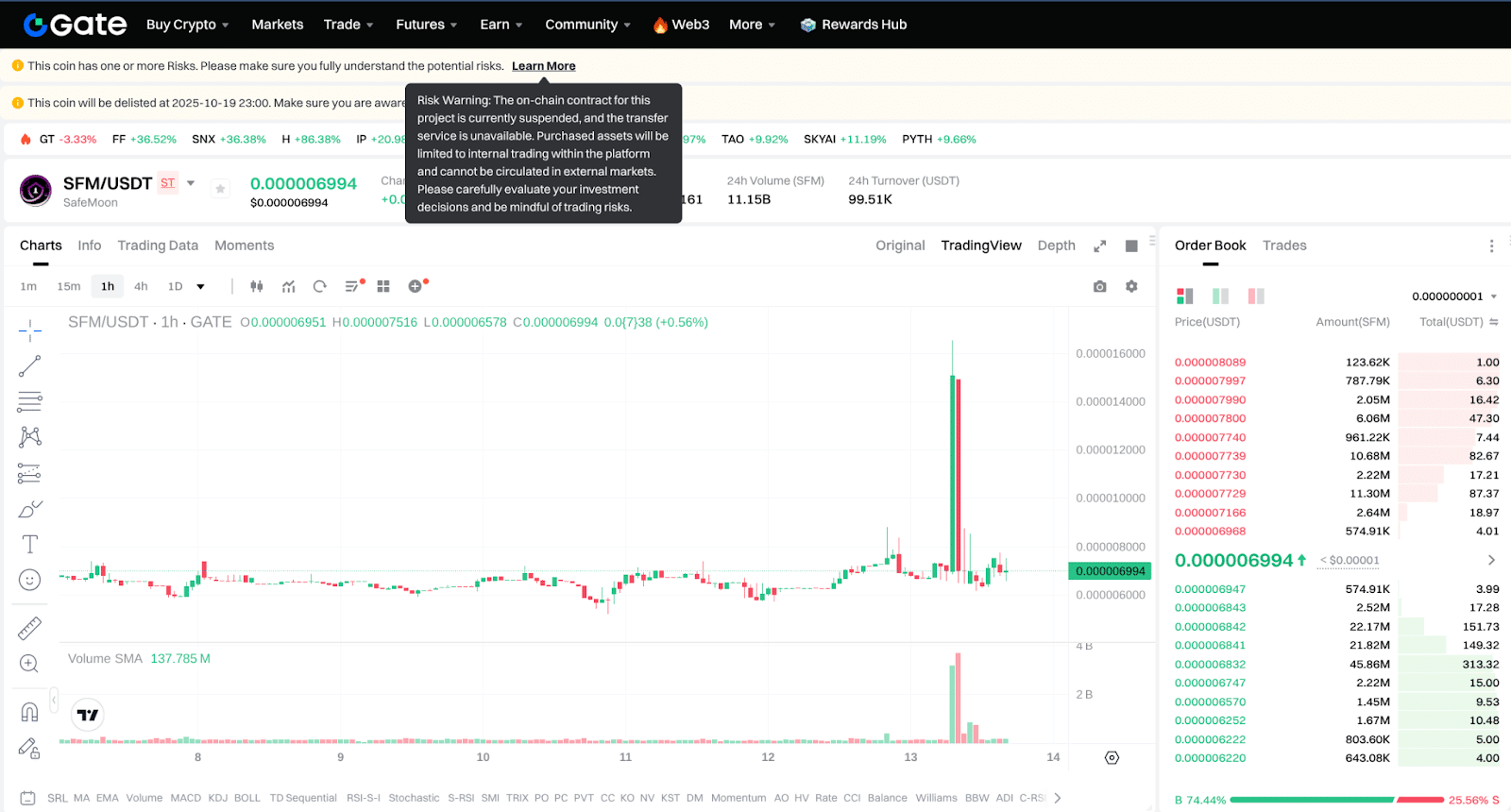
The token now exists in two forms: the legacy SFM V2 token (on BSC) and a new, highly speculative, community-governed memecoin on the Solana blockchain. Both versions trade with low liquidity and carry a risk of total loss. Gate.io delisted the token in October 2025, and the smart contract that allowed V2 token holders to convert to the newer Solana-based token has been suspended.
What Is SafeMoon?
Technically, SafeMoon, in all its versions, is a cryptocurrency token rather than a coin. This distinction arises because SafeMoon has never operated on its own blockchain, despite publicly stated plans to launch its own chain.
The token was a fork of the $BEE token, which implemented a transaction tax in its smart contract and reallocated those tax funds to liquidity pools and holder rewards. However, SafeMoon achieved much larger notoriety in the space, reaching a $5.7 billion market cap at its peak in 2021, according to court documents.
The core idea of the token centered on tokenomics that incentivized holding rather than trading. The SafeMoon transaction tax (10%) was automatically applied to every transaction, with a portion of the proceeds effectively paying a yield to holders in payments called Reflections. Another portion of the collected tax was allocated to fund a liquidity pool, designed to absorb downward price pressure as the pool grew. However, converting a portion of the tax (paid in SFM) to BNB to fund both sides of the pool also created constant sell pressure.
SafeMoon’s tax differentiated the token from typical ERC-20 and BNB-based tokens because most did not utilize a tax. Although the tax-and-redistribute mechanism of SafeMoon wasn’t novel, it was uncommon, and SafeMoon’s notably high tax set it apart. The token gained traction during the 2021 bull run due to its compelling tokenomics.
The final aspect of the tokenomics focused on token burns. Burning refers to sending tokens to an unrecoverable wallet address on the blockchain. As no one has the private keys for this wallet, the tokens are unusable.
The majority of these burned tokens were sent to one address on the BNB Chain: 0x0000000000000000000000000000000000000001
Burning began before launch. Although the V1 token had a minted supply of 1 quadrillion tokens, developers burned 223 trillion tokens before launch, leaving a fair launch supply of 777 trillion tokens. The eight-page SafeMoon whitepaper details the initial supply as well as the rewards mechanism.
SafeMoon V2
Several months after the launch of V1, SafeMoon launched its V2 token. The new token was designed to address two key challenges of the existing token contract: a massive supply and high gas fees associated with the token contract’s complexity.
In December 2021, SafeMoon V2 promised to address these challenges and rebrand to quell concerns over security risks discovered by CertiK in a May 2021 token audit. CertiK’s audit revealed that the function used to automatically add liquidity sent the LP tokens (representing ownership) to the contract’s owner () address, which made these LP tokens accessible to developers.
SafeMoon V2 also introduced a migration mechanism. Holders could use the SafeMoon Wallet to convert their V1 holdings to V2 at a 1000 to 1 ratio. This would reduce the overall supply dramatically as more users migrated to V2. If a user held 1 million V1 tokens, their wallet balance would show 1,000 V2 tokens after migration.
The V2 token can be distinguished from the V1 token by its contract address:
- V1 Token Contract Address: 0x8076C74C5e3F5852037F31Ff0093Eeb8c8ADd8D3
- V2 Token Contract Address: 0x42981d0bfbAf196529376EE702F2a9Eb9092fcB5
Users should not rely on ticker symbols to differentiate between tokens, as ticker symbols do not need to be unique.
V2 utilized the same tax structure as V1, simplifying the contract code to reduce gas fees and reducing the supply as migrations occurred. The new token addressed concerns over the massive number of tokens. However, the new contract still sent LP tokens to the contract’s owner () address, the same flaw identified by Certik. Federal charges that led to a conviction allege that executives at SafeMoon used this flaw to steal millions of dollars from the liquidity pool. We’ll discuss the charges in more detail later in the guide.
Notably, the V2 migration window is now closed. A newer token on the Solana chain also offered conversions from V2 to the new Solana-based token. This window closed as well on April 10, 2025, although the Solana token continues as a memecoin with community governance. We’ll discuss the Solana-based SafeMoon token in a later section as well.
SafeMoon Price and Chart
SafeMoon V1 and V2 no longer trade with any meaningful volume on any exchanges. At the time of writing, Gate.io offered trading for SFM, although with the caveat that the trading pair would be suspended within days. The Solana-based token trades on decentralized exchanges (DEXs), including Raydium, which offers the largest amount of liquidity.
The new Solana-based SafeMoon token addresses the LP concerns that plagued the BSC-based tokens and ultimately led to the downfall of the original project. Approximately 98% of the token’s liquidity has been locked by burning the associated LP tokens, as confirmed by Dexscreener data and third-party data providers like RugCheck.
The new Solana token utilizes the following contract address.
$SFM (Solana Chain): ELPrcU7qRV3DUz8AP6siTE7GkR3gkkBvGmgBRiLnC19Y
Traders can research the chart for the new token on DEX screening tools such as Dexscreener or GeckoTerminal. Traders can also find a simple SFM chart on Raydium, where the primary liquidity is held.
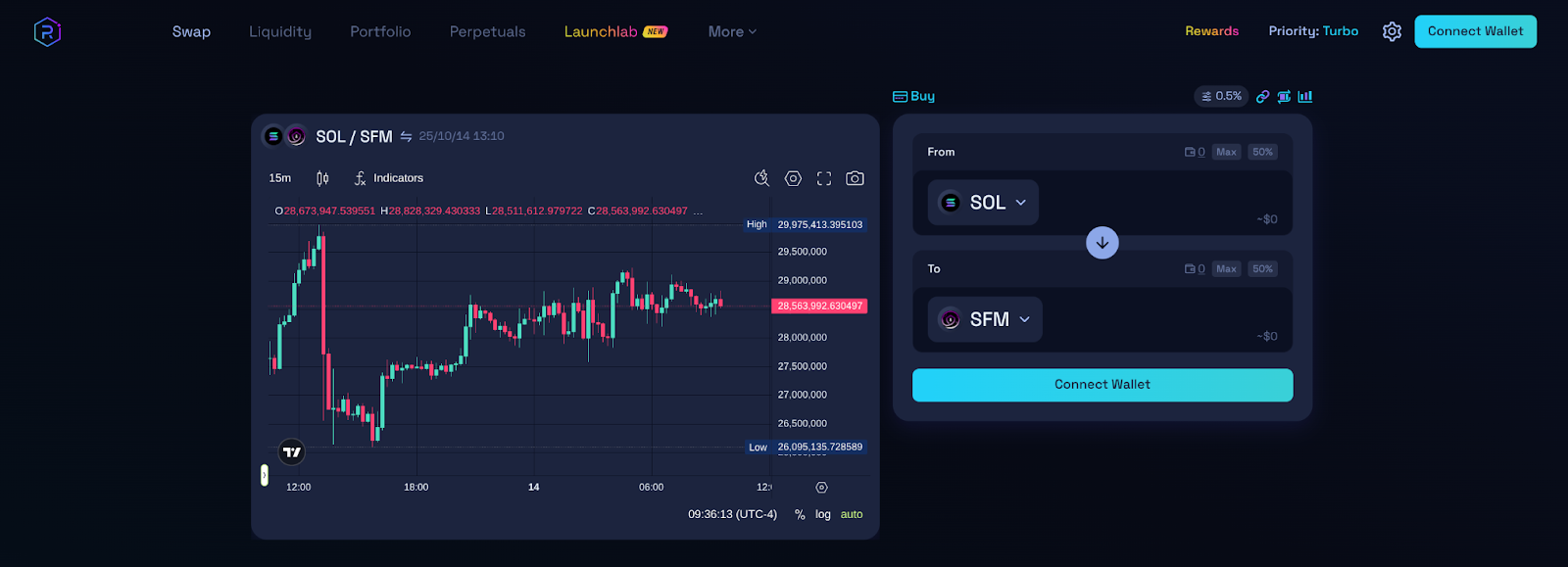
CoinGecko currently displays the chart for the legacy v2 token. However, a (now ended) migration period to convert V2 tokens to the newer Solana token provided price parity between the new and V2 tokens.
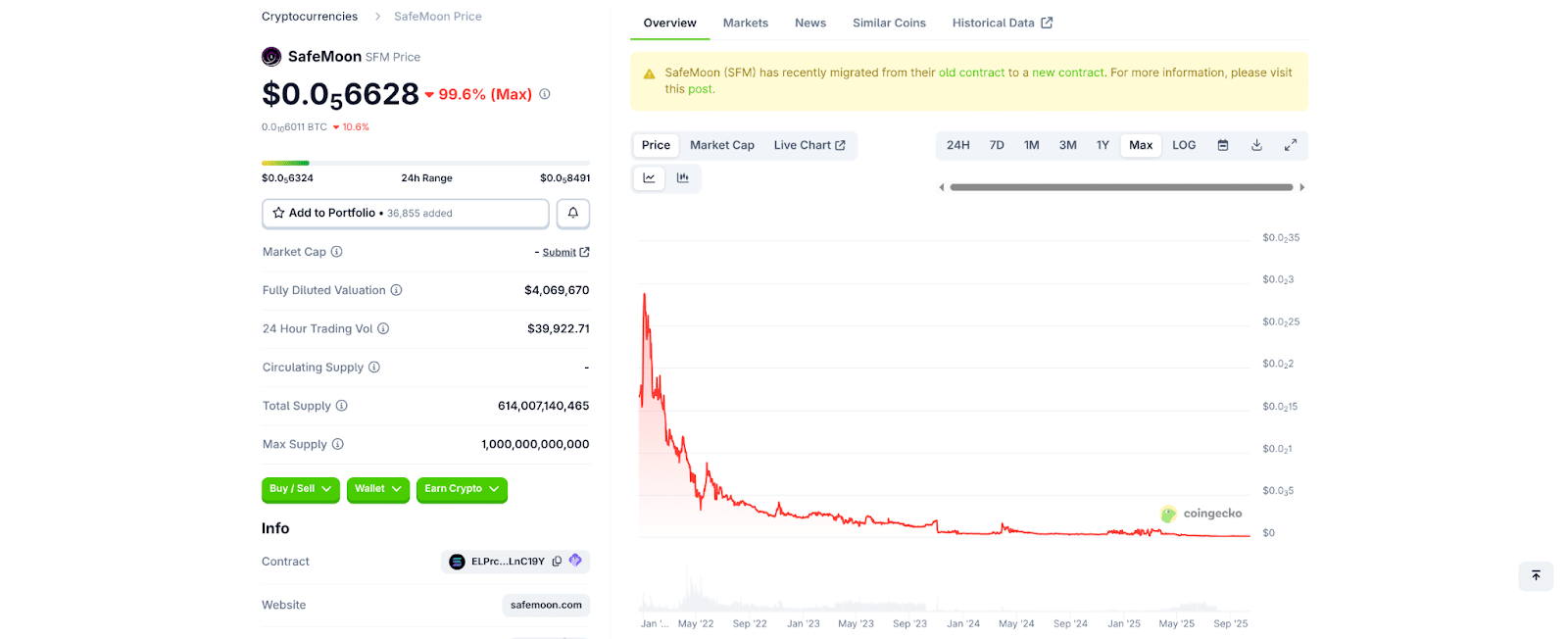
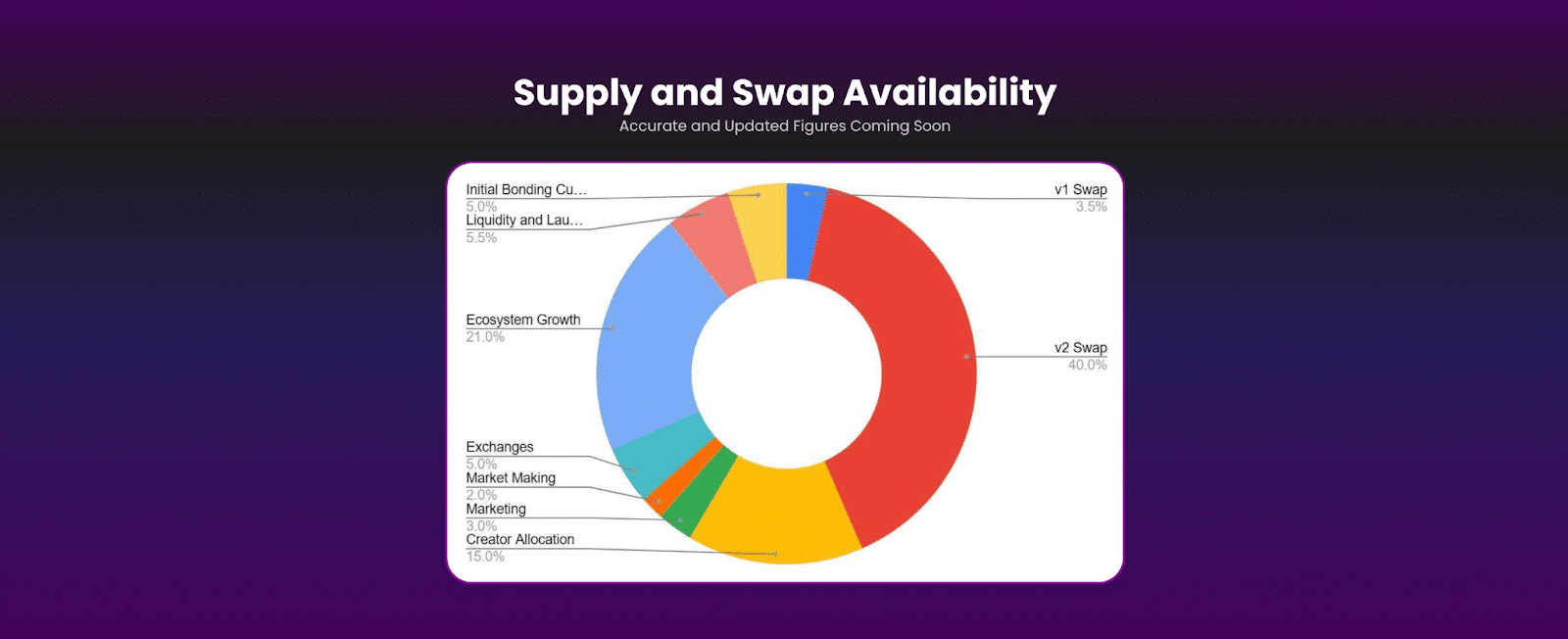
Traders considering trading $SFM should confirm the contract address and the current liquidity. As of this writing, an $82,000 liquidity pool supports a $2.5 million market capitalization for the $SFM token on the Raydium decentralized exchange. Fully diluted value currently tops $6.4 million, with additional tokens held in allocations for later use.
With trading now centered on DEXs, pricing can become more volatile. Centralized exchanges use an order book, which is a list of buy and sell orders. By contrast, DEXs use an automated market maker that manages the price based on the mix of tokens in the liquidity pool. This structure ensures that trading supply is always available within the pool’s price range. However, prices can change dramatically in response to sizable buys or sells against the pool.
For traders, this also means that slippage may be high, and DEX swaps may execute at a significantly higher or lower price than expected.
The launch of the community-driven memecoin on Solana changes the trading dynamics of SafeMoon. Unlike the higher-profile BSC token, which traded based on announcements and news, the newer token draws on community support, using a Telegram channel as a hub for SafeMoon holders.
Any long-term price projections should consider the fully-diluted value, which accounts for a one trillion token supply rather than the 614 billion tokens currently circulating.
How to Read a SafeMoon Chart
DEX tools like Dexscreener and GeckoTerminal offer charts and a variety of technical indicators. Learning how to use these indicators together can help guide your trading decisions. Some of the simplest indicators center on likely reversals. In the chart below, the Relative Strength Index (RSI) showed several points at which the token was oversold (buy signal) or overbought (sell signal).
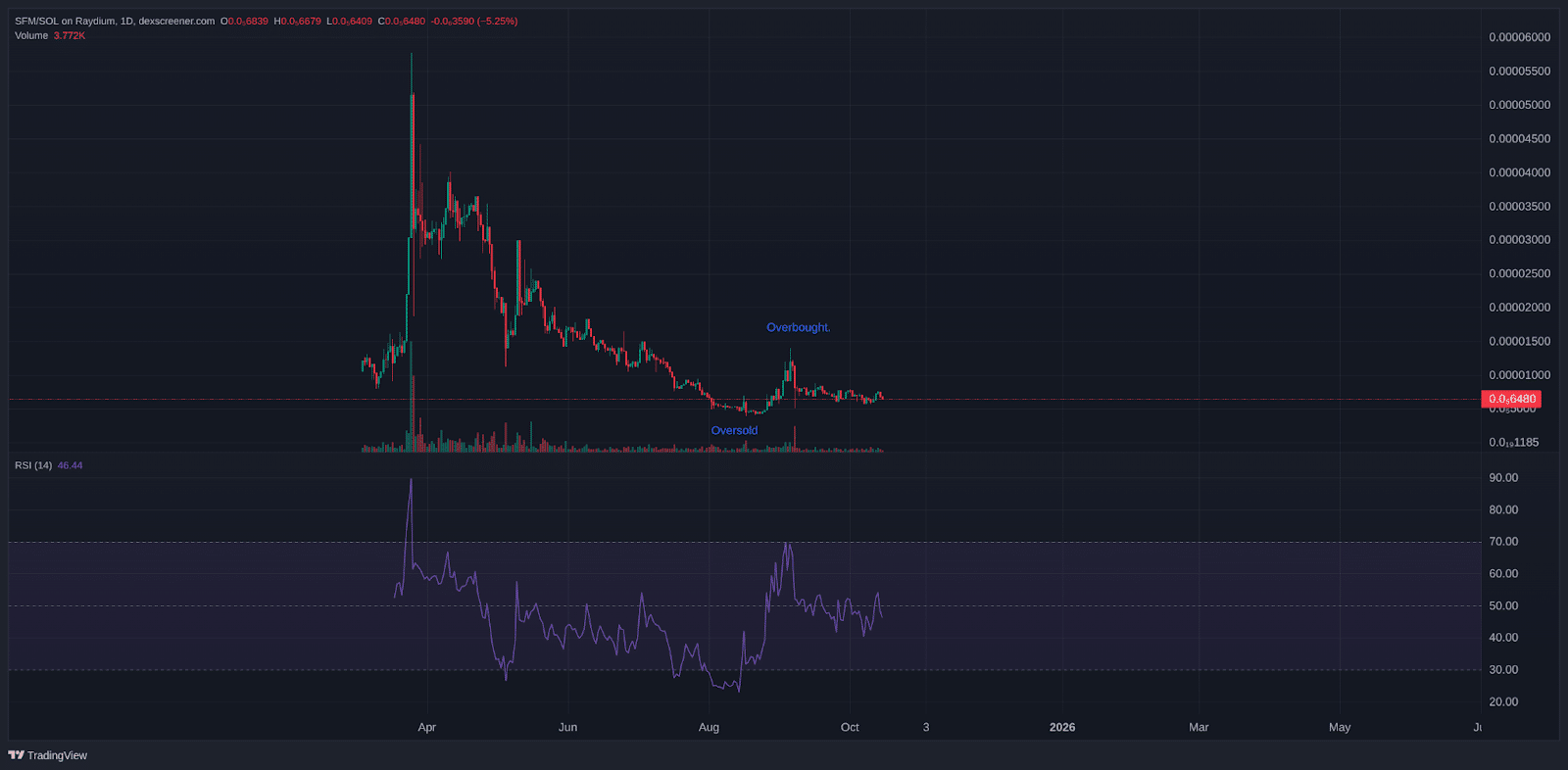
It’s often best to weigh signals against each other for confirmation. For example, volume can illustrate market conviction (or lack thereof), and MACD (moving average convergence divergence) can help you time reversal-based trades.
Other key metrics to consider include the amount of locked liquidity, market capitalization (MC), and fully diluted market capitalization (FDV).
How to Buy SafeMoon
Although the V1 and V2 tokens are now defunct, the Solana-based SafeMoon memecoin may be attractive to some traders and investors. In this section, we’ll discuss how to buy and store the Solana-based token.
To get started, you’ll need a Solana-compatible wallet that supports WalletConnect. In this example, we’ll use the Best Wallet app, which supports a wide range of blockchains and enables connections to the Raydium decentralized exchange via WalletConnect.
Download a Solana-compatible wallet application to follow along with the step-by-step instructions below. We’ll use the Best Wallet mobile app in the example below.
1) Fund Your Wallet
Many wallet applications, such as Best Wallet, enable in-app purchases, allowing you to buy SOL or other leading cryptocurrencies without leaving the wallet app. To buy SFM, we’ll need to fund the wallet with SOL.
In the Best Wallet app, click Trade and then Buy to purchase SOL with traditional currencies like USD. Follow the in-app instructions to complete your purchase.
2) Visit Raydium to Swap
When you buy on a decentralized exchange like Raydium, you’re swapping one asset for another. Let’s connect to the Raydium decentralized app (dApp) to swap SOL for SFM.
Open Raydium.io in a browser window, then select your wallet from the available options if it’s listed. We’re using Best Wallet, so we’ll choose WalletConnect, which brings up a list of compatible wallet apps installed on the device. Select Best Wallet and click Connect.
3) Select Your Pair
Choose SOL for the first asset. This is what you’re trading for the second asset (SFM). To select SFM, the safest method is to use the contract address, which serves as a unique identifier on the blockchain.
Contract Address: ELPrcU7qRV3DUz8AP6siTE7GkR3gkkBvGmgBRiLnC19Y
Paste the contract address above to select SFM as the second token in the pair.
4) Choose a Purchase Amount
Choose a purchase amount in SOL or SFM. Raydium also displays the value in your preferred currency, such as USD. Watch for indicators that suggest high slippage. These are typically highlighted in red or orange.
5) Complete Your Swap
Confirm the transaction amounts and adjust the gas fee if needed. If everything looks correct, complete your swap.
Best Wallet and similar Solana wallets will secure your Solana-based assets on the blockchain. However, with non-custodial wallets such as those described above, the user is responsible for safely storing their wallet backup.
Note: In some cases, you may need to manually add the token to your wallet to enable viewing the asset. Look for a setting to add tokens and use the network (Solana) and contract address to add the token.
Security checklist
Before using any decentralized app, use a checklist to ensure best practices for safety.
- Verify the URL: Always ensure you’re on the correct app by checking the URL in the address bar. Be particularly skeptical of links found on social media sites.
- Verify the Contract Address: When trading on DEXs, the contract address ensures you’re swapping the correct asset.
- Check Audits: Many tokens are listed on DEX platforms like Dexscreener or GeckoTerminal. Look for third-party automated audits. These can indicate risky token features, such as the ability to mint more tokens or blacklist specific wallet addresses.
- Check Gas Prices: Transactions on blockchain networks can become costlier as activity increases. Note the gas fee before making a transaction.
What is the SafeMoon Wallet?
Although now defunct, the original SafeMoon project launched a wallet app that allowed users to store SFM and monitor their earnings (Reflections) from the protocol.

Following the bankruptcy of SafeMoon LLC, the VGX Foundation purchased several of the SafeMoon assets. This purchase included the SafeMoon Wallet, which the VGX Foundation renamed to VGX Wallet and re-engineered to support the new Solana token ecosystem. However, the VGX Wallet’s general-purpose use case makes it similar to a wide range of competing multi-chain wallets, including Trust Wallet, Phantom, Best Wallet, and others.
Leadership and Founders
In the following sections, we’ll delve deeper into SafeMoon’s history and explore what happened to SafeMoon before its relaunch as a memecoin on Solana.
Kyle Nagy initially founded the project, but the team quickly grew to include John Karony (CEO) and Thomas Smith, who took on a technical role. All three were later federally indicted for fraud.
- John Karony – SafeMoon: (Braden) John Karony, also called Captain HODL, became the public face of SafeMoon and controlled both SafeMoon LLC and SafeMoon US LLC. Karony’s era spanned the project’s entire lifespan, from 2021 (post-launch) to its 2023 bankruptcy.
- Thomas Smith – SafeMoon: As CTO for SafeMoon, Thomas Smith (“Papa”) was responsible for the technical aspects of the project, including assurances of the smart contract’s safety. Smith left the project after about a year. In the following months, fraud allegations from independent blockchain researchers, including Stephen Findeisen (Coffeezilla), highlighted blockchain evidence that led to federal indictments of Karony and Smith.
- Kyle Nagy – SafeMoon: Nagy was the low-profile SafeMoon founder, recruiting Karony and Smith around the time of the project’s launch. Kyle Nagy also authored the whitepaper, which described the project’s tokenomics. Although Kyle Nagy was indicted alongside Karony and Smith, he remains at large and has never been tried for his alleged crimes in connection with SafeMoon.
What Happened to SafeMoon?
The SafeMoon saga began with meteoric success, followed by accusations of fraud, eventually ending with the indictment of three of the project’s key personalities and the bankruptcy of the SafeMoon company.
Launched in March 2021, during the crypto bull market, SafeMoon became a social media phenomenon, leveraging platforms like TikTok and Reddit. Celebrities, including Jake Paul, Soulja Boy, Lil Yachty, and Nick Carter, heavily promoted the project. This influencer-driven hype drove the token to its $5.7 billion all-time high market capitalization.
The team made several bold promises, including transitioning to a SafeMoon blockchain rather than a token on the Binance Chain. The blockchain dream served as the cornerstone of a proposed larger plan, which the team referred to as “Operation Pheonix,” intentionally mispelled. Ambitious plans included an infrastructure for the Internet of Things (IoT). Other promises that never came to be included a SafeMoon crypto exchange and the SafeMoon debit card. These promises, paired with bull-market euphoria, helped build the project’s sky-high valuation.
However, a CertiK audit early in the project’s timeline highlighted a risk related to how the token contract allocated LP tokens. These LP tokens were accessible to the team. This would prove to be the project’s downfall, as it allowed the team access to funds the community believed to be securely locked.
Within less than a year, SafeMoon pivoted to V2, which reduced the supply of tokens by a factor of 1,000 and addressed some code inefficiencies that led to high transaction costs. The SafeMoon Wallet release in 2021 served as the center point for the migration to V2. SafeMoon V2 did not address the security concern highlighted by the CertiK audit.
SafeMoon delivered on a small handful of its promises, such as the launch of V2, the SafeMoon Wallet, and listings on several centralized crypto exchanges, including Gate.io and BitMart. However, many of the other promises made by company executives occurred amid a backdrop of uncertainty about the token’s liquidity pool.
On April 20, 2021, SafeMoon’s price fell by nearly 50% as investors discovered the LP funds were not secure. This selloff marked a pivotal change in price direction.
Controversies, Lawsuits, and Trials
Fraud allegations decimated the SafeMoon project, despite efforts by SafeMoon execs to assure investors and stimulate trading activity. Although April 20, 2021, marked the beginning of the end for the project, the SafeMoon legal saga continued into 2023 and beyond, with two convictions occurring by 2025. This section reviews key controversies, lawsuits, and criminal trials that resulted from SafeMoon execs’ alleged actions.
SafeMoon Lawsuit Overview
The SafeMoon project faced several waves of litigation, ranging from private investor claims to federal crackdowns by the U.S. government. The company, its execs, and influencers who promoted the project all became targets of class action lawsuits, and in some cases, criminal charges. Allegations centered on evidence that suggested SafeMoon was a pump-and-dump scheme, with execs withdrawing funds intended for the LP. A separate civil action from the U.S. Securities and Exchange Commission (SEC) accused SafeMoon of selling unregistered securities and engaging in price manipulation tactics, such as wash trading.
Nature of Claims and Defenses in Public Filings
Criminal charges brought by the U.S. Department of Justice (DOJ) centered on conspiracy to commit securities fraud, wire fraud, and money laundering. The cases alleged that executives misled investors by promising that the Liquidity Pool (LP) was “locked” and that execs could not access the funds. The cases further alleged that the executives retained administrative access to the LP funds and used this access to misappropriate over $200 million. The defense, which failed at trial for CEO John Karony, argued that the funds were used legitimately for corporate expenses or were not subject to securities laws.
Thomas Smith, former CTO, had already pleaded guilty to similar charges in 2025 and assisted investigators. Three executives in total were indicted.
SafeMoon Trial Status and Key Dates
Criminal trials related to the company execs’ actions resulted in two convictions.
- Thomas Smith (CTO) pleaded guilty to federal charges in February 2025 and is cooperating with the government’s ongoing efforts.
- CEO Braden John Karony (CEO) was convicted in May 2025 on all counts (securities fraud, wire fraud, and money laundering) following a jury trial.
- Kyle Nagy (Founder) was indicted alongside the others but remains a fugitive.
The original entity, SafeMoon US LLC, filed for Chapter 7 bankruptcy in December 2023. Two parties purchased the company’s assets, including the VGX Foundation, which subsequently launched the Solana-based SFM token.
Allegations Commonly Cited by Critics
SafeMoon fell under suspicion as independent blockchain researchers, including Stephen Findeisen (Coffeezilla), discovered on-chain evidence of withdrawals from the LP to wallets associated with the team. Critics of the project alleged a “Rug Pull,” referring to a crypto scam in which the developers suddenly withdraw support for the project. Other allegations described the project as a Ponzi scheme due to investors earning a yield based (in part) on the tax on purchases made by newer investors.
Throughout the controversy, company execs assured investors that the LP was sound and the assets locked.
SafeMoon’s Current Status: Is SafeMoon Dead?
The original SafeMoon project is dead for all practical purposes. Two of the three executives were found guilty of fraud-related crimes, and a third remains at large. The SafeMoon company’s assets were sold during the bankruptcy process.
However, some remnants of the project remain.
- Some of the V2 (and perhaps V1) tokens remain in circulation, although trading has become increasingly difficult.
- The SafeMoon Solana-based token shares the same name, and the project markets itself as a community-governed memecoin that doesn’t make promises. The VGX Foundation, which launched the memecoin, also owns several web properties formerly owned by SafeMoon, LLC, including the X account and the SafeMoon.com domain.
- The VGX Wallet launched by the new project is based on the original SafeMoon Wallet.
Current holders of the legacy token have little recourse at this juncture because the company is in Chapter 7 bankruptcy (closure and liquidation). However, several ongoing class-action lawsuits seek recovery through celebrities and social media influencers who promoted the project. The next section details several endorsements that became the basis for the class-action suits. In September 2025, the FBI launched an appeal for Safemoon victims to come forward.
SafeMoon Boxing, Celebrities, and Media Moments
SafeMoon moved into the spotlight soon after launch, quickly becoming one of the most searched tokens on crypto data websites like CoinGecko and CoinMarketCap. Among the highest-profile events, the Triller Fight Club PPV fight in April 2021 showcased the newly minted token’s logo as fans tuned in to watch Jake Paul (YouTuber and boxer) in the major boxing event.
Other celebrities and influencers to promote SafeMoon included Nick Carter (musician), Soulja Boy (rapper), and Ben Phillips (social media personality).
Everyone needs #SAFEMOON or this will be you 📈 pic.twitter.com/r9DCQG0pmQ
— Jake Paul (@jakepaul) March 27, 2021
These notable personalities were later cited in class-action lawsuits. However, the initial reaction resulted in a token price surge as investors and speculators rushed to buy SafeMoon. This surge in demand pushed the token to all-time highs in a parabolic chart move.
The magnitude of the price crash in April 2021 demonstrated how much of the price runup was due to celebrity endorsements and highlighted the fragility of SafeMoon’s price support. Several class-action lawsuits sought recovery for investors, including a high-profile suit that named several celebrity defendants alongside company executives.
The event also served as a reminder of crypto’s volatility, particularly as influencers join the fray, and the importance of choosing long-term investments based on provable utility compared to hype.
How to Store and Manage SafeMoon
The original V1 and V2 tokens may be of questionable value given a lack of trading liquidity. However, investors in the newer Solana-based token have several viable storage options. A crypto wallet holds the private keys that control digital assets on the blockchain. A non-custodial crypto wallet gives the user control over the wallet’s private keys.
By contrast, a custodial wallet, such as a crypto exchange wallet, provides the custodian with control over the wallet’s private keys. This section discusses options for self-custody storage and best practices for managing SafeMoon and other crypto assets.
Generally, crypto wallets come in two types.
- Hot wallets refer to software apps that store the wallet’s private keys on a device that’s connected to the internet.
- Cold wallets store the wallet’s private keys offline, typically on a hardware device that works with a companion app or hot wallet. When the keys are not needed for signing, they remain safe from online threats.
Cold wallets are considered to be safer because they store the keys offline, although they are often less convenient to use.
When choosing a wallet, ensure it supports the crypto networks you need to use. For example, you’ll need a Solana-compatible wallet to store the new Solana-based SafeMoon memecoin. However, the legacy (V1 and V2) tokens required a BNB Smart Chain (BSC) wallet. Check out our article on the Best Crypto Wallets to find one that suits your needs.
Best Practices for Token Management
When managing SFM or other assets, always follow best practices for safety.
- Diversify Storage (Hot vs. Cold): Never keep all assets in one wallet. Hardware wallets (cold storage) are strongly recommended for long-term savings and larger balances, while hot wallets (like Best Wallet or Phantom) should only be used for active trading and smaller amounts.
- Secure Your Seed Phrase: The recovery phrase (seed phrase) is the master key. Store this phrase offline and safeguard it against analog threats, such as fires, floods, or theft.
- Network Fees and Bridging Cautions: When swapping SFM on a DEX like Raydium, always confirm the gas fee (paid in SOL on the Solana chain) before executing the trade. Beware of any apps offering to bridge SafeMoon assets. We are not aware of any operational migration tools at this time. Don’t fall for a SafeMoon scam.
- Verify Transactions on Explorers: Before confirming any transaction, verify the recipient address and the contract address. You can also use DEX aggregators like GeckoTerminal to research locked liquidity and token contract red flags detected by automated scanners. After a transaction, use a blockchain explorer (like Solscan) to confirm the transaction details. Consider making small transactions before attempting a larger transaction.
Tax and Record Keeping Basics
Reflections and similar crypto yields are generally treated as taxable ordinary income at the time they are received. Specialized crypto tax software (like Koinly or CoinTracker) can help accurately track increases in token balances (Reflections) or other yields. These apps can also help you track and report capital gains or losses. Keep careful records of purchase and sales prices, as this information may be missing from blockchain records used by crypto tax apps.
SafeMoon Risk Factors
The SafeMoon token contract still exists, although for all intents and purposes, the contracts for both V1 and V2 are essentially defunct. Similarly, the team and company are no longer active in the project. However, the SafeMoon project did highlight several risk factors for investors to watch for in other projects or to be aware of when interacting with the still-existing SafeMoon contracts.
Smart Contract Risk
The SafeMoon token is fundamentally flawed due to two major security issues:
- Centralization Risks: The original V1/V2 contract retained the flaw that gave administrators access to the LP tokens.
- External Exploits: The SafeMoon token contract suffered an $8.9 million hack in March 2023 due to a vulnerability in the code’s burn function. This token’s code, even in V2, still bears risks. These risks cannot be fixed in the existing contract.
Liquidity and Exchange Risk
Current holders of V1 and V2 tokens will face significant difficulties in trading. Centralized exchanges no longer support trading for the BSC SFM token. While it may be possible to find the token in a decentralized exchange, liquidity is likely poor, leading to extremely high slippage. Additionally, several scam tokens and dubious projects bearing the SFM ticker and logo have emerged since SafeMoon’s implosion. Traders should verify the contract address for SFM or any other tokens they wish to trade.
Regulatory and Legal Risk
The SEC and DOJ have already weighed in on the legality of SafeMoon’s structure as launched under V1 and V2. The token’s structure as an unregulated security weighs on its value and that of similarly structured tokens.
Team and Governance Risk
Crypto project leads often consist of unvetted or unproven developers and leadership teams. In SafeMoon’s case, two of the three indicted executives were found guilty or pleaded guilty to charges. The whereabouts of the third indicted executive remains unknown. As the SafeMoon assets were purchased by VGX Foundation, new investors in the Solana-based SafeMoon memecoin should investigate VGX’s track record and management team before investing.
Market Structure and Fee Model Risk
Although overlooked in the bull-market exuberance, SafeMoon’s tax on all transactions created a strong headwind for investors. A 10% tax on purchases, transfers, and sales makes the token uncompetitive for use as a currency and reduces trade profitability by 10% on each end of the transaction. While buying and selling taxes on tokens have become more common on memecoins, traders should factor these costs into trading decisions.
SafeMoon Alternatives to Research
While SafeMoon V1 and V2 are effectively defunct, other tokens use a similar structure. Investors can also choose from standard L1 and L2 coins or other investments that provide portfolio exposure to the crypto space.
- Tokens with Reflection Mechanics: Other projects that use similar Reflections to increase holder balances include RFI, ECG, MINIDOGE, and TIKI. Before investing in any of these or other similar projects, research the team, token audits, and liquidity.
- Standard L1 and L2 Ecosystem Coins: Layer 1 coins like SOL, ETH, or BNB offer portfolio exposure to the crypto space with the comparative safety of investing in an established protocol with transparent metrics. Investors can also research Layer 2 coins, such as ARB, or even Layer 3 coins, such as DEGEN.
- Stable Strategies: Investors can also consider a diversified portfolio of blue-chip cryptocurrencies. These might include well-established assets like BTC and ETH, or an expanded portfolio that includes decentralized finance (DeFi) assets or utility coins like Chainlink (LINK), Uniswap (UNI), Aave (AAVE), or Compound (COMP).
Check out our article on the Best Cryptocurrencies with the Most Potential if you are looking for some solid Safemoon alternatives.
SafeMoon Resources and Research Workflow
When researching SafeMoon or other cryptocurrencies, following a vetted workflow can help you stay on track and filter out the noise.
- Official Channels and Contract Verification: Safemoon.com, safemoon.meme, and the @safemoon X account all refer to the Solana-based SafeMoon memecoin. Be wary of similar names, particularly ones that offer a token migration. These are likely scams or unrelated projects. Also, verify the contract address before buying any cryptocurrency. Tickers like $SFM can be used with any token.
- Community Forums and Developer Updates: The Solana-based SafeMoon token offers a Telegram group where users can interact or ask questions. Always verify information independently and avoid using links provided in forums. The new token is community-governed, so check the DAO proposals for information on proposed updates.
- Cross-check “SafeMoon news” Items: Don’t trust, verify. Information on SafeMoon or any crypto project may be miscommunicated, misunderstood, or deliberately misleading. Look for additional sources, and if possible, look for blockchain-based proof. Weigh the information and sources carefully.
- Red Flag Checklist for Trading: Use third-party auditing tools (often found on DEX aggregators) to complete a checklist before trading SafeMoon or other DEX tokens. Top red flags include the following:
- Contract not renounced
- LP not locked
- LP lock expiring soon
- Mintable tokens
- Address Blacklist
- High transaction taxes
- Thin liquidity
FAQs
What is SafeMoon?

SafeMoon refers to a highly controversial crypto project that gained viral popularity in 2021. The token originally launched on the Binance Smart Chain (BSC). Its core feature included a mandatory 10% tax on every transaction that was split to pay rewards (Reflections) to existing holders and fund a liquidity pool (LP). The token’s popularity drove its market capitalization to a peak exceeding $5.7 billion in April 2021. However, the SafeMoon company is now defunct.
How to buy SafeMoon?
Investors can buy the Solana-based memecoin that replaced the original SafeMoon token using a decentralized exchange (DEX) on the Solana network, such as Raydium. The correct contract address for the new token is: ELPrcU7qRV3DUz8AP6siTE7GkR3gkkBvGmgBRiLnC19Y. Connect your crypto wallet and use the DEX to swap SOL for $SFM.
What happened to SafeMoon?
SafeMoon collapsed due to alleged fraud and pump-and-dump allegations. The pivotal point was April 20, 2021, when public analysis revealed that the liquidity pool (LP) was not locked, leading to a nearly 50% price crash. The project’s executives subsequently faced charges for fraud, and SafeMoon filed for Chapter 7 bankruptcy in December 2023. The VGX Foundations later acquired the project’s intellectual property, relaunching SafeMoon as a community-governed memecoin on the Solana chain.
Is SafeMoon dead?
The original SafeMoon project is dead for all practical and legal purposes. The company (SafeMoon LLC) is defunct, and its assets were liquidated in Chapter 7 bankruptcy. The original leadership is gone, with two members convicted of crimes related to the project. However, the $SFM token is technically still active on the Solana blockchain as a new, community-governed memecoin.
SafeMoon V2 explained
SafeMoon V2 was a relaunch of the SafeMoon token designed to reduce the token supply by a factor of 1,000 and reduce gas fees associated with transactions. The SafeMoon Wallet provided a migration tool for users transitioning from V1 to V2 of the SafeMoon token. A flaw in the contract, present in V1 and V2, allowed the executive team to access the LP tokens that provided trading liquidity for SafeMoon.
SafeMoon price vs SafeMoon value
SafeMoon V1 and V2 have no measurable fundamental value because the company is bankrupt, and the token has no provable utility. The price of the Solana-based token that replaced the original token reflects the low trading volume and high market risk of a pure memecoin.
How to read a SafeMoon chart
SafeMoon charts for the Solana-based token can be analyzed on DEX screeners (like Dexscreener or GeckoTerminal). Metrics to watch include locked liquidity, market cap (MC), and fully diluted value (FDV). You can also use chart indicators like RSI or MACD to time entries and exits for trades.
Who is the SafeMoon CEO?
The CEO of SafeMoon was Braden John Karony, also known as Captain HODL. Karony was convicted in 2025 of conspiracy to commit securities fraud, wire fraud, and money laundering. These charges stemmed from misappropriated funds taken from the project.
Who is the SafeMoon founder?
The founder and creator of the SafeMoon token contract was Kyle Nagy. Although indicted alongside the other SafeMoon executives, Nagy remains at large as a fugitive.
Is SafeMoon a scam?
The original SafeMoon project, launched in 2021 on the Binance Chain, was determined to be a fraud by US authorities. The project’s CEO was convicted, and the company closed in Chapter 7 bankruptcy. While the new Solana-based SafeMoon token is community-governed and has locked its liquidity, its future remains uncertain.
What is the SafeMoon Wallet?
The SafeMoon Wallet was a non-custodial wallet app for storing SafeMoon, tracking reflections, and migrating V1 tokens to V2. The wallet assets were acquired in bankruptcy by the VGX Foundation. The new app now operates as the VGX Wallet. This multi-chain wallet was instrumental in the migration to the new Solana-based SafeMoon token.
Where to see SafeMoon news and official updates?
News and updates regarding the new Solana-based SafeMoon memecoin are handled by the VGX Foundation and its community admins. You can find information at safemoon.meme or on their X feed (@safemoon). News regarding the original project can be found on crypto industry news outlets.
References
- Chief Executive Officer of Digital Asset Company Found Guilty in Multi-Million Dollar Crypto-Fraud Scheme (justice.gov)
- SFM/USDT (gate.com)
- SafeMoon White Paper (whitepaper.io)
- Skynet SafeMoon CertiK (certik.com)
- SFM/SOL (raydium.io)
- SafeMoon SFM Price (coingecko.com)
- SafeMoon Reborn: A True Community Memecoin (safemoon.meme)
- Telegram SafeMoon Army (t.me)
- VGX Wallet (safemoon.com)
- Coffeezilla, the YouTuber Exposing Crypto Scams (newyorker.com)
- Chief Executive Officer of Digital Asset Company Found Guilty in Multi-Million Dollar Crypto-Fraud Scheme (justice.gov)
- SafeMoon LLC, SafeMoon US LLC, Kyle Nagy, Braden John Karony, Thomas Glenn Smith (sec.gov)
- Founders and Executives of Digital-Asset Company Charged in Multi-Million Dollar International Fraud Scheme (justice.gov)
- SafeMoon (johnsonfistel.com)
- United States returns over $680,000 in stolen cryptocurrency using civil asset forfeiture (justice.gov)
- X SafeMoon (x.com)
- The SafeMoon DAO (realms.today)

Why you can trust 99Bitcoins
Established in 2013, 99Bitcoin’s team members have been crypto experts since Bitcoin’s Early days.
Weekly Research
100k+Monthly readers
Expert contributors
2000+Crypto Projects Reviewed