




In This Article
Bitcoin can feel like it’s either mooning or melting down with no warning, but those wild moves aren’t random. Underneath every spike and crash is a mix of liquidity, leverage, headlines, and human psychology all hitting the market at once. When big players buy, funding is cheap, and the news flow is bullish, price can rip higher in a hurry. On the flipside, when liquidity dries up, leverage unwinds, or bad news hits, the same mechanics work in reverse.
This article breaks down the real reasons Bitcoin goes up or down: macro trends, on‑chain data, order books, market structure, and good old‑fashioned fear and greed. Instead of staring at candles and guessing, you’ll learn which signals actually matter, how they tend to interact, and what to watch if you want to stop being blindsided by volatility and start understanding the forces behind the next big move.
Why is Bitcoin Going Down / Up: Summary
How and why does Bitcoin go up and down? Bitcoin’s price is defined by the last trade conducted on a specific exchange. Price goes up when buying pressure increases and goes down when selling pressure increases. There are several major factors that can cause the price to go up or down, such as:
- Media hype / FUD
- Loss of trust in fiat currencies
- Institutional adoption
- Supply shortage
- Dumping of coins on the market
In short, this is what affects Bitcoin’s price.
1. What is Bitcoin’s Price?
When people talk about “the price of Bitcoin,” they’re usually referring to either:
- The USD price on a specific exchange (such as Bitfinex, Binance, or Bitstamp), or
- A composite index price that averages Bitcoin’s value across multiple major exchanges (like CoinGecko or CoinMarketCap).
On any given exchange, the price you see is simply the value of the last trade executed. For example, if Bitcoin is listed at $65,000 on Coinbase, that means the most recent buy or sell order was completed at $65,000. The next trade will instantly update that number.
Because Bitcoin is a decentralized asset traded across thousands of venues worldwide, there is no single, official Bitcoin price. Instead, each exchange has its own order book and price, though these tend to be very close thanks to market competition and arbitrage.
Price Index
Since there isn’t one universal Bitcoin price, indexes have become the standard way to track it. Price indexes (like CoinDesk, CoinMarketCap, and CoinGecko) calculate a composite number by averaging prices across leading exchanges, usually weighting them by factors such as liquidity and trading volume.
Indexes are useful because they smooth out sudden price swings that may only happen on a single exchange. For example, if a large sell order temporarily pushes Bitcoin down on one platform, the index price won’t overreact, it reflects the broader market.
In the last few years, indexes have become even more important with the rise of Bitcoin ETFs (Exchange-Traded Funds) and increasing institutional adoption. Many ETFs and financial products reference these composite indexes to ensure consistency and avoid manipulation. This makes the index price not just a convenience for traders, but also a key benchmark for Wall Street and global markets.
2. What Determines Bitcoin’s Price?
Right, so what makes Bitcoin go up or down? Price discovery describes the process by which buyers and sellers meet on a crypto exchange to reach agreement on the price at which they’ll trade.
Buyers want to pay as little as possible for their Bitcoin. Sellers want to sell Bitcoin for as much as possible. Both must compromise upon a certain price before any trading can occur.
As I’ve mentioned before, the current price of Bitcoin, on any exchange, is simply the most recent price a buyer and seller have agreed to.
Let’s take a closer look at how buyers and sellers on a crypto exchange reach an agreement.
The Order Book
The trading interface on any standard crypto exchange features what’s known as the “order book.” It’s not a real book of course—rather the display page for market information that relates to the execution of buy and sell orders.
On the buy side of the book are listed all the standing offers to buy Bitcoin at a certain price—also known as “bids.” On the sell side are all the offers to sell Bitcoin at a certain price—also known as “asks.”
Recent trades are often displayed too, in a list and/or chart format.
Here’s an example of BitStamp’s real-time order book, as displayed via the interface of BitcoinWisdom.com:
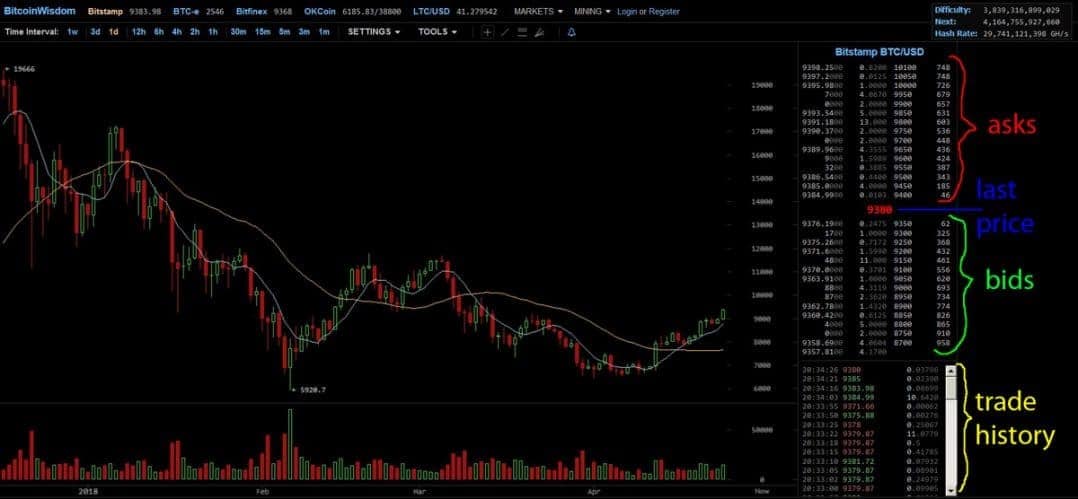
Asks are listed at the top right; showing the price the sellers want for their coin and the number of coins they are willing to sell.
Additional asks are present in Bitstamp’s order book, but only a dozen or so asks that are closest to the last price are visible here. Below are the closest bids, showing the price and number of coins the buyers want.
At the bottom is the trade history, which shows how many coins were traded and at what price. The most recent trade will be the one that set the last price.
This last price reflects the current valuation of Bitcoin on the exchange—in other words, the current Bitcoin price. It will change only as further trading occurs.
Makers and Takers
Bitcoin’s price movements are often explained away as more buyers than sellers, or vice versa. In practice, this isn’t really true since it always takes two parties to trade (if someone bought Bitcoin, someone else sold it).
What really drives the price up or down is the side that’s more aggressive in “crossing the spread.” The spread is simply the difference between the best bid and the best ask price.
In our Bitstamp example, the best bid (i.e. buying price) is $9,350, and the best ask (i.e. selling price) is $9,400, so the spread is $50.
Whichever side is more motivated to trade will pay the $50 spread cost in order to execute the trade immediately. This side is known as “the taker,” as it’s taking the offer listed in the order book by “the maker” (the person who created the trade).
Let’s say that multiple buyers, convinced that price will hit $10,000 by Friday, are acting as takers.
Buyers believe they’ll profit by buying below $10,000. This makes them more likely to pay the spread to buy up all the coins on offer at $9,400—they expect to make $600 minus the $50 spread.
Once buyers have absorbed all the coins offered at $9,400, the next best ask then becomes coins offered at $9,450—and after that, coins offered at $9,500, and so on, up the ask list.
If buying is aggressive, sellers soon realize it and start raising the prices of their asks. This continues until buying pressure is exhausted, at which point the process will reverse. Over time, these impulses drive the price up or down.
This process happens across all Bitcoin exchanges. What keeps prices more or less synchronized across exchanges is the process of Bitcoin arbitrage, the trading strategy that takes advantage of the price differences between trading venues.
For example, if Bitcoin is cheap on Bitstamp but expensive on Coinbase, then traders will buy on Bitstamp and sell on Coinbase. The effects of arbitrage are what keep prices aligned across exchanges.
Leading Exchanges
Finally, it’s worth noting the effect of market-leading exchanges. Those with the highest volumes (i.e. the highest number of coins traded) tend to be considered as having the more “official” price.
For example, if Bitcoin’s price spikes on a major exchange such as Coinbase, Binance, or Bitstamp and especially across several major exchanges at once, then it will almost certainly lead all other global exchanges to have higher prices too. The days of easy profit to be made on Bitcoin’s global market arbitrage are over. After all, it is a two trillion asset by market cap now. The institutions have entered the ring and the market has matured.
The reason for this leading exchange(s) phenomenon is simply that most traders pay close attention to major exchange prices.
Traders have the expectation that prices on major exchanges will filter through to minor exchanges due to the effect of arbitrage effects and the belief that other traders will act accordingly.
This leading exchange effect occurs even across exchanges that use different currencies.
For example, if Bitcoin that’s being traded in a high-volume country such as Japan, where it’s priced in JPY, starts dipping below the average international price, that’s likely to act as a drag on prices in USD, EUR, and other markets too.
3. Why Does Bitcoin Go Down?
Ever seen Bitcoin going down and wondered why? Now that you understand what Bitcoin’s price is and how it’s determined, let’s go over some events that can make Bitcoin’s price plummet.
Price Near All-Time High
Often when Bitcoin’s price reaches a point near a recent all-time high, price resistance is met and the price fails to cross the previous high.
This is attributed to the fact that many traders place sell orders near historical all-time highs. Therefore, when the price reaches these points, a selling pressure is felt that brings the price down. When Bitcoin crosses above significant psychological price levels it is normal for people to sell. Think about the sell pressure Bitcoin faced at $100,000 as an example.
Media FUD
FUD stands for Fear, Uncertainty, and Doubt. Media FUD happens from time to time when Bitcoin receives very negative press. Here are some examples of how Bitcoin has been declared dead over 380 times throughout the years.
This type of media FUD can cause mass panic and increase the selling pressure as people lose faith in Bitcoin.
Keep in mind that more often than not the media is looking to make headlines and generate interest rather than conduct extensive detailed research. So don’t rush to sell the moment you hear Bitcoin is dead yet again.
Dumping Coins on the Market
As a general rule, whenever a large amount of Bitcoins is being sold on the market, it will drag Bitcoin’s price down since the sell pressure increases.
For example, in certain cases, the FBI or different authorities seize substantial amounts of Bitcoin from illegal operations. When this happens, they usually auction off these Bitcoins to the public.
Since authorities aren’t geared towards maximizing profit and a usually large amount of Bitcoin are being auctioned, they are normally sold below the market price.
This, in turn, causes Bitcoin’s price to drop, as the auction winner usually sells some of his newly acquired coins on exchanges as well.
4. Why is Bitcoin Going Up?
Now that you’ve learned why Bitcoin is going down, let’s have a closer look at a different case. There are certain events that increase buy pressure and make Bitcoin’s price go up. Here are some examples:
Crossing an ATH
If Bitcoin’s price crosses a certain all time high, in many cases this generates positive buying momentum which increases the price even more.
Having said that, when extreme buying momentum occurs it’s highly likely a sharp drop in price will soon follow (also known as a correction). If you’re taking advantage of a buying momentum, keep this in mind and consider taking some money off the table before this happens.
Media Coverage / Hype
The same way media FUD can generate panic and selling pressure, media hype can generate increased buying pressure and affect the price predicitions for Bitcoin.
This was evident in 2017’s great Bitcoin rally when the price neared $20,000. Every other day Bitcoin was covered in the news, generating increased adoption, interest and mainly speculation from the masses.
The saying “buy the rumor, sell the news” implies that whenever the media coverage kicks in, it’s time to be wary about the price since a correction may soon come. So while initially, media coverage drives up the price, it can also cause it to crash if it rallies too fast.
Loss of Trust in Fiat

One of the major drivers behind Bitcoin’s price surge throughout the years was loss of trust in traditional fiat currencies (USD, EUR, GBP, etc.).
When people lose trust in their own currency (e.g. inflation) or banking system they look for an alternative to store value that isn’t controlled by any government or bank. Usually, Bitcoin, among other assets such as gold, is a popular solution.
Some good examples of this are the Cyprus bail in crisis of 2013, India’s demonetization in 2016 and Argentina’s Peso decline in 2019.
Adoption
When a major retailer or financial institution starts accepting Bitcoin, it usually signals the market that Bitcoin is becoming more mainstream. This may cause the price to rise due to speculation of future mass adoption.
Another major price driver is the approval of Bitcoin financial instruments such as Bitcoin ETFs and Bitcoin futures. These financial instruments allow big institutions such as banks, hedge funds, etc. to invest in Bitcoin without actually buying the currency.
Some believe that if major market players consider Bitcoin a legitimate investment, it’s only a matter of time until the general public starts investing in it as well, increasing the buying pressure.
Supply Shortage
Another main driver behind increased buying pressure is shortage in supply. Bitcoin’s supply is capped at 21 million. As of today, over 94% of this amount has already been mined.
Today, every 10 minutes on average, another 3.125 Bitcoins come into existence, however, this amount is halved every 4 years or so.
Some believe that Bitcoin’s halving event will drive up Bitcoin’s price as a shortage in supply of new Bitcoins will occur. The next halving event is scheduled for around May 2024.
5. Conclusion
Bitcoin’s price will likely continue to experience periods of volatility even as the market matures. While the overall market cap is now large enough to absorb more trading activity than in the past, panic selling from Bitcoin whales is still an issue. Early Bitcoin whales still control significant holdings, and their decisions to sell or move coins can create sharp price swings as the rest of the market tries to make sense of their activity. Now, in addition to large Bitcoin whales, we have to account for large institutional positions. Institutions act far differently from early whales, as they lack a true conviction in the asset and are known to move in and out of large positions based on overall market conditions.
Broader economic uncertainty, recession worries, and regulatory developments remain powerful drivers of sentiment. The world’s economy is temperamental and many investors are waiting for the one straw that might break the camel’s back, so to speak. That means people can pul
Whether Bitcoin ultimately pushes higher or faces new corrections in the short term will depend on how these forces balance out, but one thing is clear, Bitcoin’s price action will remain closely watched as the world navigates an evolving financial landscape.
See Also:
FAQs
Why Does Bitcoin’s Price Fluctuate?


What causes Bitcoin to go up and down really? Bitcoin’s price is extremely volatile. It’s not uncommon to see price movements of 5% or even 10% in a single day. The reason for these fluctuations is that Bitcoin’s market cap is still relatively small.
The market cap = Number of Bitcoins in circulation * Price per Bitcoin.
Usually, the smaller market cap an asset has, the more volatile it will be. Imagine throwing a rock into a small pond. Now take the same rock and throw it into the ocean. The rock will have much more effect on the pond than on the ocean.
In the same manner Bitcoin (the small pond for now) is more volatile (i.e. affected) by everyday buy / sell orders (the rock). When Bitcoin’s price increases, so will the market cap and the price movement will gradually decrease.

Why you can trust 99Bitcoins
Established in 2013, 99Bitcoin’s team members have been crypto experts since Bitcoin’s Early days.
Weekly Research
100k+Monthly readers
Expert contributors
2000+Crypto Projects Reviewed