





Ethereum co-founder Vitalik Buterin said the network needs “a new path,” openly walking back Ethereum’s long-standing reliance on Layer-2 networks for scaling. Vitalik’s comments came as ETH USD slid a further -2% overnight to $2,270, with the total crypto market cap slipping back below $2.7 trillion.
This comes at a time when most Ethereum activity lives off the main chain, raising a simple question: Did scaling drift too far? Ethereum has spent years pushing transactions onto L2s to cut fees and congestion.
That strategy worked on cost, but it also created trade-offs around control and trust. Now, the project’s original architect says those trade-offs are too big to ignore. Another talking point for Ethereum is yesterday’s (February 3) ETF flows, which saw BlackRock buy $42.9M ETH, marking a green day for the products.
Talking of L2s, while Ethereum is saturated with them, there still isn’t one for Bitcoin, until now. Bitcoin Hyper (HYPER) is one of the hottest crypto presales in recent memory, having raised over $31M to date. Stick around until the end to find out why HYPER is a must-buy for 2026.
Why Is Vitalik Backtracking on Ethereum L2s?
There have recently been some discussions on the ongoing role of L2s in the Ethereum ecosystem, especially in the face of two facts:
* L2s' progress to stage 2 (and, secondarily, on interop) has been far slower and more difficult than originally expected
* L1 itself is scaling,…— vitalik.eth (@VitalikButerin) February 3, 2026
Vitalik, an Ethereum co-founder, says the original idea of L2s acting as clean extensions of Ethereum no longer fits reality. Some L2s keep emergency controls or single-company oversight. That breaks Ethereum’s core belief in ultimate decentralization.
He argues some networks prefer regulatory control or business certainty over full autonomy. While not explicitly naming names, some of the more prominent Ethereum L2 examples include Arbitrum, Optimism, and the Coinbase-backed Base.
The Ethereum L2 sector is currently valued at around $7Bn, highlighting how much value is wrapped up in the various protocols. To further emphasize this, DefiLlama data show around $7.6Bn in TVL (Total Value Locked) across Base, Arbitrum, and POL (formerly Matic).
This conversation is prevalent right now because of the recent Fusaka upgrade on Ethereum, which has not only made transactions faster but also significantly reduced fees. With Ethereum finally scaling to this level, the ever-growing number of L2s seems obsolete, and ETH USD receives a boost as a result.
DISCOVER: 20+ Next Crypto to Explode in 2026
What Next for ETH USD: Huge Blackrock ETF Inflows Bullish for Ethereum?
While ETH USD slipped -2% overnight and is trading back under $2,300, as Vitalik spoke out about the current state of Ethereum and the L2 space, one undeniable bullish data point is ETF flows.
Yesterday (February 4), Ethereum ETFs finished the day with +$14M in flows, largely driven by BlackRock buying $42.9M, with Grayscale also scooping up over $27M across its two products.
While BlackRock and Grayscale went on ETH USD spending sprees, Fidelity nearly ruined the day with over $54M in outflows from its FETH ETF.
The play for Ethereum traders is simple right now. $2,100 is the three-year support level for ETH USD, and as long as that holds, there is room for further upside. $2,500 is the next significant resistance level, indicating Ethereum is now in a tight range between $2,100 and $2,500.
There is likely a lot of chop ahead until either end of this range is broken, so trade cautiously or not at all until a direction becomes clear. Many analysts will wait until $2,500 is breached before going long, or until the $2,100 support zone is broken before shorting.
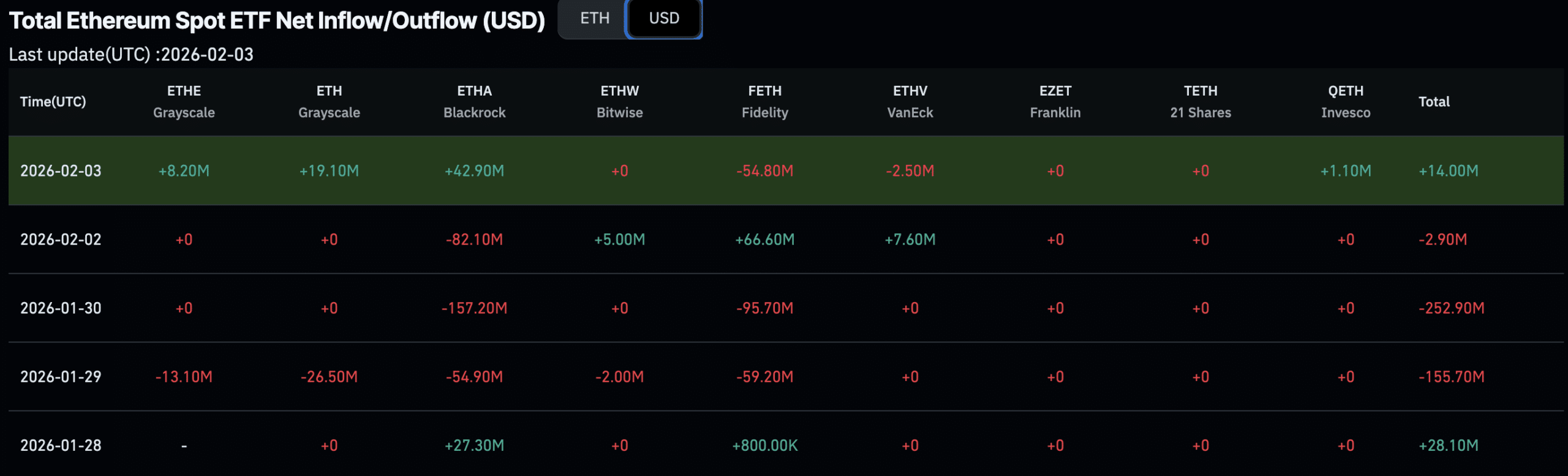
(SOURCE: CoinGlass)
BONUS: Forget Ethereum L2s, Bitcoin Hyper (HYPER) is Bringing the First Ever Native L2 Protocol to Bitcoin
Bitcoin is about to level up, thanks to Bitcoin Hyper (HYPER). It is a brand-new Layer-2 protocol built for the Bitcoin core layer and has already raised over $31M in its ongoing ICO.
Ethereum Layer 2s have already created the playbook. Arbitrum , POL, Optimism, and Base currently hold tens of billions of dollars in TVL, with individual L2 tokens reaching $3Bn to $10Bn in valuation at their respective peaks.
And that’s on a network that already has smart contracts and is constantly being diluted by the handful of new L2s that launch on Ethereum every year.
Now, let’s take a look at Bitcoin. A $1.5 trillion+ market cap, the most trusted blockchain on Earth, and some of the biggest diamond-handed whales in crypto. Yet there is still no native, high-performance Layer 2 for its core layer.
That’s the gap HYPER is filling. Bitcoin Hyper is positioning itself as the first true L2 for Bitcoin, unlocking fast transactions, smart contract functionality, and DeFi-native liquidity.
This will be achieved by using the Solana Virtual Machine, which routes transactions to the HYPER L2 network for super-cheap, near-instant processing before returning them to the Bitcoin core layer for settlement.
If Ethereum L2s can command multi-billion-dollar valuations on a smaller base layer and amid ever-growing competition, what does that imply for the first scalable execution layer on Bitcoin?
Ethereum L2s come more and more often, while the first-ever Bitcoin L2 will only come once. The HYPER presale isn’t just another token launch; it’s a chance to front-run an entire sector before the market prices it in.
Newly purchased HYPER tokens can earn a dynamic 37% APY when staked in its native protocol.
Be part of the Bitcoin Hyper community on Telegram and X.
EXPLORE:
Follow 99Bitcoins on X For the Latest Market Updates and Subscribe on YouTube For Daily Expert Market Analysis.

Why you can trust 99Bitcoins
Established in 2013, 99Bitcoin’s team members have been crypto experts since Bitcoin’s Early days.
Weekly Research
100k+Monthly readers
Expert contributors
2000+Crypto Projects Reviewed