






Crypto markets have matured, but the way liquidity moves across major blockchains still feels outdated. Capital is spread across different ecosystems, each optimized for a specific role. Bitcoin remains the primary settlement layer and long-term store of value. Ethereum continues to anchor decentralized finance and on-chain applications. Solana attracts traders and developers who prioritize speed and low transaction costs.
These networks were not built to interact seamlessly with one another. Liquidity becomes fragmented the moment capital moves from one chain to another, often passing through bridges, wrapped assets, and slow settlement paths.
Even simple actions, such as deploying Bitcoin liquidity into DeFi or reallocating funds between Ethereum and Solana during market volatility, require multiple steps and additional trust assumptions. In periods where liquidity efficiency matters more than speculation, these frictions become increasingly visible.
This disconnect is also shaping how new infrastructure projects position themselves. One of them is LiquidChain ($LIQUID), which is currently running a crypto presale as it develops a Layer-3 network designed specifically to coordinate liquidity across Bitcoin, Ethereum, and Solana.
Why Bitcoin, Ethereum, and Solana Still Operate in Silos
Each of the three major networks evolved with different priorities. Bitcoin was designed for security and finality, not complex financial logic. Ethereum introduced programmable money and composable DeFi, but its execution environment still concentrates activity within its own ecosystem. Solana focused on throughput and low fees, creating a fast-moving environment that remains largely self-contained.
Because of this, liquidity tends to stay where it originates. Bitcoin capital rarely moves directly into DeFi without being transformed. Ethereum liquidity is deep but slow to leave its native environment. Solana’s speed advantages are difficult to extend beyond its own chain. The result is a market where capital exists in abundance, yet remains inefficiently deployed.
Over time, this fragmentation affects more than just users. Developers must choose where to deploy, knowing they are leaving liquidity behind on other chains. Protocols compete for attention within isolated ecosystems instead of tapping into shared capital. During bearish or uncertain market conditions, these inefficiencies are amplified as participants become more cautious about moving funds across chains.
How LiquidChain Tries to Fix the Coordination Problem
LiquidChain approaches this challenge from an architectural perspective. Instead of launching another base-layer blockchain, it is designed as a Layer-3 execution and settlement network that operates above existing chains. The idea is not to replace Bitcoin, Ethereum, or Solana, but to coordinate how liquidity and execution interact across them.

At its core, LiquidChain treats liquidity as a shared resource. Assets originating on Bitcoin, Ethereum, and Solana are represented within a unified execution environment, allowing capital to be accessed across ecosystems without repeated bridging or wrapping. Developers deploy once at the LiquidChain level, while the network handles multi-chain execution behind the scenes.
This model relies on a high-performance virtual machine built for real-time operations and cross-chain proofs that allow Bitcoin UTXOs, Ethereum accounts, and Solana state to interact securely and atomically. Rather than duplicating liquidity, LiquidChain focuses on synchronizing access to it, which aligns with a broader shift toward execution-layer infrastructure.
LiquidChain’s Crypto Presale and Tokenomics
The project’s crypto presale shows this infrastructure-first positioning. The $LIQUID token is currently priced at $0.013, with more than $370,000 raised so far according to project disclosures.
Staking is part of the design, with a decreasing APY model that gradually reduces incentives as network participation grows, a structure often used to encourage early participation without locking in unsustainable yields.
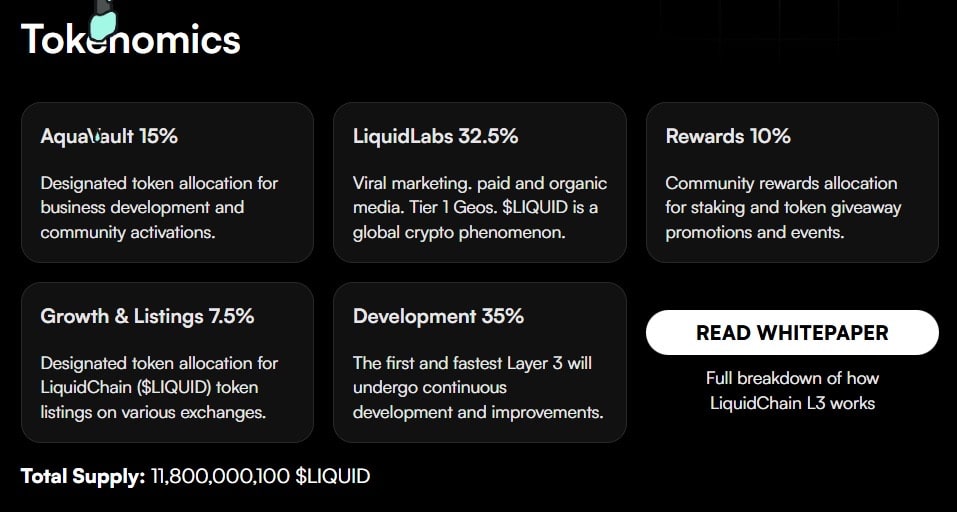
Based on the published breakdown, 35% of the total supply is allocated to development, supporting ongoing Layer-3 improvements. LiquidLabs holds 32.5% for ecosystem growth, including marketing and expansion efforts.
AquaVault accounts for 15% for business development and community initiatives, while 10% is reserved for rewards tied to staking and incentives. Growth and exchange listings make up 7.5%. The total supply is capped at 11,800,000,100 $LIQUID.
Closing Thoughts
Bitcoin, Ethereum, and Solana do not fail to work together because of competition. They fail because they were never designed to coordinate liquidity at scale. As markets become more efficiency-driven, this structural gap becomes harder to ignore.
LiquidChain’s Layer-3 approach places it within a growing category of infrastructure projects focused on coordination rather than disruption. Whether it succeeds will depend on execution and adoption, but the problem it targets is well-defined. That context helps explain why its crypto presale is being watched less for speculative promises and more for how effectively it can address one of crypto’s longest-running inefficiencies.
Explore LiquidChain and its ongoing crypto presale:
Presale: https://liquidchain.com/
Social: https://x.com/getliquidchain
Whitepaper: https://liquidchain.com/whitepaper

Why you can trust 99Bitcoins
Established in 2013, 99Bitcoin’s team members have been crypto experts since Bitcoin’s Early days.
Weekly Research
100k+Monthly readers
Expert contributors
2000+Crypto Projects Reviewed