





Cardano’s DeFi ecosystem just received a solid upgrade. USDCx, a USDC-backed stablecoin designed for seamless access to cross-chain USDC liquidity, is now live via Circle’s xReserve. The model offers 1:1 backing with USDC held in reserve, full interoperability across supported chains, and a structure that minimizes reliance on third-party bridges.
At launch, USDCx is supported by Cardano-native DeFi platforms including Liqwid Finance, Minswap, and SundaeSwap. That integration opens the door for payments, lending, trading, borrowing, and liquidity provision using a stablecoin designed to connect with broader USDC liquidity across ecosystems.
The rollout illustrates a larger trend: interoperability is no longer optional. Stablecoin infrastructure is evolving toward cross-chain functionality, cleaner settlement, and reduced bridging risk.
That same structural direction sits at the core of LiquidChain ($LIQUID), a project currently in its crypto presale phase. While USDCx focuses specifically on stablecoin liquidity within Cardano’s environment, LiquidChain is building a broader execution layer aimed at unifying BTC, ETH, and SOL liquidity under a single settlement framework.
Why USDCx Matters for Cross-Chain Liquidity
The introduction of USDCx signals growing demand for native interoperability without the fragility of traditional bridge models. Historically, wrapped assets and bridge-based transfers introduced added attack surfaces and operational friction. By anchoring USDCx 1:1 to USDC held in xReserve and enabling direct interoperability across chains, Circle’s design reduces complexity for both institutions and retail participants.
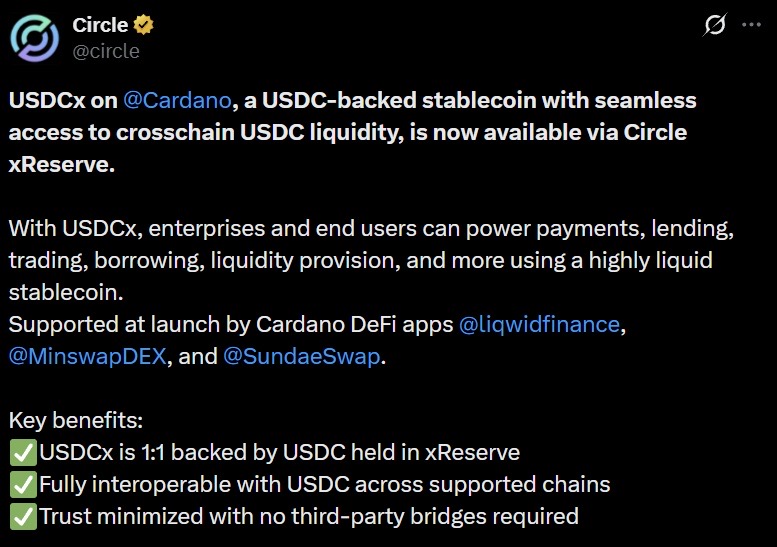
Source: X/@circle
For Cardano, this expands liquidity access and strengthens DeFi composability. Lending protocols gain deeper stablecoin markets. DEXs benefit from tighter spreads. Borrowing and yield strategies can operate with more predictable collateral structures.
Yet USDCx remains focused on one asset class; stablecoins.
Liquidity fragmentation across Bitcoin, Ethereum, and Solana extends beyond stablecoins alone. Each ecosystem holds native capital pools that do not coordinate efficiently with one another. That broader structural challenge is where infrastructure-layer protocols attempt to step in.
LiquidChain: A Broader Infrastructure Play in a Bear Market
LiquidChain acts as a Layer 3 settlement protocol that interoperates directly with Bitcoin, Ethereum, and Solana. Instead of issuing a specific cross-chain asset, it introduces a Cross-Chain Virtual Machine capable of referencing multiple underlying blockchains within one execution layer.
At the verification level, a Unified Proof Engine validates Bitcoin UTXOs, Ethereum account states, and Solana balances in real time. The objective is coordinated settlement which allows multi-chain execution without relying purely on external bridges.
In bearish conditions, infrastructure development often continues quietly while speculative narratives cool. Liquidity efficiency becomes more important when capital is scarce. Unified settlement layers can reduce redundancy for developers and improve capital utilization across ecosystems.
The $LIQUID token powers this framework. Utility includes transaction fees for cross-chain execution, liquidity staking for network validation, and ecosystem grants to incentivize development.

Tokenomics are structured around a total supply of 11.8 billion tokens, distributed across:
- Development (35%)
- Liquid Labs (32.5%)
- AquaVault (15%)
- Rewards (10%)
- Growth & Listings (7.5%)
A large allocation toward development and infrastructure signals emphasis on protocol buildout. Rewards allocation supports validator participation, while growth and listings allocation addresses future exchange expansion.
The ongoing crypto presale provides early-stage access before mainnet deployment and targeted exchange listings. As interoperability gains attention across ecosystems (evidenced by USDCx on Cardano) infrastructure projects attempting to unify broader liquidity pools may enter deeper market discussions.
USDCx enhances stablecoin connectivity within Cardano. LiquidChain aims to coordinate liquidity across the largest ecosystems entirely.
Different scopes. Different ambitions.
Infrastructure Narratives Are Expanding
Stablecoin interoperability and cross-chain settlement are no longer niche conversations. From Circle’s USDCx rollout to emerging Layer 3 frameworks, the market is moving toward integrated liquidity environments.
Cardano’s adoption of USDCx demonstrates institutional confidence in cross-chain stablecoin design. Meanwhile, LiquidChain’s crypto presale reflects growing interest in infrastructure that targets liquidity unification at a deeper level.
For participants evaluating opportunities in this cycle, the distinction lies in exposure. Established ecosystems continue strengthening their native liquidity rails. Early-stage infrastructure protocols aim to connect those rails into a broader network.
The crypto presale phase naturally carries execution risk. Delivery, integrations, and adoption determine long-term outcomes. But infrastructure layers built during slower market periods often aim to position themselves ahead of the next expansion phase.
LiquidChain’s focus on BTC, ETH, and SOL liquidity coordination places it in that structural category. As cross-chain design changes (from stablecoins like USDCx to meta-layer execution protocols) capital may increasingly gravitate toward solutions addressing fragmentation at scale.
USDCx strengthens Cardano’s liquidity framework today. LiquidChain’s crypto presale centers on building a settlement architecture that attempts to unify liquidity across dominant chains tomorrow.
The success of that vision depends on execution and adoption. For now, both narratives underscore one clear theme: interoperability is becoming a defining layer of the next DeFi cycle.
Explore LiquidChain and its ongoing crypto presale:
Presale: https://liquidchain.com/
Social: https://x.com/getliquidchain
Whitepaper: https://liquidchain.com/whitepaper

Why you can trust 99Bitcoins
Established in 2013, 99Bitcoin’s team members have been crypto experts since Bitcoin’s Early days.
Weekly Research
100k+Monthly readers
Expert contributors
2000+Crypto Projects Reviewed