




Crypto right now is flooded with presales. New tokens launch every week, each one promising the next big thing. Most of them fade into obscurity within days.
But every so often, a project cuts through the noise.
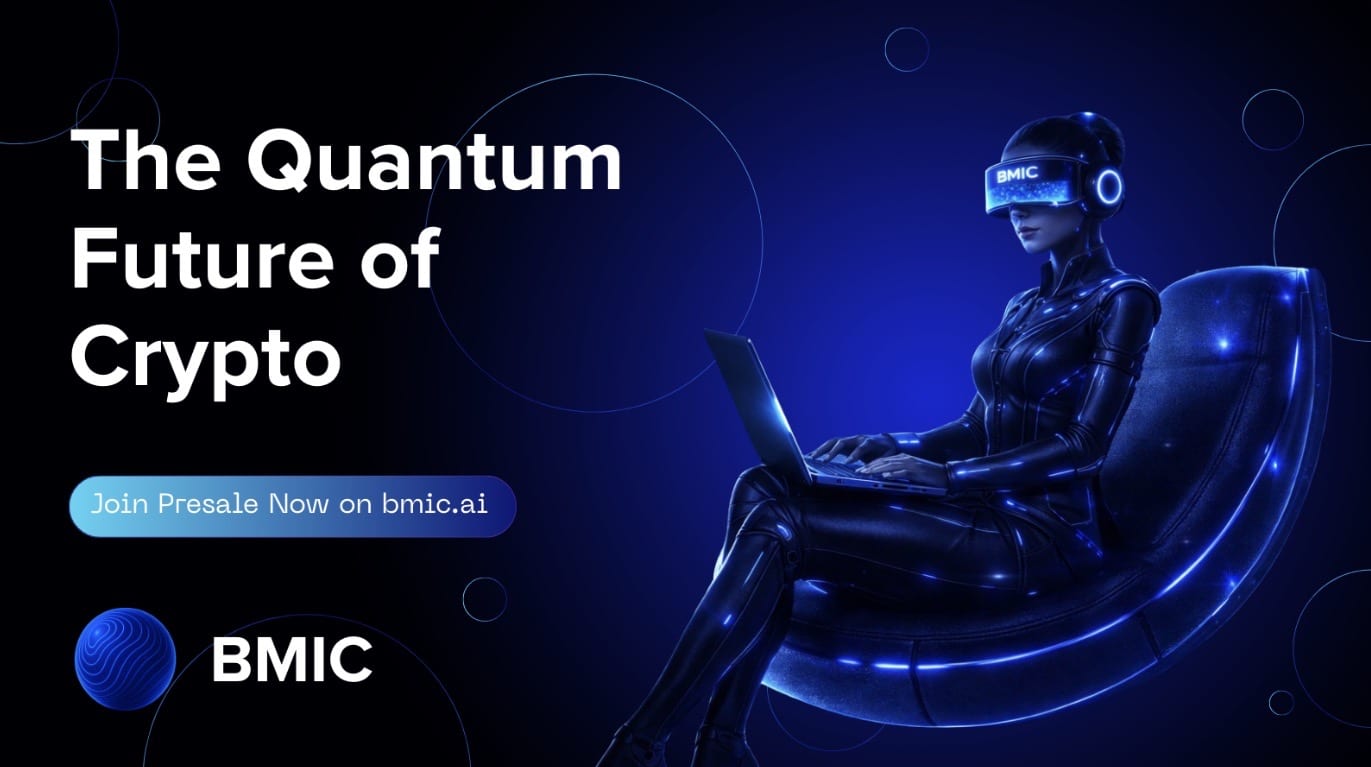
BMIC ($BMIC) is one of those projects. In a bear market where most presales struggle to scrape together a few thousand dollars, this quantum-safe wallet platform has quietly pushed toward the $500,000 mark. Clearly, something here is catching investors’ attention.
The question is why.
How Exactly BMIC Works
The pitch is simple, but the technology behind it gets complex fast.
Here’s the problem BMIC aims to solve. Every time you send crypto from a standard wallet (MetaMask, Ledger, Trust Wallet, doesn’t matter) your public key gets written to the blockchain. Right now, that’s fine. No computer on earth can turn that public key into your private key.
Within the next five to ten years, machines with enough stable qubits could run algorithms designed to crack the cryptography protecting those keys. Every wallet that has ever made a transaction has its public key sitting on the blockchain. That’s a lot of exposed data.
BMIC built its platform to remove that attack surface entirely. Instead of traditional wallets that leak keys with every transaction, BMIC uses what it calls “signature-hiding architecture.” The wallet builds on smart account standards like ERC-4337, combined with hybrid post-quantum cryptography signatures approved by NIST. Transactions route through private layers, meaning the public key never appears on-chain.
But BMIC isn’t stopping at wallets. The platform is building what it calls the first complete quantum-secure finance stack. That includes staking with no exposed keys—so long-term holders can earn yield without creating vulnerabilities. And it includes a payment card system using the same post-quantum authentication, so spending crypto doesn’t leak your key either.
An AI layer runs in the background, monitoring for threats and helping optimize the heavier computational load that comes with post-quantum algorithms. For banks and businesses, BMIC offers Quantum Security-as-a-Service, letting institutions plug into the same infrastructure without rebuilding their entire backend.
The project also has its sights set on something bigger down the road. The Quantum Meta-Cloud, still in development, aims to create a decentralized network where users can access quantum computing power without going through big tech gatekeepers. Token holders will be able to burn BMIC for compute credits to run workloads.
BMIC’s Crypto Presale Details, Tokenomics, and Token Utility
BMIC has a total token supply of 1.5 billion, and that number cannot increase. Half of that supply (750 million tokens) is allocated to BMIC’s token presale. That’s the portion available to early buyers before the public launch.
The rest breaks down like this:
- Rewards & Staking: 12%
- Liquidity & Exchanges: 10%
- Ecosystem Reserve: 9%
- Marketing: 6%
- Private sale: 10%
- Team: 3%
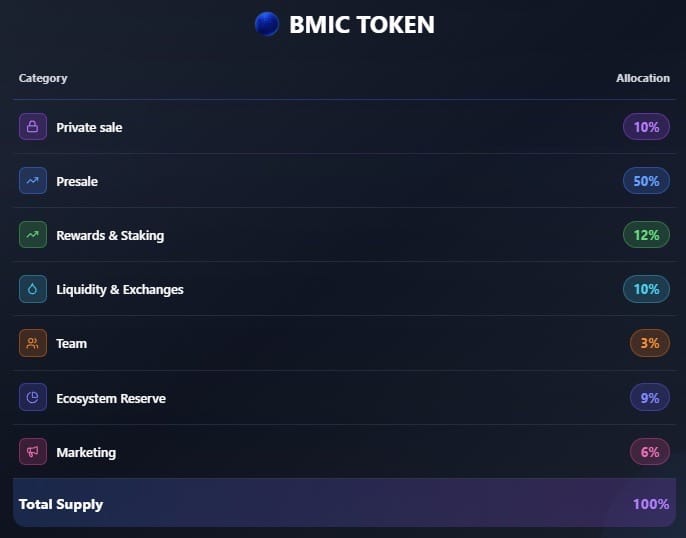
The team allocation is worth noting. At 3%, it’s lower than what most projects take, which signals that the founders aren’t planning to dump tokens on the market down the line.
Early buyers got in at $0.048485 per token, with later phases seeing gradual increases up to $0.058182. The public launch price is set above the final presale tier, which means the window for the lowest prices closes once the presale ends.
So far, the market response has pushed the raise toward $500,000. In a bear market where capital is scarce, that kind of momentum stands out.
The token itself has real utility baked in. Holders can stake to earn rewards and help secure the network. They get voting rights in protocol governance as the project moves toward decentralization. And they can use tokens to pay for wallet services and enterprise APIs.
There’s also a deflationary mechanism built into the model. A fixed percentage of company revenue funds token buybacks and burns, which reduces supply over time. That means demand is tied to actual usage of the platform.
For institutions, the QSaaS model creates another layer of demand. Banks, fintechs, and healthcare providers that want quantum-safe custody and key management will need to acquire tokens to access those services.
Read our guide on how to buy $BMIC during the presale phase.
Why This Presale Is Different
Crypto has no shortage of projects making big claims. Most of them won’t exist in five years.
BMIC’s bet is that quantum security is the next major evolution of how crypto works. Every wallet on the market today has a flaw that future technology will expose. BMIC is trying to fix that flaw before it becomes a crisis.
The presale is still open, with the next price step approaching as demand ticks up. The wallet alpha is scheduled for mid-2026, with a full public beta by late 2026. For now, early buyers are getting in at the lowest available prices before the tiered increases kick in.
All in all, the presale numbers show a number of investors believe the project is onto something real.
Meet the future of quantum-secure Web3 with BMIC:
Presale: https://bmic.ai/
Social: https://x.com/BMIC_ai
Telegram: https://t.me/+6d1dX_uwKKdhZDFk

Why you can trust 99Bitcoins
Established in 2013, 99Bitcoin’s team members have been crypto experts since Bitcoin’s Early days.
Weekly Research
100k+Monthly readers
Expert contributors
2000+Crypto Projects Reviewed