







As Bitcoin’s supply nears its limit, PepeNode (PEPENODE) is stepping in with a new way to bring mining back to the masses. Nearly all BTC is already in circulation despite the final coin not arriving until 2140, raising the question of whether traditional mining is still worth pursuing.
PepeNode introduces crypto’s first virtual mining game that’s free from hardware requirements and high electricity costs. It’s also free from the traditional token lockups commonly found in staking, such as those seen with Ethereum, where users must lock their ETH for extended periods or wait through unbonding times to reaccess their tokens.
But to be clear, PepeNode isn’t trying to replace Bitcoin mining. Instead, it’s giving retail players a way back into mining at a time when the game has become restrictive. It’s now dominated by institutions with massive capital that affords industrial hardware and huge energy infrastructures.
Retail participation has always been a cornerstone of crypto’s foundation, and PepeNode aims to bring that back to mining.
And right now, retail users can join the ongoing presale and secure PEPENODE tokens at $0.0011546 – but only for the next 30 hours, after which the price will increase in the next round.
With Bitcoin Nearly Fully Mined and Centralized, the Next Evolution Begins
As of Wednesday, the total mined Bitcoin stands at roughly 19.95 million BTC. With a fixed supply of 21 million BTC, that leaves only about 1.05 million BTC left to be issued, meaning around 95% of all Bitcoin is already in circulation.
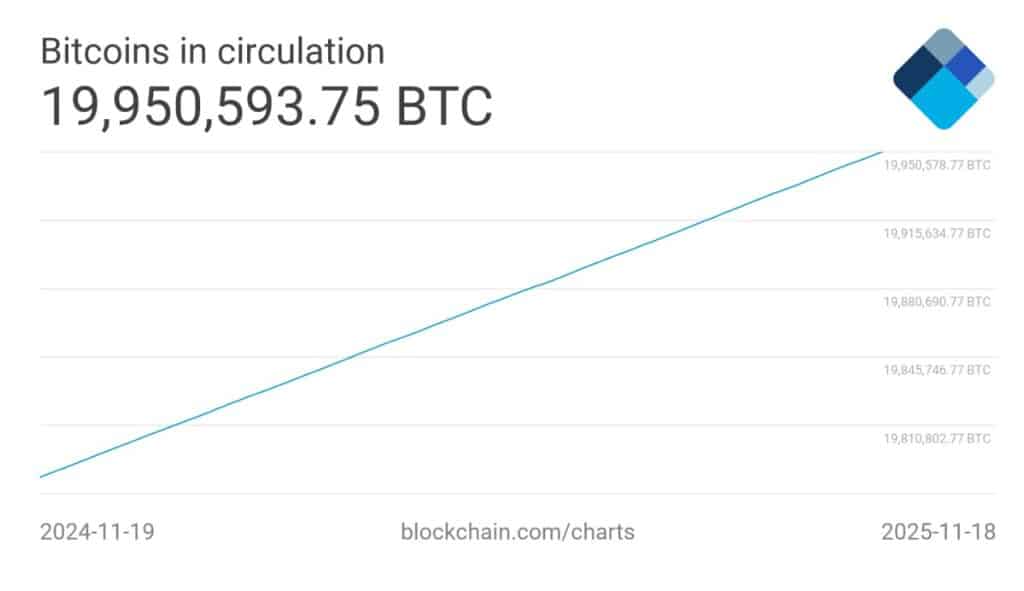
Source: https://www.blockchain.com/explorer/charts/total-bitcoins
With just 5% of Bitcoin’s supply left to be mined over the next 115 years, the long-term profitability of mining is becoming a growing concern. For mining to remain viable, Bitcoin’s price must continue to rise; otherwise, miners face tightening margins, rising difficulty, and escalating operational costs.
However, profitability isn’t the only issue – centralization is also a concern. The latest industry data shows that public Bitcoin miners now control 38.17% of global hashpower, even though only 29 companies are included in this dataset – and this doesn’t even account for the large private miners. In reality, public and private corporations collectively dominate the network.
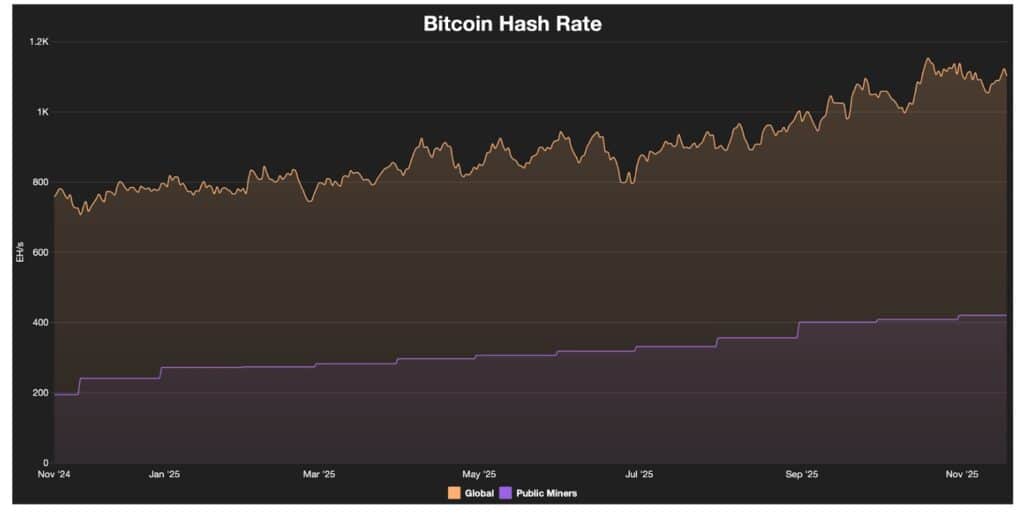
Source: https://bitcoinminingstock.io/hashrate
Recent events have shown how fragile centralized infrastructure can be. A Cloudflare outage on Tuesday revealed that nearly 20% of the internet – including platforms like X and ChatGPT – depend on a single provider. It sparked running jokes across crypto that even projects claiming to be “the world’s most decentralized and incorruptible application” can still be knocked offline by a centralized bottleneck.
Of course, centralization goes against the very reason Bitcoin was created in the first place, but fighting it as an individual is nearly impossible. Unless you hold Marathon Digital–level reserves, such as the company’s 52,850 BTC (worth around $4.8 billion), you don’t have the balance sheet strength to survive prolonged downturns or continuously expand hashpower.
In other words, for a retail user hoping to “take a shot” at mining, the barrier is essentially immovable. You’d need industrial-grade ASIC hardware, tens of thousands of dollars in upfront costs, and electricity prices near 3–4 cents per kWh just to break even – and even then, the odds of solo-mining a block are close to zero.
Pepe Node Creates A System That Can Be Financially Rewarding And Genuinely Fun
PepeNode turns everything that’s out of reach for retail miners into something they’ll actually be excited to dive into. Instead of a capital-intensive arms race, PepeNode creates a system that can be financially rewarding and genuinely fun – thanks to its gamified mining mechanics that make the entire experience engaging.
Every player starts with the same blank canvas: an empty virtual server room. From there, they begin building out their mining setup by adding nodes, each with unique properties, while also having the option to expand their server room as their operations grow.
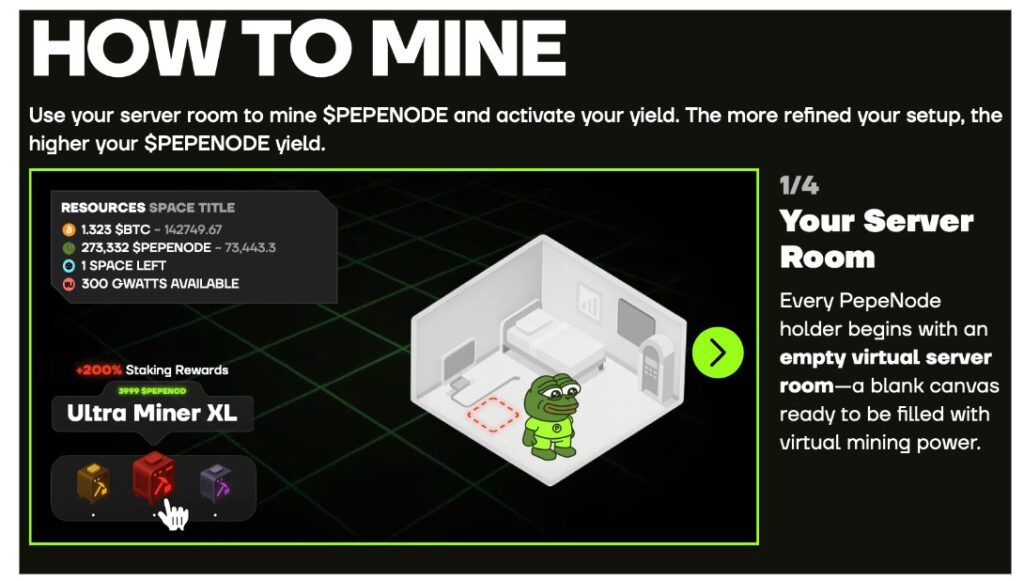
The real challenge – and the fun – comes from the strategy and the randomness. Because every node is unique, players can get lucky and pull a high-performing one. But optimal results only come from combining nodes in the right way.
Even with strong nodes, players might need to expand their layout or sell back certain nodes to buy better ones and perfect their setup.
These gameplay mechanics are what distinguish PepeNode from traditional mining, where accumulating more hardware or endlessly scaling up is the name of the game. Instead, the randomness forces players to strategize – and once they do, they can build a PEPENODE-token-generating machine that also earns some of the most valuable meme coins in the space, such as Pepe (PEPE) and Fartcoin (FARTCOIN).
Other major meme coins, such as Dogecoin (DOGE) or Shiba Inu (SHIB), could also become part of the reward pool as the game evolves and gains traction.
Currently, PepeNode offers an experience that the retail crowd, tired of being shut out of Bitcoin mining, can fully get behind.
PEPENODE Carries The Iconic Pepe The Frog Mascot
The PepeNode presale gives investors a chance not only to accumulate the tokens needed to build out their virtual mining setup, but also to secure a token that has the potential to become a top-tier meme coin in its own right.
Because PEPENODE carries the iconic Pepe the Frog mascot, it steps in as the next iteration of crypto’s most recognizable meme. But unlike most meme coins, it comes with real utility baked into the ecosystem.
Since PEPENODE is the only token used to play the game, anyone seeking an easier way to earn top meme coins is naturally driven to buy it, creating organic demand from actual gameplay rather than hype alone.
PEPENODE also has powerful tokenomics behind it. About 70% of all tokens spent on upgrades and node purchases are burned permanently, shrinking supply over time as the game grows.
On top of that, PEPENODE can already be staked, and, in fact, more than 1.3 billion tokens are currently locked, meaning roughly 71% of presale buyers have already staked their holdings. That’s a major reduction in circulating supply before the game even launches.
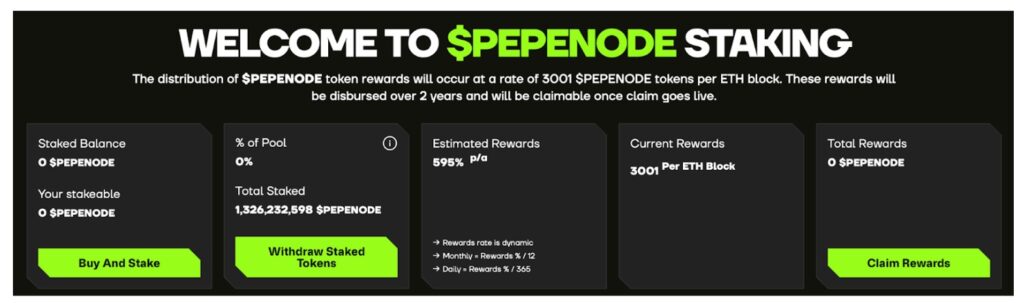
PEPENODE will also power governance, giving holders a say in how the game evolves over time – another incentive to hold rather than sell, and another mechanism that tightens supply.
Not To Late To Join PepeNode Presale
To buy PEPENODE, head to the PepeNode site to purchase using ETH, BNB, USDT (ERC-20 and BEP-20), or even credit or debit cards.
PepeNode recommends using Best Wallet, which is considered by several crypto influencers and even crypto media as the best crypto and Bitcoin wallet in the market today. PepeNode is listed on Best Wallet’s highly accurate project screening tool, Upcoming Tokens, allowing you to buy, track, and claim in-app.
The token’s smart contract has been audited by Coinsult, providing early adopters peace of mind about the security of its code.
Follow the project on X and Telegram for the latest updates.
DISCOVER: 16+ New and Upcoming Binance Listings in 2025

Why you can trust 99Bitcoins
Established in 2013, 99Bitcoin’s team members have been crypto experts since Bitcoin’s Early days.
Weekly Research
100k+Monthly readers
Expert contributors
2000+Crypto Projects Reviewed