




Ever wish your computer could quietly earn you money while you sleep? With Monero (XMR), that idea isn’t far-fetched. Unlike Bitcoin or Ethereum, where mining now demands expensive, specialized hardware, Monero mining is still accessible to everyday users. Whether you’re on a gaming PC, a modest laptop, or even an old desktop gathering dust, you can put your CPU or GPU to work generating XMR.
What makes Monero stand out is its focus on decentralization and privacy. The network is designed so anyone can contribute hash power without needing an industrial-scale setup. This levels the playing field, keeping the network secure while giving miners of all sizes a fair shot at earning rewards.
So, if you’re ready to turn your Mac or PC into a passive income machine, this guide will walk you through everything you need to know, from setting up your hardware to joining a mining pool and optimizing performance. Let’s dive into the step-by-step process of mining your first Monero coins efficiently and safely.
Monero Mining: Summary
Here’s a quick guide to how to mine XMR with your GPU or CPU:
Before we break down the details, here’s a snapshot of how to start mining XMR, no fancy equipment required:
- Hook up your GPUs/CPUs – Ensure your system is ready for sustained workloads and install the latest drivers.
- Optimize your settings – Adjust power usage, temperature limits, and thread counts to balance efficiency with performance.
- Join a mining pool (like Minergate) – Solo mining is tough; joining a pool boosts your chances of steady payouts.
- Start mining and monitor your progress – Run your mining software, track performance, and watch your XMR balance grow.
If that sounds surprisingly simple, that’s because it is. Monero’s mining ecosystem is built for accessibility; you don’t need deep technical expertise or thousands of dollars in hardware. In the next sections, we’ll dive into each step in detail, covering the tools, software, and tweaks that will help you get the most out of your mining setup.
Why Mine Monero?
So, what are the good reasons to start mining Monero?
Mining Monero (XMR) can be a practical way to offset the cost of a high-end GPU/CPU. XMR is also highly liquid, as it can be traded for Bitcoin (BTC), making it a cost-effective way to gradually build a Bitcoin position. Since BTC can be easily converted to cash, mining XMR indirectly provides a pathway to fiat income. Some major exchanges also allow direct XMR-to-fiat trading, adding flexibility.
Monero’s RandomX algorithm is designed to be energy-efficient compared with Ethash (used by Ethereum, Ethereum Classic, and UBQ) and Equihash (used by Zcash, Zencash, and Hush). Lower power usage means reduced heat output, which can be important for home miners and can also help extend the lifespan of your GPU/CPU.
In general, mining may allow you to take advantage of price appreciation in the future, but with less risk than just buying. Let us explain.
Mining crypto and holding it is similar to the adage of buying low and selling high—except that most buyers don’t understand technical analysis and do this at the wrong times. Meaning they’re buying high (during parabolic price increases) and selling low (during normal price corrections on continued upward trends).
However, buying gear and mining cryptocurrency with it allows you to have an income-producing asset in the gear itself, with aftermarket resale values holding very well and even appreciating.
Calculating Monero Mining Profitability
Before we get into the details of Monero crypto mining, we need to perform some economic calculations.
First, head over to whattomine.com, which provides up-to-date figures for the current price, block time, and network hash rate (as measured in kilohashes per second—or KH/s—denoting thousands of calculations per second).
Monero Mining Profitability & Break-Even (September 2026)
| Metric | Value |
| Monero Difficulty | ~ 655 G |
| Block Reward | ~ 0.600 XMR |
| Network Hashrate | ~ 5.4–5.5 GH/s |
| Monero Price | ~$320–$325 |
With a mid-range GPU, such as an AMD RX 570, you could achieve around 800–900 h/s while consuming roughly 120 W. Pair that with a modern CPU (around 30 KH/s at 140 W), and your combined setup could generate roughly $3–$3.50 in daily revenue at a Monero price of ~$320 per XMR. After electricity costs (~$0.10/kWh, about $0.60/day for both CPU and GPU), your net profit would be around $2.40–$2.90 per day.
If your hardware costs around $900–$1,000 total, you could break even in roughly 6–8 months, assuming mining difficulty and coin prices stay stable. Higher electricity costs or rising difficulty will reduce profit, while cheaper power or more efficient hardware can improve returns.
Mining Monero with a combined CPU + GPU setup can be a practical way to support the network and gain hands-on experience with cryptocurrency mining. While it can provide modest profits, it’s still not a shortcut to large earnings, especially for beginners.
Choosing Your Hardware
Experimenting with different GPUs and CPUs using mining calculators can help you find the best balance of cost, performance, and power efficiency—often measured as hash rate per dollar spent or per watt consumed.
For Monero’s RandomX algorithm, CPUs are now the most efficient option, but AMD GPUs can still provide strong performance when paired with a capable CPU. Nvidia GPUs are generally less efficient for RandomX, making AMD cards a preferred choice for miners looking to maximize their GPU-based hash rate.
Read our full comparison of the best Monero mining hardware.
How to Mine Monero on PC
The big advantage of Minergate is that you can use it on Windows or Mac, and you can mine with a GPU, CPU, or both (dual-mining), so it has a very low barrier to entry for a wide audience.
In this guide, we’ll walk you through setting up Minergate and the Claymore miner. The steps are demonstrated on a Windows 10 machine, but the process is similar for Windows 7 or 8, as well as Linux and Mac. Downloading, configuring, and starting your miner typically takes under 20 minutes.
Step 1: Install Video Card Drivers
AMD GPUs: Head over to amd.com to download your GPU drivers. Go to amd.com and choose Support & Drivers. Enter your GPU information and click Display Results.
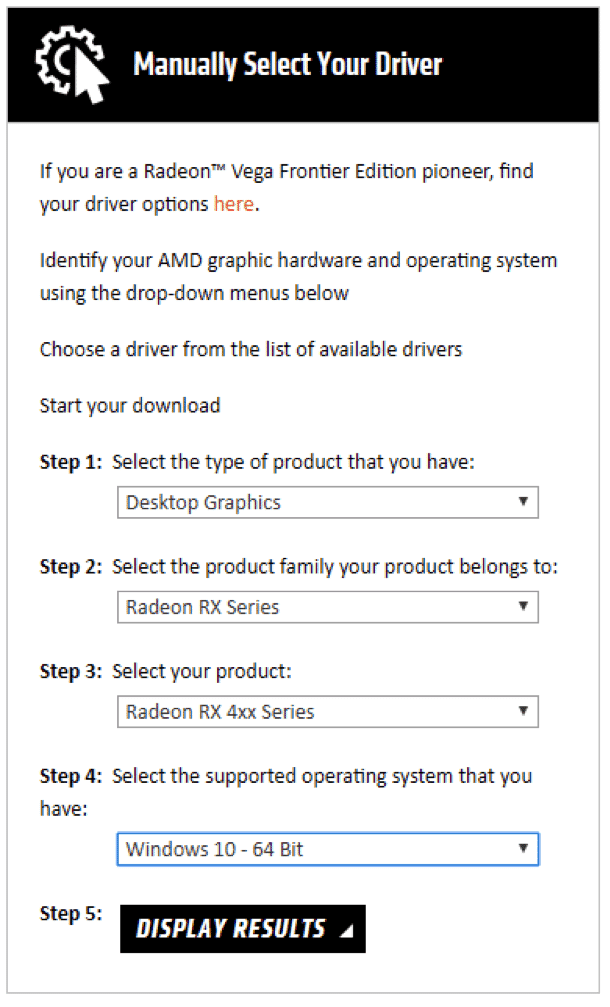
You can click the Download button for the current driver or choose Download Previous Drivers & Software on the right-hand side. This will allow you to choose older versions that are known as great drivers for mining, based on your cards:
- R9 and Older: Use 15.12
- RX 4XX Series: Use 16.9.2 or 16.10.3
- RX 5XX Series: As these are newer, we’d recommend going with the current driver for now
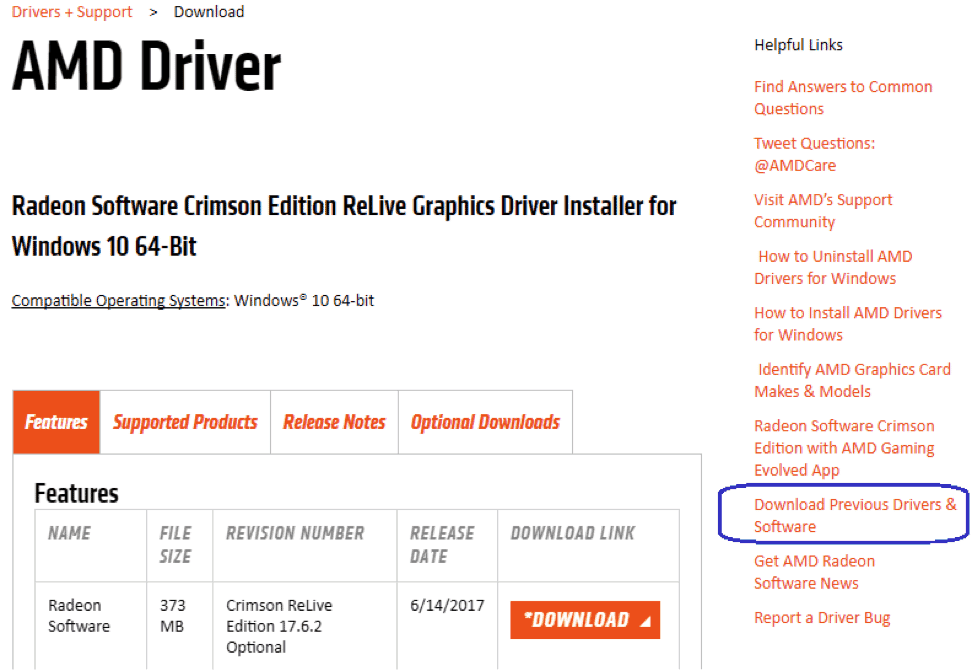
Click the red Download button to get started.
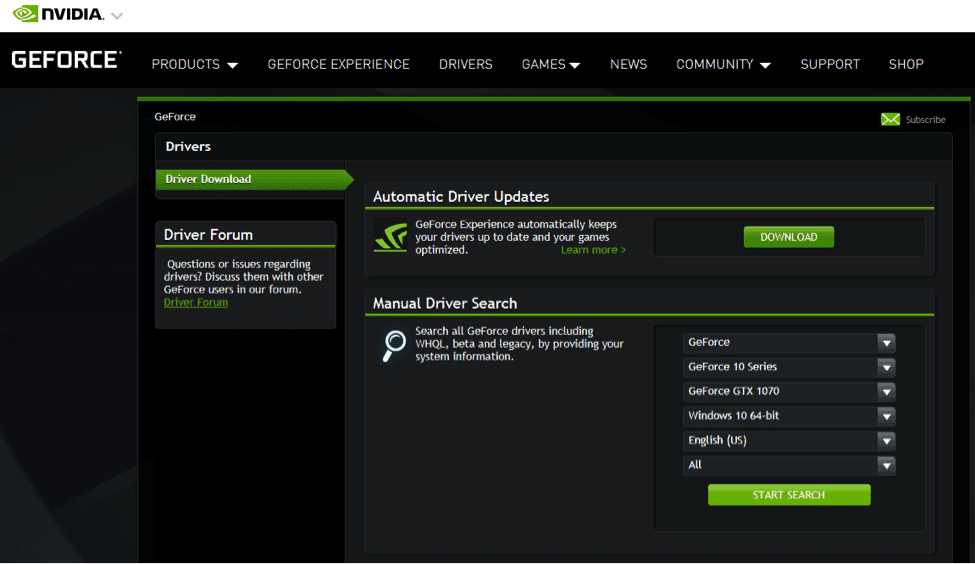
- Nvidia GPUs: To get the latest Nvidia GeForce drivers, go to https://www.geforce.com/drivers, enter your card info, click Start Search, and download the current version from the results.
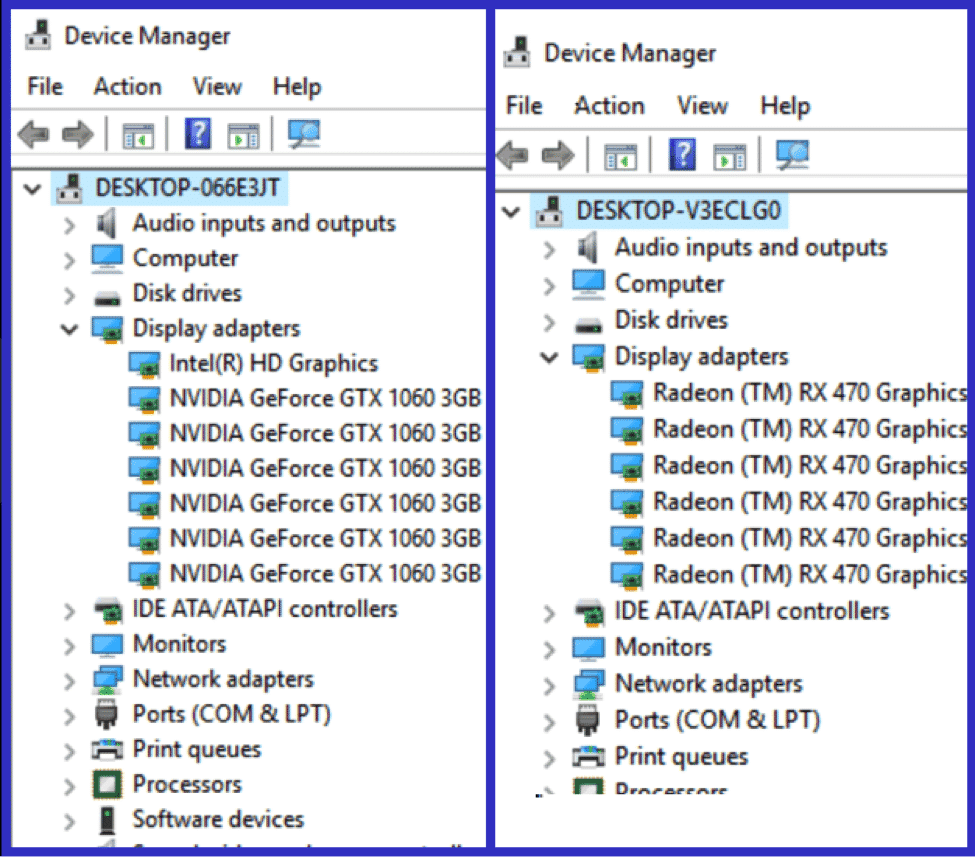
Install your GPU drivers like you normally would and reboot. You’ll know your GPUs are recognized correctly if you go into Device Manager (search in the Windows search bar) and don’t see any warning marks on your GPUs. Shown correctly, it should look something like this:
Troubleshooting Tip
Some miners have had success installing all GPUs at once and then installing the drivers.
Others prefer to install only one card, install the drivers, shut down the system, install the rest of the GPUs, and let them all be recognized by Windows (you’ll experience the system lagging, some flickers, or some brief black screens while each card is detected by Windows).
If you run into an issue with one method, delete the drivers and try the other method. If you do need to remove your drivers, use the DDU (Display Driver Uninstaller) program from Guru3d.com to remove everything cleanly, and then start over.
Important: The next part of this tutorial refers to using MinerGate as a mining software. After receiving several complaints about the company, we decided to review it personally. Make sure to read our MinerGate review to get a better idea of its downsides.
If you don’t want to use MinerGate, please skip straight to Step 4.
Step 2: Register a Free Account at Minergate
To easily mine with your CPU and GPUs, including laptops, you’ll need an account at Minergate. Click the Sign Up button at the top, and then set up your account with a valid email address and a secure password.
Step 3: Download the Minergate Software
The next step is to download the Minergate software. Click on Downloads at the top, and it should detect the right version for you (i.e., Mac, Windows, Linux).
Run the downloaded file to install Minergate, and just click like you normally would through any other installation process. After the installation has completed, run the program, enter the email you registered with, and click on Start Mining.
Next, click on Start Smart Mining—this option will look for the most profitable coin for you to mine and start your hashing. That’s it—it’s literally that easy to get mining with this easy-to-use platform.
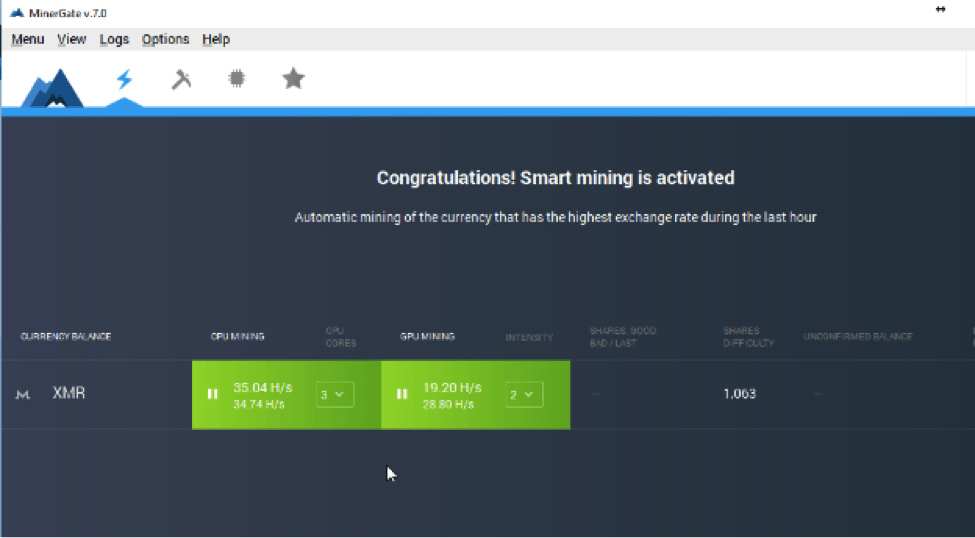
The above image shows CPU and GPU mining on a laptop with an old i7 2630 and integrated graphics. The image below shows a mining rig with a Celeron 1840 CPU and four RX 470s.
Your performance with Minergate GUI smart mining will vary based on the specs of your equipment.
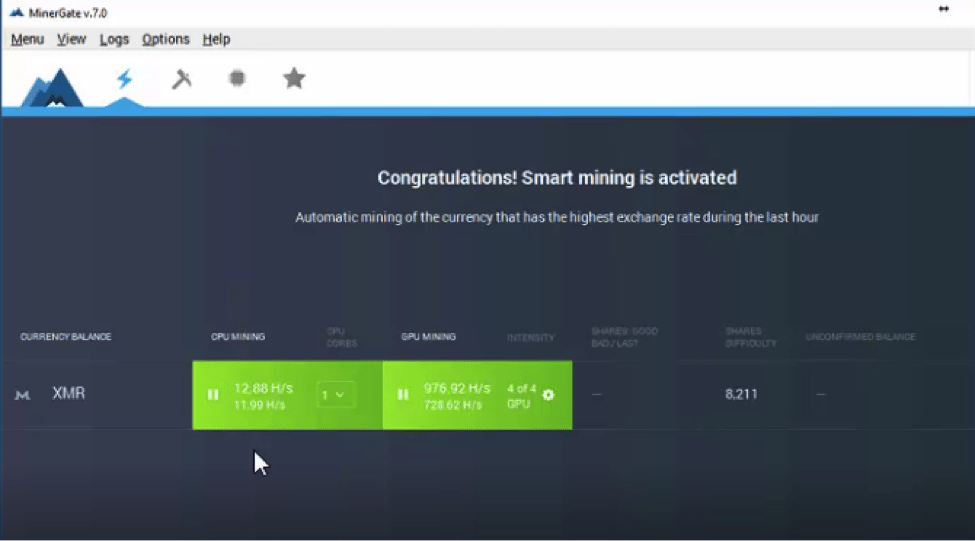
Being able to mine with a click button GUI like this is amazing, as it lets almost anyone get started with mining without any fuss, .bat files, or configuration. Just click a button and boom—you’re mining crypto.
But we want to take it to the next level. Read on to see how you can maximize your Monero mining and increase your performance almost 2.5x on mining rigs.
Step 4: Advanced – Maximizing Your Monero Mining Rig
Nvidia Mining Rigs
If your rig uses Nvidia GPUs, the EWBF miner is generally the preferred choice for GPU mining. At the same time, if you have a capable CPU (like an Intel i5 or i7), you can also mine Monero with your CPU using Minergate.
Minergate is compatible with other miners, so you can dual-mine: run Minergate on your CPU while using a separate miner (like EWBF) for coins like Zcash. This allows you to maximize your hardware’s earning potential without conflicts between miners.
Step 5: Tweak Windows Settings
Some settings should be modified in Windows to get you ready for mining. First, you don’t want your computer to go to sleep, as it will interrupt your mining. Go to your Power Settings and set it to Never Turn Off or Sleep.
You’ll want to modify your system page file and manually set it to 16,384 MB (16 GB).
To reduce interruptions while mining, you might consider temporarily disabling Windows Updates. If you prefer to keep them on for security reasons, that’s fine—but be aware that automatic updates can sometimes restart your system unexpectedly, which will pause your mining operations.
If you’re using Windows Defender or another antivirus program, add an exclusion for your miner folder. This prevents the software from mistakenly flagging or blocking the miner, ensuring your programs (like Claymore or others) run smoothly without interference.
Step 6: Run the Miner
Once you’ve completed your Windows tweaks, run the miner by double-clicking the .bat file you created. If Windows prompts you for firewall approval, allow it, and your miner will start hashing for Monero.
In our example, a rig with four RX 470 GPUs reached around 1,000 h/s using Minergate’s one-touch GUI. Switching to Claymore (or a currently supported AMD miner) on the same rig boosted performance to over 2,400 h/s—nearly a 2.5× improvement. Claymore has long been a powerhouse for AMD mining, and modern miners continue this tradition.
The advantage of this setup is that your GPU mining can still credit your Minergate account. You can run the Minergate GUI for CPU mining while simultaneously running the GPU miner, maximizing your overall hash rate without conflict.
Step 7: Check Your Progress
When you’re logged in to Minergate, go to your Dashboard to monitor your active workers and see your overall mining progress. Click on the Withdraw button to send the Monero you have mined to another XMR wallet or exchange.
Conclusion
Mining XMR can be a rewarding way to put your hardware to work, whether you’re using a GPU, CPU, or a combination of both. By optimizing your setup and choosing the right miner, you can maximize efficiency, reduce costs, and even diversify your earnings across different cryptocurrencies. With a bit of experimentation and careful management, Monero mining offers a practical entry point into the world of crypto while keeping your operation flexible and accessible.
See also:
- Monero Mining Calculator
- Best Monero Wallets in 2026 to Store XMR
- What is Bitcoin Mining and How Does it Actually Work in 2026
- Bitcoin Mining Hardware Reviews & Comparison
FAQs
How much is Monero worth?


[ccpw id=”167164″]
What algorithm does Monero use for mining?
Monero uses the RandomX algorithm for mining. It was introduced in late 2019, replacing the older CryptoNight algorithm.
What do you need to mine Monero?
The best hardware for mining Monero is a GPU; however, it can be mined with a CPU as well.
Can you mine Monero through ASIC?
No, you can’t. Monero’s RandomX algorithm is specifically designed to resist ASIC development, keeping mining accessible to CPUs and standard GPUs. This approach helps maintain decentralization and prevents large-scale mining farms from dominating the network.

Why you can trust 99Bitcoins
Established in 2013, 99Bitcoin’s team members have been crypto experts since Bitcoin’s Early days.
Weekly Research
100k+Monthly readers
Expert contributors
2000+Crypto Projects Reviewed