






In This Article
- Trezor Safe 3 Review Summary
- Special Trezor 30% Discount for 99Bitcoins Readers
- Company Overview
- What’s Included With the Trezor Safe 3 Hardware Wallet
- Trezor Safe 3 Supported Coins
- How Much Does The Trezor Safe 3 Cost?
- Who Is the Trezor Safe 3 Suitable For?
- Looking for a Free Software Wallet Alternative?
- Conclusion – Is the Trezor Safe 3 Worth It?
This Trezor Safe 3 product info and review takes a close look at one of Trezor’s most affordable hardware wallets and how it fits into today’s crypto security landscape. As a direct evolution of the original device, the Safe 3 builds on the Trezor One vs Safe 3 design philosophy by keeping things simple while introducing meaningful security upgrades.
In this Trezor wallet review, we examine the Trezor Safe 3 hardware wallet, including its core security model, supported cryptocurrencies, and real-world usability. Key topics include Trezor Safe 3 features, hardware wallet specs, and how the device handles long-term storage for hardware wallet cryptocurrency users. We also answer common questions such as is Trezor safe and whether Trezor Safe 3 Bluetooth support exists (spoiler: it doesn’t).
The guide also breaks down Trezor Safe 3 price and features and compares the device against leading alternatives, including Trezor Safe 3 vs Safe 5, Trezor Safe 3 vs Trezor Model T, and Trezor Safe 3 vs Ledger Nano S Plus, helping readers decide which hardware wallet best matches their needs in 2026.
Key Takeaways
- The Trezor Safe 3 is a security-focused hardware wallet designed for long-term cryptocurrency storage.
- It combines a Secure Element chip with open-source firmware for physical protection and transparency.
- The wallet supports over 8,000 cryptocurrencies but lacks native support for some major networks.
- There is no Bluetooth support, which reduces attack surface but limits mobile convenience.
- The Trezor Safe 3 is competitively priced and offers strong value compared to similar hardware wallets.
- It is best suited for users who prioritize security over frequent mobile access or advanced interfaces.
Trezor Safe 3 Review Summary
The Trezor Safe 3 is one of the flagship hardware wallets from Trezor, along with their Trezor Safe 5. The Safe 3 is based upon the design of the highly-renowned Trezor Model One but with some significant upgrades, both hardware- and software-wise.
The Safe 3 is compact, easy to use, and supports almost any major asset or Ethereum-based token you could think of. Coupled with the Trezor Keep Metal, users can reliably store their seed phrase in a virtually indestructible way.
That’s the Trezor Safe 3 in a nutshell. If you want a detailed review of our experience with this Trezor cold wallet, keep on reading.
| Feature | Details |
|---|---|
| Wallet Type | Hardware wallet (cold storage) |
| Supported Assets | 8,000+ cryptocurrencies and tokens |
| Security Model | Offline key storage + Secure Element (EAL6+) |
| Recovery Options | Seed phrase, Shamir Backup |
| Connectivity | USB-C (no Bluetooth) |
| Mobile Support | Desktop & Android (iOS via desktop workaround) |
| Display & Controls | OLED screen with two physical buttons |
| Open-Source Firmware | Yes |
| Third-Party Wallet Support | Yes |
| Price | $79 |
| Best Use Case | Long-term cryptocurrency storage |
Special Trezor 30% Discount for 99Bitcoins Readers
For a limited time only, get 30% off the Trezor One and Trezor Model T wallets. To claim your discount, use code 99coins30 at checkout on the official Trezor site.
Company Overview
Trezor is part of SatoshiLabs Group, a company founded in 2013 by Marek “Slush” Palatinus and Pavol “Stick” Rusnák. It is currently headquartered in Prague, Czech Republic.
The company released the world’s first electronic hardware wallet, the Trezor One, in 2014. It went on to become one of the world’s most popular hardware wallets. Trezor now provides several cold-storage options, as well as Bitcoin-only versions of their hardware wallet devices.
SatoshiLabs is known for its commitment to open-source software. The company has also made contributions to the community via blockchain research and initiatives, including the creation of the innovative Shamir Backup.
What’s Included With the Trezor Safe 3 Hardware Wallet
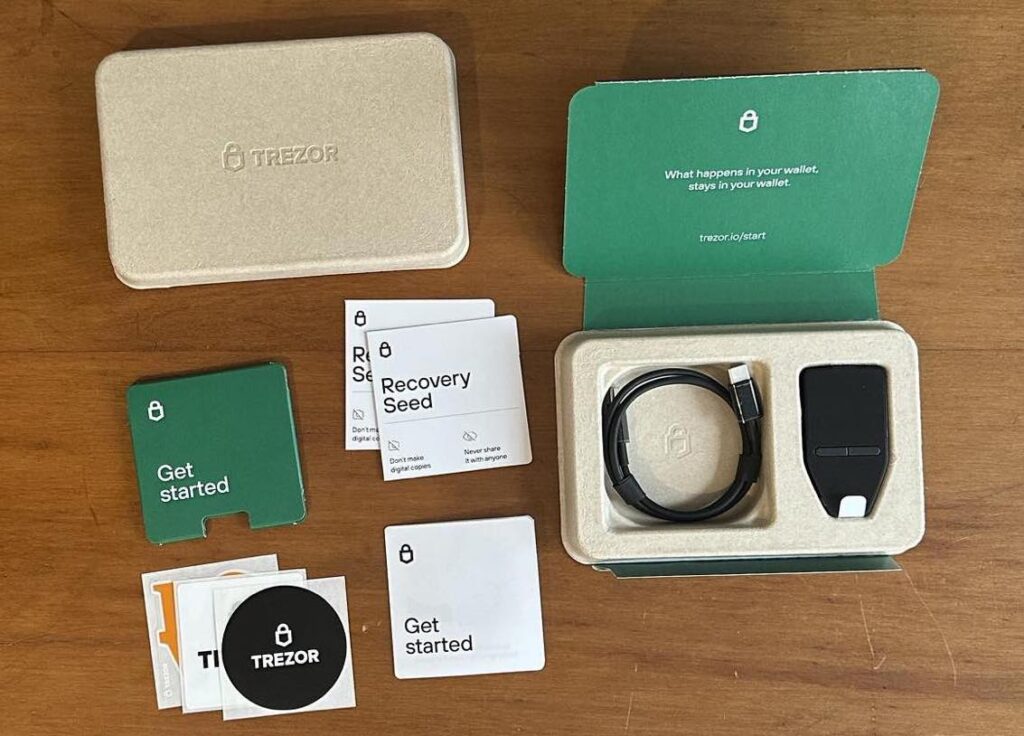
The Trezor Safe 3 comes in a modest, environmentally-friendly box containing one Trezor Safe 3 device, a USB-C to USB-C connector cable, and two seed phrase backup cards. It also includes a small “Get started” leaflet, as well as some free Trezor stickers. Keep an eye on the tamper evident seals
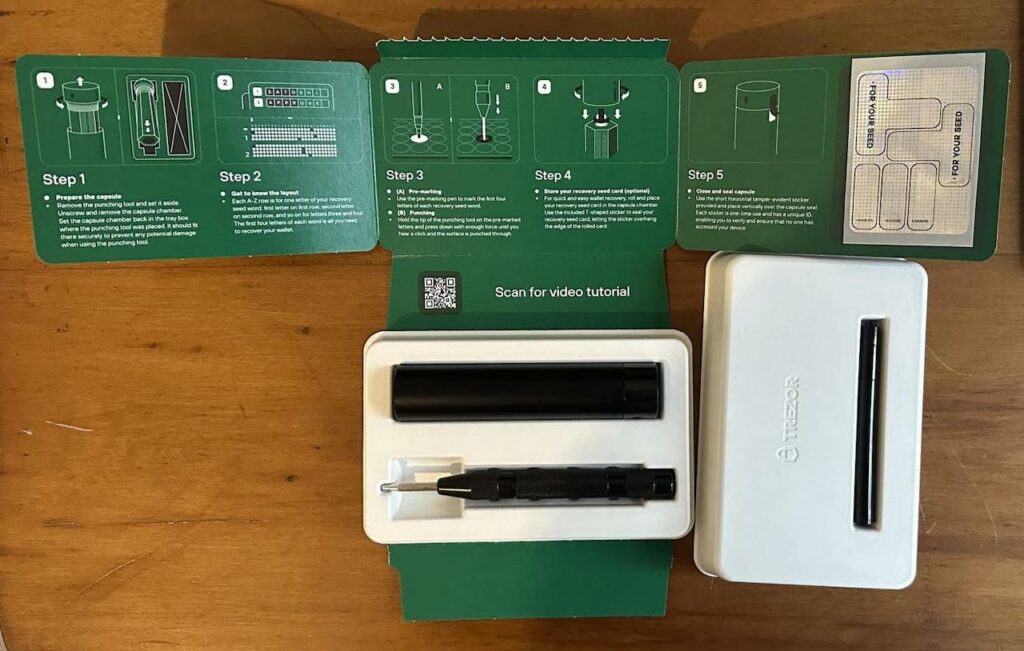
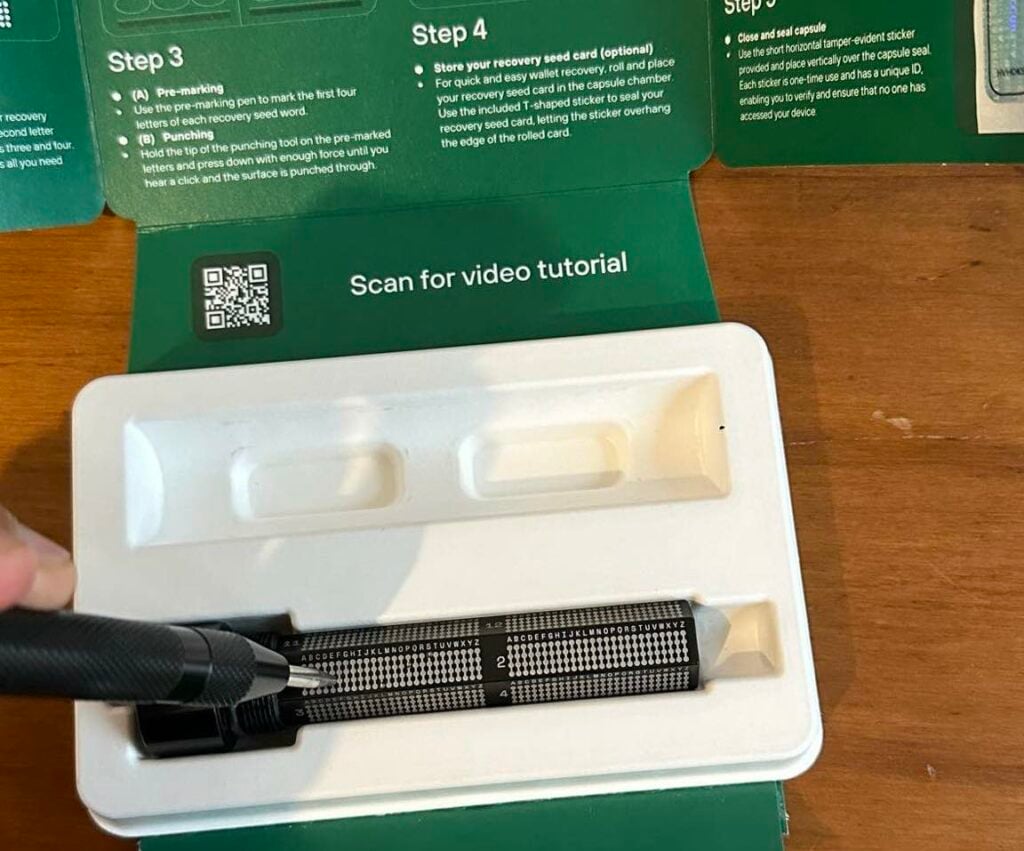
We also received a Trezor Keep Metal device, designed for storing your seed phrase in a near-indestructible way. This package contains one Trezor Keep Metal capsule and casing, a hole-punch tool, a marker, three unique tamper proof seals, and an instruction guide.
Trezor Safe 3 Supported Coins
The Trezor Safe 3 hardware wallet cryptocurrency support is robust with over 8,000 different crypto assets from several blockchains. This includes, but is not limited to:
| Blockchain | Supported Assets (Examples) |
|---|---|
| Bitcoin | BTC |
| Ethereum | ETH, ERC-20 tokens, ERC-721 NFTs |
| BNB Chain | BNB, BEP-20 tokens |
| Cardano | ADA |
| Ripple | XRP |
| Polygon | MATIC |
| Litecoin | LTC |
| Avalanche | AVAX |
| Dogecoin | DOGE |
| Stablecoins | USDC, USDT (via supported networks) |
| Staked Assets | Lido Staked Ether (stETH) |
| Meme Coins | SHIB and other ERC-20 BEP-20 and SPL tokens |
This Trezor crypto wallet also supports a very wide range of Ethereum-based tokens, including ERC-20 tokens and non-fungible tokens (NFTs) such as ERC-721 assets. Asset support depends on network compatibility and integration with Trezor Suite or third-party wallets.
Trezor Safe 3 Features Reviewed
The Trezor Safe 3 was a nice and familiar experience, taking the same hardware design and companion app as the Trezor Model One, its predecessor. This section focuses on the most important decision factors in a Trezor Safe 3 hardware wallet review: security design, asset support, usability, and real-world limitations. Rather than listing specs in isolation, we look at how those features actually affect long-term cryptocurrency storage. You can also learn more in our Trezor Safe 5 Review.
Security Architecture and Secure Element
The Trezor Safe 3 introduces a Secure Element chip rated EAL6+, marking a meaningful shift in Trezor’s hardware design. The chip is responsible for enforcing PIN attempts and protecting against physical extraction attacks, while the main device logic continues to run on open-source firmware. This hybrid approach is designed to balance transparency with stronger resistance to hardware tampering.
In practice, the Secure Element adds an extra defensive layer if the device is lost or stolen, but it does not remove the need for proper seed phrase storage. Like all non-custodial wallets, ultimate security still depends on how carefully recovery information is handled. Shamir Backup support further strengthens recovery by allowing the seed phrase to be split across multiple shares, reducing single-point-of-failure risk.
Supported Coins and Ecosystem Compatibility
From an asset perspective, the Trezor Safe 3 supports more than 8,000 cryptocurrencies and tokens, covering Bitcoin, Ethereum, ERC-20 tokens, NFTs, and several major Layer 1 networks. This makes the wallet well suited for long-term hardware wallet cryptocurrency storage rather than frequent trading or DeFi interaction.
That said, support is not universal. Some popular ecosystems, including Solana, Monero, Polkadot, and Cosmos, are not natively supported inside Trezor Suite. In certain cases, these assets can still be managed through third-party wallet integrations, but users with heavy exposure to those networks should be aware of the added complexity.
Connectivity, Controls, and Daily Usability
The Safe 3 uses a USB-C connection and does not support wireless features. There is no Trezor Safe 3 Bluetooth capability, which reduces the device’s attack surface but also limits convenience for mobile-first users. Transactions are confirmed directly on the device using a small display and two physical buttons, a design carried over from earlier Trezor models.
This interface prioritizes clarity and security over speed. While it lacks the polish of a touchscreen, on-device confirmations are straightforward, and the absence of wireless connectivity may appeal to users who prefer a more conservative security posture.
Mobile and Desktop Compatibility
Trezor Safe 3 works best in a desktop environment, where full functionality is available through Trezor Suite. Android users can connect the device via USB-C and manage assets without significant limitations. iPhone users, however, must rely on a desktop computer due to iOS restrictions and the lack of Bluetooth support.
As a result, the Safe 3 is better suited for users who interact with their wallet occasionally rather than those who need constant mobile access.
Design, Build Quality, and Durability
Physically, the Safe 3 maintains a compact and lightweight form factor. The plastic casing keeps the device portable and discreet, though it does not feel as premium as some higher-priced alternatives. The small screen and minimalist layout reinforce the wallet’s focus on function over aesthetics, making it practical for secure storage but less appealing for users who value visual polish.
Pros
-
Secure Element (EAL6+) adds strong protection against physical attacks
-
Open-source firmware improves transparency and trust
-
Supports over 8,000 cryptocurrencies and tokens
-
Shamir Backup provides advanced recovery options
-
Affordable price compared to other hardware wallets
-
USB-C connectivity with clear on-device transaction confirmation
Cons
-
No Bluetooth connectivity for wireless or mobile use
-
No touchscreen display, relies on two physical buttons
-
Limited iOS compatibility due to lack of Bluetooth support
-
Some major cryptocurrencies require third-party wallets
-
Plastic build feels less premium than higher-end competitors
How Do I Setup My Trezor Safe 3
The Trezor Safe 3 is designed to be set up alongside the Trezor companion app on a desktop. It follows almost exactly the same process as the Trezor Model One and Trezor Model T.
Step 1: Download the App & Connect to a Computer
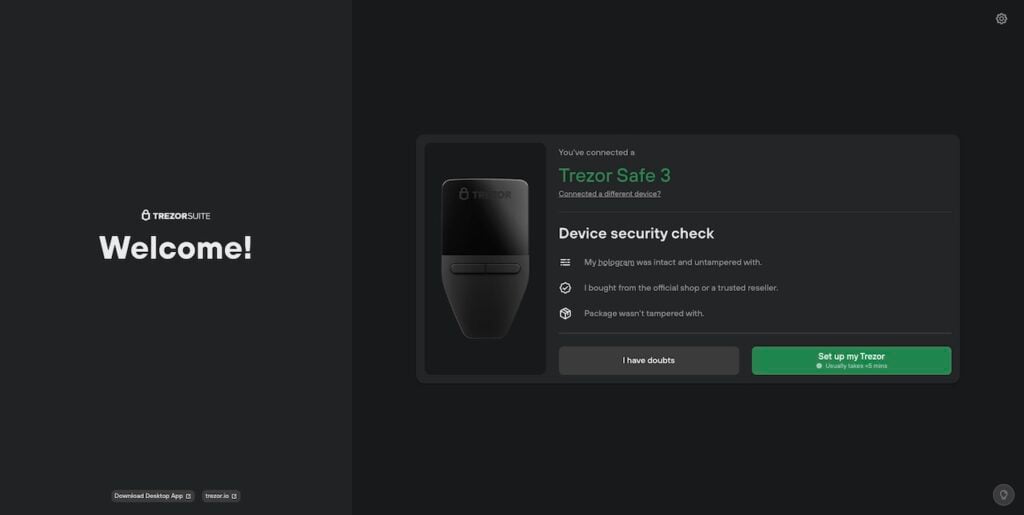
To begin, use a computer to visit the Trezor start page shown in the “Get started” leaflet included in the box. Install the desktop app, or simply open the web version in your browser.
Remove the tamper evident seal on the Safe 3, and connect the device to your computer using the USB-C to USB-C cable provided. Confirm the connection within the app.
Step 2: Install Firmware & Verify Authenticity
Your Trezor Safe 3 comes as a blank device, so the next step is to install the wallet’s latest firmware. Follow the instructions on the app to install it.
Next, the app will help you verify the authenticity of your device to ensure that it is genuine and safe to use.
Step 3: Create a Wallet & Back up the Seed Phrase
Next, you need to create your wallet.
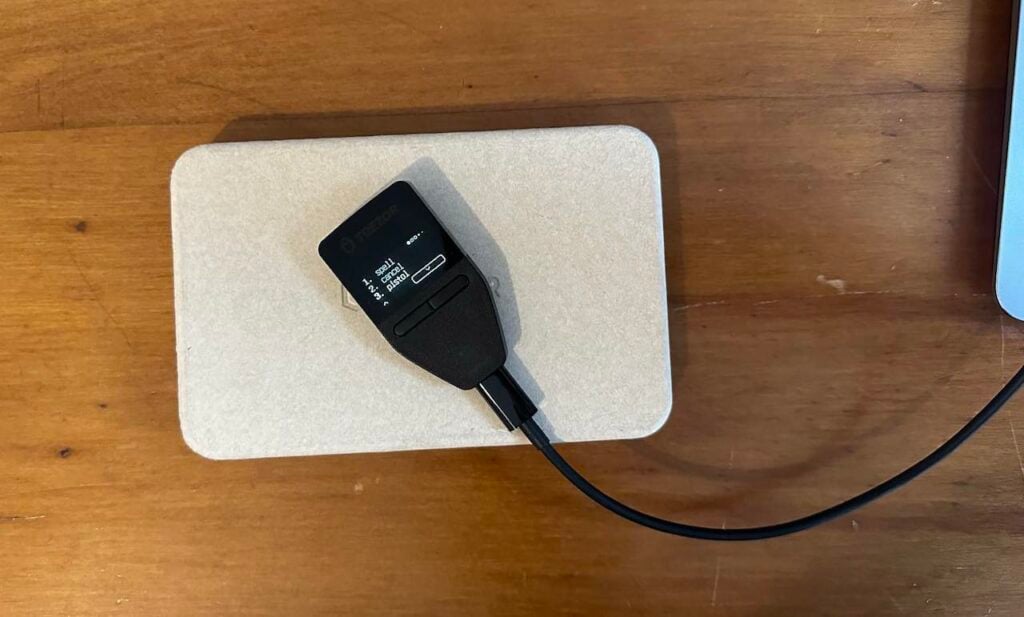
Select “Create new wallet” and follow the steps on your Safe 3’s screen using the two physical buttons on the device.
Write down the seed phrase manually on one of the seed phrase cards provided using a pen. You will then confirm three of the words from your seed phrase on the device.
Step 4: Back up Your Seed Phrase Using Keep Metal (Optional)
If you have one, this is also the perfect time to back up your seed phrase using Trezor’s Keep Metal device (sold separately).
To back up your seed phrase using the Keep Metal, use the marker to pre-mark the first four letters of each word into the capsule. Double-check the markings, and then permanently mark them using the punch tool.
You may also simply roll up your seed phrase card and store it inside the hollow center of the capsule.
Screw the capsule casing back on, and apply one of the unique tamper-proof seals to the opening end of the capsule and cover.
Step 5: Set a PIN, Select Assets
You will then be asked to set up an optional PIN number to access your Safe 3 device, between 4 and 12 digits long.
Finally, select the assets or asset types that you intend to store on your Safe 3. You can always add new assets later, but this step will make it easier to select assets from the device’s main menu.
Add an optional passphrase for access via the app, and voila! Your Trezor Safe 3 is ready to begin storing cryptocurrencies.
How Much Does The Trezor Safe 3 Cost?
The Trezor Safe 3 price is $59, placing it firmly in the entry-level tier of hardware wallets. At this price point, it competes directly with budget-focused cold storage devices while still offering advanced security features like a Secure Element and Shamir Backup.
The wallet is best purchased directly from Trezor’s official website, which reduces the risk of tampering and ensures access to the latest firmware and authenticity checks. Buying from unofficial resellers is generally discouraged for hardware wallets due to supply-chain risks.
From a value perspective, the Safe 3 delivers strong security for its cost. While it lacks premium features such as a touchscreen or wireless connectivity, those omissions help keep the price low and the attack surface minimal. For users focused on long-term storage rather than daily transactions, this trade-off often makes sense.
When comparing Trezor Safe 3 specs, price and features, the wallet stands out for users who want strong physical security without paying for premium hardware elements they may not need. The inclusion of a Secure Element at this price is uncommon, and open-source firmware remains a key differentiator compared to competitors from Ledger.
However, users who prioritize mobile convenience or frequent transactions may find better value in higher-priced alternatives with Bluetooth or touchscreens. In contrast, long-term holders who prefer a conservative security model will likely find the Safe 3 offers excellent value for money.
Who Is the Trezor Safe 3 Suitable For?
The Trezor Safe 3 is best suited for cryptocurrency holders who want a straightforward and secure cold storage solution. It appeals to users who primarily manage assets on desktop or Android devices and do not require wireless connectivity or a touchscreen interface. Long-term holders, Bitcoin-focused users, and those who value open-source security practices will find the Safe 3 particularly attractive.
On the other hand, users who trade frequently, rely heavily on mobile access, or want a more modern interface may be better served by hardware wallets with Bluetooth support or touchscreens.
Trezor Safe 3 Alternatives
While the Trezor Safe 3 hardware wallet specs offer strong security at an affordable price, it is not the only hardware wallet worth considering. Below is a breakdown of how the Safe 3 compares to other popular options from Trezor and Ledger, focusing on real differences that matter to buyers.
| Wallet | Price | Touchscreen | Bluetooth | Secure Element | Best For |
|---|---|---|---|---|---|
| Trezor Safe 3 | $59 | No | No | Yes | Affordable long-term cold storage |
| Trezor Model T | $219 | Yes | No | No | Ease of use and touchscreen control |
| Trezor Safe 5 | $169 | Yes | No | Yes | Premium Trezor experience |
| Ledger Nano X | $149 | No | Yes | Yes | Mobile-first users |
| Ledger Nano S Plus | $79 | No | No | Yes | Budget hardware wallet users |
Trezor Safe 3 vs Trezor Model T
The Trezor Model T sits higher in Trezor’s product lineup and is aimed at users who prioritize ease of use over price. Its touchscreen makes PIN entry, passphrase input, and transaction confirmations faster and more intuitive. However, it comes at a significantly higher cost and does not include a Secure Element chip.
By contrast, the Safe 3 trades the touchscreen for physical buttons but adds a Secure Element and comes in at a much lower price. For users focused on long-term storage and security rather than frequent interaction, the Safe 3 often represents better value.
Trezor Safe 3 vs Trezor Safe 5
The Trezor Safe 5 is the most advanced hardware wallet in Trezor’s current lineup. It combines a touchscreen interface with upgraded hardware and a more premium build. This makes it better suited for users who want modern usability without compromising security.
That said, the Safe 5 is significantly more expensive. Users who do not need a touchscreen or enhanced ergonomics may find that the Safe 3 delivers nearly the same core security at a much lower cost. A detailed breakdown of those differences is covered in our dedicated Trezor Safe 5 review, which can be referenced for readers considering an upgrade.
Trezor Safe 3 vs Ledger Nano X
The Ledger Nano X is designed with mobile-first users in mind. Its Bluetooth connectivity allows for wireless management through Ledger’s mobile app, making it more convenient for frequent access and transactions.
The Safe 3 takes a more conservative approach. It avoids wireless connectivity entirely, reducing potential attack vectors but sacrificing convenience. Users who prioritize maximum isolation and transparency may prefer the Safe 3, while those who value portability and wireless access may lean toward the Nano X.
Trezor Safe 3 vs Ledger Nano S Plus
The Ledger Nano S Plus is the closest direct competitor to the Safe 3 in terms of price. Both wallets are similarly sized, rely on USB connections, and target long-term storage rather than active trading.
The main difference lies in philosophy. The Safe 3 emphasizes open-source firmware and transparency, while the Nano S Plus relies on a closed-source security model. Users who value auditability and community review may prefer Trezor’s approach, while others may prioritize Ledger’s broader mobile ecosystem.
Looking for a Free Software Wallet Alternative?
Trezor Safe 3 can be a great hardware wallet to balance affordability and security with features like the Secure Element chip and Shamir Backup. However, it may not be the ideal solution for users seeking flexibility, convenience, or regular access to their funds. This is where Best Wallet excels as a software wallet alternative.

Designed for everyday crypto management, Best Wallet supports over 60 blockchains, making it versatile for both beginners and advanced users. Unlike the Trezor Safe 3, which requires a physical device and setup, Best Wallet operates entirely on your smartphone, offering seamless access to features like staking, integrated DEX trading, and fiat on/off ramps.
Trezor Safe 3 vs. Best Wallet: A Comparison
| Feature | Trezor Safe 3 | Best Wallet |
| Type | Hardware Wallet (Cold Storage) | Software Wallet (Hot Wallet) |
| Security | Very high (Secure Element, Shamir Backup) |
High (local key storage, 2FA, biometrics)
|
| Ease of Use | Moderate (physical device required) | High (intuitive mobile app) |
| Supported Assets | 8,000+ cryptocurrencies |
Multiple currencies across 60+ blockchains
|
| Cost | $79 | Free to download and use |
| Backup Options | Seed phrase, Shamir Backup |
Local backup with 12- or 24-word phrases
|
| Integrated DEX | No | Yes |
| Fiat On/Off Ramps | No | Yes |
| Accessibility | Requires physical device | Available on iOS and Android |
| Durability | Durable design with Secure Element |
Digital wallet, no physical device needed
|
| Best For | Long-term secure storage |
Everyday crypto management and trading
|
| Unique Features | Shamir Backup, Secure Element chip |
Staking, DEX, fiat ramps, iGaming hub
|
What’s New With the Trezor Safe 3 in 2026?
The Trezor Safe 3 has been out for a while now, and since its launch in late 2023, there’ve been a few important updates. Some features were removed, others improved, and there’s more clarity around how it works with mobile devices. Here’s what’s new and what you should know before you buy (or if you already own one).
CoinJoin Support Got Removed
Trezor used to support CoinJoin transactions directly in Trezor Suite, but that changed on June 1, 2024. They dropped the feature because the partner who ran the coordination server pulled out, and Trezor decided not to continue it with someone else.
If you’ve already used CoinJoin in the past, your account and funds are still there. You just can’t start new CoinJoin rounds anymore. So if you see other reviews hyping CoinJoin support, keep in mind it’s no longer active.
Some Coins Were Dropped From Trezor Suite
As of February 2025, a few coins were removed from Trezor Suite. These include Dash, Bitcoin Gold, DigiByte, Namecoin, and Vertcoin. If you’re holding any of those, you won’t be able to manage them in the latest version of Suite. You’d need to either downgrade or use an external wallet that supports them.
It’s a good reminder that coin support can change, so it’s worth double-checking what’s supported before moving funds around.
There’s a Bitcoin-Only Version of the Safe 3
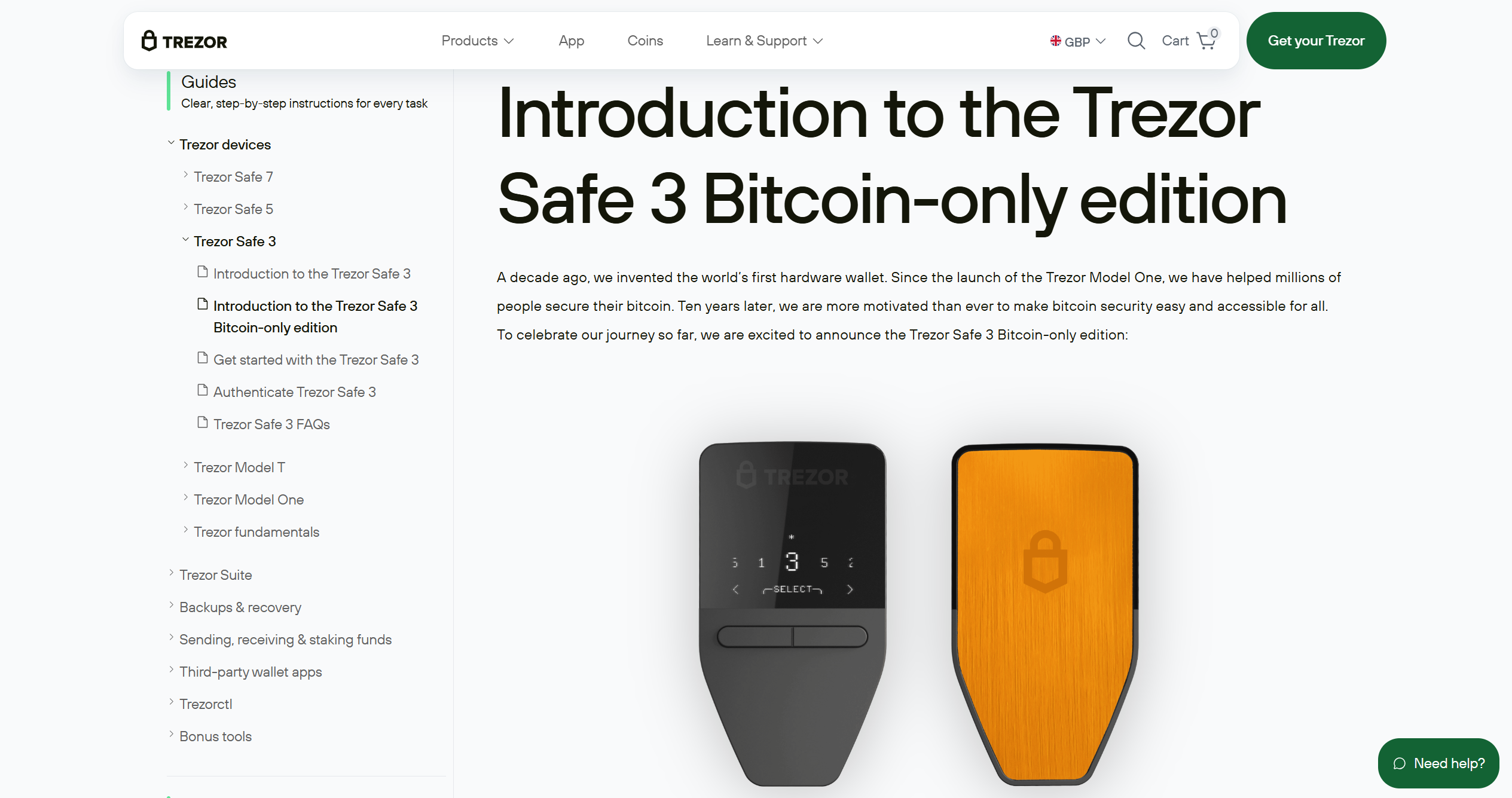
Trezor released a Bitcoin-only version of the Safe 3, and it’s easy to spot thanks to its orange color. This version runs firmware that only supports Bitcoin. If you’re a BTC maxi or just don’t want other coins getting in the way, this might be your best pick.
Works on Desktop and Android, but iPhone Users Need a Workaround
Trezor still recommends using a desktop computer for setup, especially for first-time users. But Android users can now plug in their Safe 3 via USB and run Trezor Suite Mobile with no issues. It works smoothly and supports full functionality.
For iPhone users, it’s a different story. Because the Safe 3 doesn’t have Bluetooth and iOS doesn’t play nice with USB accessories like this, you’ll need to use a desktop to get started and manage your wallet.
The Secure Element Does More Than You Might Think
The Safe 3 has a Secure Element chip rated EAL6+, which adds another layer of physical protection. It’s responsible for enforcing PIN attempts and guarding your keys from tampering. So even if someone gets your device, the chip helps make sure your private keys stay safe.
Trezor combines this with open-source firmware and another chip that handles the main logic, so you’re getting both transparency and hardware security in one package.
Trezor Suite Keeps Getting Better
Trezor Suite has seen regular updates over the past year. Some of the more useful changes include:
- Passphrase protection is now off by default during setup. You can still turn it on later from the settings.
- The new authenticity check helps confirm that your device is legit when you first set it up.
- Firmware version 2.9.1 added features like Cardano message signing and improved how transactions are displayed.
It’s all part of an ongoing push to make things easier for new users while keeping advanced tools close at hand.
Conclusion – Is the Trezor Safe 3 Worth It?
The Trezor Safe 3 strikes a strong balance between security, simplicity, and price. By combining offline key storage with a Secure Element and open-source firmware, it delivers a conservative security model that appeals to long-term holders who prioritize protection over convenience features.
At its price point, the Safe 3 offers meaningful upgrades over earlier entry-level hardware wallets without pushing users into premium territory. The absence of Bluetooth and a touchscreen may feel limiting to some, but those design choices also reduce complexity and potential attack surface. For users who primarily manage assets on desktop or Android and do not require constant mobile access, these trade-offs are reasonable.
Overall, the Trezor Safe 3 is a dependable hardware wallet for securing cryptocurrencies over the long term. It may not be the most feature-rich option available, but its focus on transparency, physical security, and affordability makes it a solid choice for users who want a straightforward and proven cold-storage solution. For those on the hunt for a more comprehensive hardware wallet why not explore our Trezor Safe 7 review to see how far the Safe cold storage range has evolved.
Trezor Safe 3
$79
Pros
- Reputable company
- Easy to use
- Enhanced security
- Affordable
- Supports Shamir Backup
Cons
- Setup requires a computer
- Possible to incorrectly back up a seed phrase
FAQs
What is Trezor?


Trezor is a leading hardware crypto wallet developer. It is part of SatoshiLabs Group, a company founded in 2013 by Marek “Slush” Palatinus and Pavol “Stick” Rusnák.
What is a Trezor wallet?
Trezor wallets are hardware crypto wallets developed by Trezor, which keeps cryptocurrencies in isolation from the internet, thereby providing an extra layer of security.
What makes the trezor safe 3 the best overall hardware wallet?
Trezor Safe 3 is one of the best hardware wallets on the market due to its affordable price, user-friendly interface, and support for a large number of cryptocurrencies.
What is the difference between Trezor Safe 3 vs Model One?
The Trezor Safe 3 is an upgraded version of the Trezor Model One for just $10 more. The main difference is the inclusion of the Secure Element chip and the Shamir Backup option for the Trezor Safe 3.
What is the difference between Trezor Safe 3 vs Ledger Nano S Plus?
These two hardware wallets are made by different companies, TREZOR and Ledger. The Trezor Safe 3 was released in late 2023, while the Nano S Plus was released in April 2022. The Trezor Safe 3 can store 8,000+ coins, while the Nano S Plus can store 5,500+. They both have a USBC connection and a Secure Element chip. Since they are identical in price, we would go with the newer Trezor Safe 3.
Is the Trezor Suite software safe to download and use?
If you download the Trezor Suite directly from TREZOR’s website, it is perfectly safe. When using the Trezor Safe 3 or any other TREZOR wallet, you never type your seed phrase directly into the computer. It will always go through the hardware wallet.
What colors does the Trezor Safe 3 come in?
The Trezor Safe 3 comes in Cosmic Black, Galactic Rose, Stellar Silver, and Solar Gold.
Does the Trezor Safe 3 have Bluetooth?
No. The Trezor Safe 3 does not support Bluetooth connectivity. It uses a wired USB-C connection only, which helps reduce potential attack vectors.
When was the Trezor Safe 3 released?
The Trezor Safe 3 was released in late 2023 as part of Trezor’s updated hardware wallet lineup.
Is Trezor a decentralized wallet?
Yes. Trezor wallets are non-custodial, meaning users retain full control of their private keys. No centralized entity can access or manage funds stored on a Trezor device.
Is the Trezor Safe 3 safe?
The Trezor Safe 3 is considered safe for long-term cryptocurrency storage. It combines offline key storage, a Secure Element, and open-source firmware, which together provide strong protection against both remote and physical attacks.
Can the Trezor Safe 3 be used with a mobile phone?
The wallet works with desktop computers and Android devices via USB-C. iPhone users must use a desktop computer due to iOS restrictions and the lack of Bluetooth support.
References
- San José State University School of Information. Blockchain Basics. San José State University, https://ischoolblogs.sjsu.edu/blockchains/basics/
- Stanford Online. How Does Blockchain Work? Stanford University, https://online.stanford.edu/how-does-blockchain-work
- Massachusetts Institute of Technology Sloan School of Management. Blockchain Explained. MIT Sloan, https://mitsloan.mit.edu/ideas-made-to-matter/blockchain-explained
- Library of Congress. Cryptocurrency and Blockchain. Library of Congress, https://guides.loc.gov/fintech/21st-century/cryptocurrency-blockchain
- National Institute of Standards and Technology. Blockchain Technology Overview. NIST, https://www.nist.gov/blockchain

Why you can trust 99Bitcoins
Established in 2013, 99Bitcoin’s team members have been crypto experts since Bitcoin’s Early days.
Weekly Research
100k+Monthly readers
Expert contributors
2000+Crypto Projects Reviewed