




Thinking about investing in Bitcoin (BTC), but unsure whether it’s safe? Reasonable enough. Digital assets have become increasingly mainstream, and Bitcoin, the world’s first and largest cryptocurrency, continues to attract everyone from first-time buyers to institutional investors adding BTC to their balance sheets.
Often described as “digital gold,” Bitcoin is known for its fixed supply, decentralized design, and long-term growth potential. At the same time, it’s a highly volatile asset and comes with risks that every investor should understand before committing capital.
What’s the best way to invest in Bitcoin? In this guide, we’ll walk you through how to invest in Bitcoin as safely as possible. You’ll learn where to buy Bitcoin, how to store it securely, and the different ways people invest—from long-term holding to ETFs and trading. We’ll also cover the most common safety concerns, including price volatility, scams, custody risks, and regulatory considerations.
By the end, you’ll have a clear understanding of whether Bitcoin fits your risk tolerance and how to approach investing in it with confidence.
Don’t like to read? Watch our video review instead:
How to Safely Invest in Bitcoin: Summary
There are several ways to gain exposure to Bitcoin, each with a different risk profile:
- Buying and holding Bitcoin (self-custody)
- Trading Bitcoin and derivatives
- Investing via Bitcoin ETFs
- Using Bitcoin IRA (for US investors)
For most long-term investors, the safest approach is buying Bitcoin and holding it in a secure personal wallet, where you control the private keys.
If you want a deeper breakdown of each option—and how to minimize risk—read on.
The Different Forms of Investing in Bitcoin
Before we begin, a word of advice: Bitcoin is a high-risk asset type. It is extremely volatile, and its price can sometimes fall more than 70–80% during bear markets. This level of volatility is normal in crypto, but at the same time, it requires careful planning and realistic expectations.
Unlike traditional assets such as stocks or bank deposits, Bitcoin is not backed by institutions like the FDIC. When you invest in Bitcoin—especially through self-custody—you are responsible for your own security.
At its core, Bitcoin is a digital currency, not a company or a stock. The most basic form of investing is simply buying BTC and holding it. However, there are several other ways to gain exposure, which we’ll cover throughout this guide.
Buying and Hodling Bitcoin
Bitcoin has been proclaimed dead over 475 times. However, here’s the truth about how profitable it’s been to buy and hold Bitcoin. Bitcoin holders have been in profit over 95% of the time:
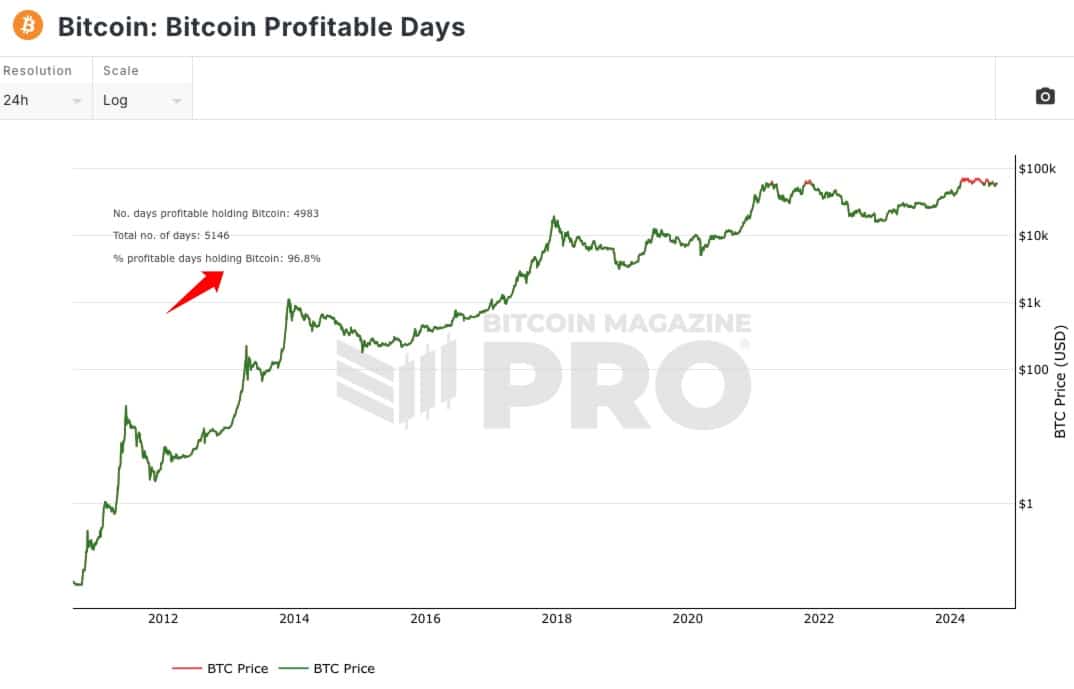
The most common form of “investing” in Bitcoin is buying the currency in hopes it will appreciate (also known as “hodling”, see the origins of the term here).
If you choose this strategy, one rule matters above all else:
Do your own research.
No one can reliably predict Bitcoin’s price. Learn how it works, why people value it, and decide for yourself whether it fits your goals.
Practical tips for hodling Bitcoin safely:
- Only invest what you can afford to lose. Bitcoin should be treated as a speculative asset.
- Consider self-custody for long-term holdings. Keeping BTC in your own wallet reduces reliance on third parties.
- Use hardware wallets for larger amounts. They provide strong protection against online attacks.
- Avoid outdated “paper wallet” setups unless you fully understand the risks—modern software wallets with proper backups are safer for most users.
- Buy from reputable exchanges with strong security practices.
- Use dollar-cost averaging (DCA). Buying fixed amounts regularly can reduce timing risk and emotional decision-making.
Here’s a short video to explain DCA:
Bitcoin IRA
For US residents, Bitcoin IRAs offer another way to gain exposure to Bitcoin within a retirement account. These accounts allow you to invest in Bitcoin (or crypto-related products) while benefiting from traditional IRA tax structures.
It’s important to note:
- Not all Bitcoin IRAs are tax-free. Tax treatment depends on whether the account is a Traditional or Roth IRA.
- Providers typically charge custody, trading, and management fees.
- You do not directly control private keys in most setups, introducing counterparty risk.
Bitcoin IRAs can make sense for long-term retirement planning, but investors should carefully compare fees and custody models.
Bitcoin ETFs
Bitcoin ETFs allow investors to gain exposure to Bitcoin through traditional brokerage accounts, without managing wallets or private keys.
The first European Bitcoin ETF was launched on August 15, 2023, on the Euronext Amsterdam stock exchange. This was followed up less than five months later with the U.S. Securities and Exchange Commission (SEC) approving 11 different Bitcoin ETFs in January 2024. Major asset managers earned approval, including BlackRock, Fidelity, and Franklin Templeton. Many investors prefer ETFs due to their familiar nature.
Pros of Bitcoin ETFs:
- Easy access through traditional brokers
- No need to manage wallets or keys
- Familiar tax and reporting frameworks
Cons of Bitcoin ETFs:
- You don’t own actual Bitcoin
- You can’t withdraw BTC or use it on-chain
- Management fees reduce long-term returns
- Selling ETF shares can trigger taxable events in many jurisdictions
ETFs are best suited for investors who want Bitcoin price exposure without engaging directly with crypto infrastructure.
Trading Bitcoin
Bitcoin trading is different from buying and holding. When you are trading Bitcoin, it means that you are actively trying to buy Bitcoin at a low price and sell it back at a higher price in relatively short time intervals. You can think of investing as “Time in the market” and trading as “Timing the market”. Both can be great ways to make money if you know what you are doing.
Successful trading requires knowledge and practice. The cryptocurrency market is occupied by very large players who are waiting for newbies to come in and throw their money away by trading aimlessly and without investment objectives. For most people, long-term investing outperforms frequent trading, especially after fees and taxes.
Here’s our beginner’s guide to Bitcoin trading:
Mining Bitcoin
For the past few years, mining Bitcoin has only been profitable if done at scale. This means you will need to get expensive mining equipment and have access to free or very cheap electricity.
From my perspective, it’s much more cost-effective to buy Bitcoin with this money instead of using it to buy mining equipment. If you want to learn more about mining, watch this video:
Cloud Mining
You may have heard of all sorts of sites that allow you to mine bitcoins through the web. This is known as cloud mining, and from what we’ve seen, these sites fall into one out of two categories:
- They are complete scams that will run away with your money and will never actually use it to mine Bitcoin.
- They are not scams, but they are bad investments since you will probably get more bitcoins if you just use that money to buy bitcoins instead of paying for the service (e.g., Genesis Mining, Hashflare).
Various Bitcoin Investment Schemes
Almost every other day I get a question about a site or company that claims to double your bitcoins, give you insane daily interest on your bitcoins or help you invest them in some sort of complex and obscure ponzi scheme.
These sites can be categorized mostly as scams or HYIPs (high-yield investment programs).
These sites usually take money from people around the web with the promise of good returns. They then start by paying these returns with money from new sign-ups, which creates a big buzz around the site.
Usually, they will also have some sort of referral program so that users can bring in their friends.
This will go on for around 3-4 months until, one day, the website will just go offline, and the money will be gone. No more payments will be made, and a lot of people will get mad that they got scammed.
We have reviewed many Bitcoin investment sites in the past (e.g., Bitconnect, USI Tech, and more), and we have yet to find a site that I can say is legit or safe to invest in.
Again, here are common warning signs that include:
- Guaranteed profits
- Referral-heavy structures
- Pressure to deposit quickly
- Lack of transparency
How can you find out if a site is a scam for yourself? Easy, use our Bitcoin scam test tool.
Conclusion
Should you invest in Bitcoin? There’s no universal answer. Whether Bitcoin is a good investment depends on your goals, risk tolerance, and time horizon.
What matters most is how you invest:
- Educate yourself first
- Start small
- Prioritize security
- Avoid hype-driven decisions
Bitcoin can play a role in a diversified portfolio, but only if you’re prepared for volatility and take responsibility for your own safety. Learning as you go is part of the process. The key is managing risk so mistakes don’t become catastrophic.
See also:
- A Beginner’s Guide to Bitcoin Cloud Mining in 2026
- Bitcoin and Crypto Portfolio Trackers Reviewed and Compared
FAQs
How do I make money with Bitcoin?

Aside from what we’ve mentioned in this post, there are several other ways to make money with Bitcoin, such as:
- Micro earnings
- Owning a faucet
- Signature campaigns
- Affiliate programs
- Gambling
- Writing about Bitcoin
- Bitcoin-related services
- Bitcoin lending
- Bitcoin forks
Feel free to read more about earning Bitcoin.
How much was a Bitcoin worth in 2009?
On October 12, 2009, Martti Malmi, a Finnish developer who helped Satoshi work on Bitcoin, sold 5050 bitcoins for $5.02. This gave 1 Bitcoin the value of $0.0009.
Can you convert Bitcoin to cash?
Yes, Bitcoin can be converted to cash. If you’re looking for physical cash, you can find buyers through Paxful or HodlHodl. If you’re just looking to convert Bitcoin into fiat currency (i.e., USD, EUR, etc.), there are a variety of Bitcoin exchanges available.

Why you can trust 99Bitcoins
Established in 2013, 99Bitcoin’s team members have been crypto experts since Bitcoin’s Early days.
Weekly Research
100k+Monthly readers
Expert contributors
2000+Crypto Projects Reviewed