







As Bitcoin (BTC) continues to mature into a global macro asset, hyper-recurring fears that quantum computers could crack early wallets, including Satoshi’s Bitcoin holdings, resurface. This week, on-chain analyst Willy Woo dismissed those concerns, arguing that even a worst-case scenario would not threaten Bitcoin’s survival.
Against that backdrop, investors are increasingly looking beyond native Bitcoin alone and asking whether scalable Bitcoin Layer-2s like Bitcoin Hyper could be the more brilliant asymmetric play heading into 2026.
Can Quantum Computing Really Crack Satoshi’s Bitcoin?
The idea that quantum computing could suddenly destroy Bitcoin usually starts with early wallet designs. Approximately 4M BTC, including Satoshi Nakamoto’s estimated 1 M coins, are held in pay-to-public-key (P2PK) addresses.
These older formats reveal the public key on-chain once the transaction is spent, which, in theory, could make them vulnerable to a sufficiently advanced quantum computer that could derive the private key.
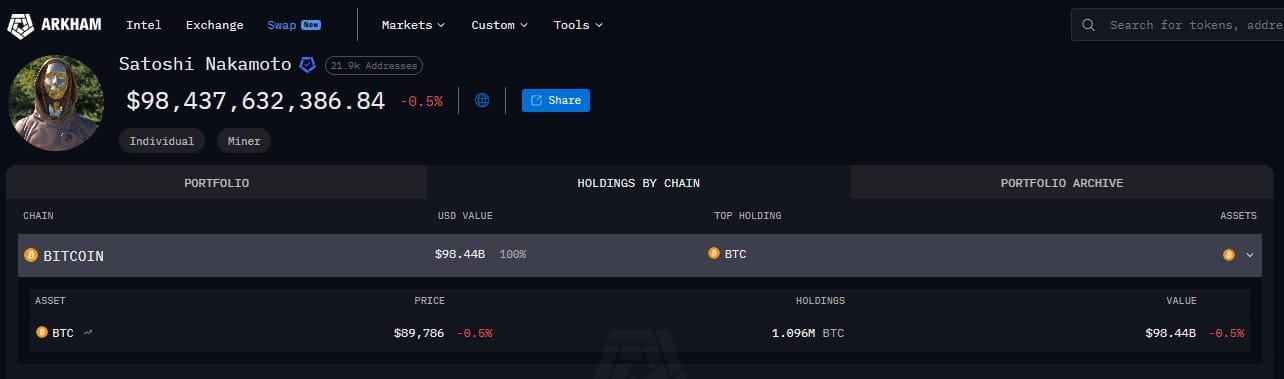
(Source – intel.arkm)
However, theory and reality differ significantly. As Adam Back, co-founder of Blockstream and one of Bitcoin’s earliest contributors, recently noted, Bitcoin does not rely on “encryption” as people assume. Its security model is based on elliptic curve cryptography, and cracking it would require quantum machines that are still decades away.

(Source – X)
Back estimates a 20-40-year timeline before such threats become plausible, and by then, post-quantum cryptography standards will already exist and can be adopted.
Importantly, newer Bitcoin address formats do not expose public keys on-chain unless coins are spent, which means the vast majority of BTC in circulation is not immediately vulnerable. The notion of an overnight quantum apocalypse is essentially speculation, not market reality.
DISCOVER: 16+ New and Upcoming Binance Listings in 2025
What If…?
The more significant risk, according to analysts such as Willy Woo and James Check, is not technical failure but market psychology. A viral hypothetical post recently circulated showing BTC price collapsing to $3 if Satoshi’s coins were hacked and dumped. Woo’s response was “Many OGs would be in to buy the flash crash”.
Many OGs would be in to buy the flash crash.
BTC network would survive, most coins are not immediately vulnerable.
However 4M coins in P2PK addresses (including Satoshi’s) have their public keys in the open and are vulnerable.
->Many year shakeout.
— Willy Woo (@woonomic) December 14, 2025
Woo argues that even if quantum computing were somehow weaponized tomorrow, Bitcoin would survive. Most coins are not exposed; users would rapidly migrate to quantum-resistant addresses, and the network would adapt. James Check, a market analyst, also shared this view, noting that Bitcoin’s primary risk is short-term price volatility, not protocol failure.
There is no realistic scenario where the community freezes Satoshi’s coins preemptively. If anything, a sudden shock would likely trigger the most significant Bitcoin redistribution in history, transferring coins from weak hands to conviction capital. That framing turns fear into opportunity, especially for investors who think beyond the short-term spot BTC price alone.
DISCOVER: 15+ Upcoming Coinbase Listings to Watch in 2025
Why Bitcoin Hyper Could Be the Smart Money Play for 2026?
This is where Bitcoin Hyper enters the conversation. While Bitcoin remains the settlement layer, scaling, yield, and application layers are increasingly moving off-chain and into a Bitcoin-native Layer-2 ecosystem. Bitcoin Hyper is positioning itself squarely in that transition. A more advanced zk-proof (Zero-Knowledge) mechanism is used, enabling a transaction to succeed without revealing significant information.
Built as a Bitcoin Layer-2, Bitcoin Hyper is designed to bring higher throughput, lower fees, and programmable utility to the Bitcoin ecosystem without compromising base-layer security. Instead of betting solely on BTC price appreciation, Bitcoin Hyper offers exposure to Bitcoin’s expanding economic layer, where activity, yield, and usage can grow faster than the underlying asset itself.

Early participants are drawn to Bitcoin Hyper’s presale structure, staking incentives, and the ability to earn yield while waiting for full network rollout. In a market increasingly dominated by institutional accumulation and long-term narratives, this kind of infrastructure play aligns with how smart money typically positions ahead of multi-year cycles.
If Bitcoin’s future is less about survival, then Bitcoin Hyper stands out as a strategic bet for investors looking toward 2026 and beyond.
To keep up with the latest news, you can join X and Telegram
Visit HYPER HereDISCOVER: 10+ Next Crypto to 100X In 2025
Join The 99Bitcoins News Discord Here For The Latest Market Updates
Key Takeaways

Why you can trust 99Bitcoins
Established in 2013, 99Bitcoin’s team members have been crypto experts since Bitcoin’s Early days.
Weekly Research
100k+Monthly readers
Expert contributors
2000+Crypto Projects Reviewed