






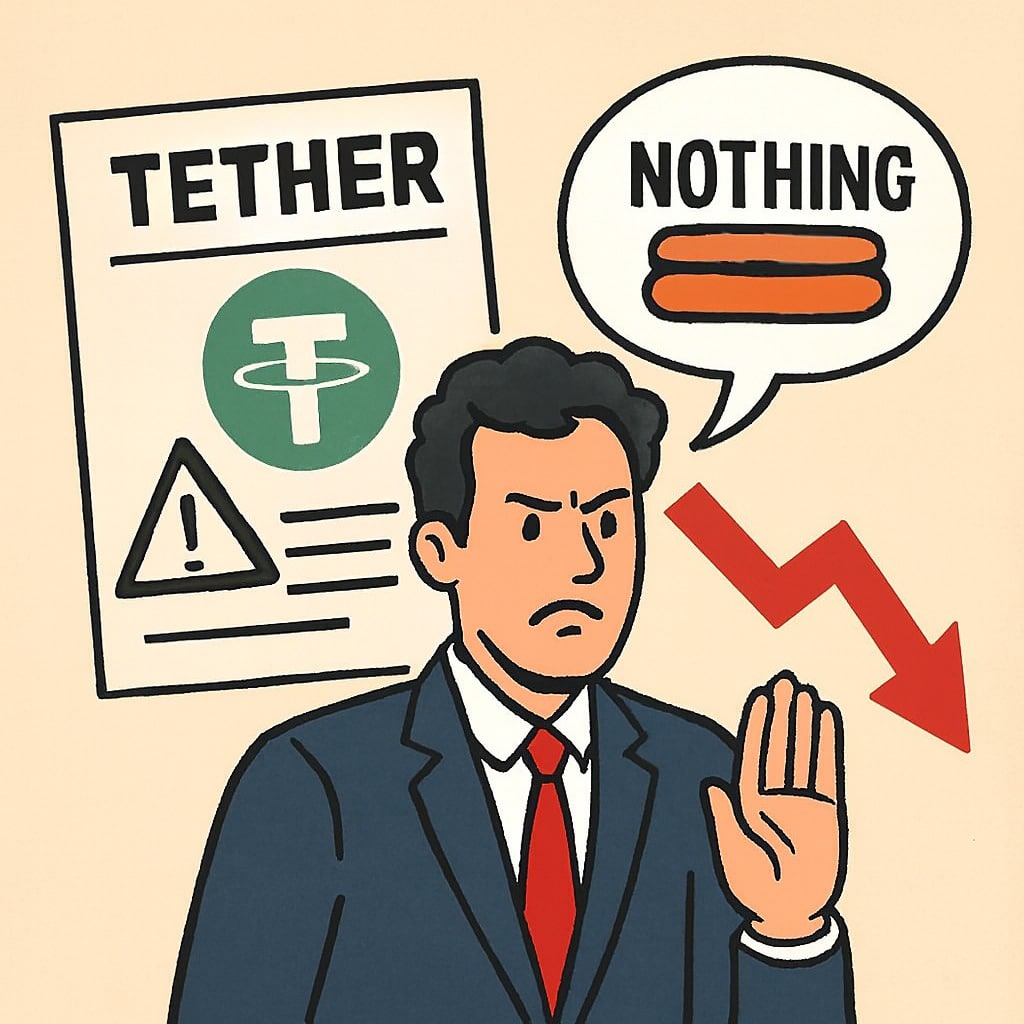
Crypto’s political ambitions just got a lot harder to ignore. A Super PAC with direct ties to Tether crypto executives has quietly funneled $300,000 into a Georgia congressional race. The money trail runs through a company co-founded by Tether’s own U.S. CEO. The details raise questions that the crypto industry’s biggest stablecoin issuer has so far declined to fully answer.
Fellowship, a Super PAC that promised $100 million in political funding when it launched, spent its first disclosed $300,000 on advertising for Georgia Republican House candidate Clay Fuller. That spending went directly to Nxum Group, a firm co-founded by Bo Hines, who serves as CEO of Tether U.S. and previously advised the Trump administration on crypto policy.
🚨TETHER-LINKED FIRM MAKES FIRST POLITICAL AD BUY
Tether-linked Super PAC Fellowship made its first disclosed 2026 midterm ad spend, directing $300,000 to Nxum Group, a firm co-founded by Tether US CEO Bo Hines, a former adviser to President Donald Trump. pic.twitter.com/isV4lcqMhS
— Coin Bureau (@coinbureau) April 12, 2026
The PAC neither disclosed the expense proactively nor listed Fuller among its publicly endorsed candidates, an omission that political watchdogs have flagged as unusual, even if not technically illegal.
This sits against a backdrop of crypto capital pouring into Washington at an unprecedented pace, with industry-linked PACs raising tens of millions across recent election cycles. How much does political influence actually move the needle for crypto’s biggest players? And who benefits when it does?
DISCOVER: 15+ Upcoming Listings to Watch in 2025
Tether Crypto and PAC Story Reveals Crypto’s Political Outlook
Fellowship appointed Jesse Spiro, Vice President of U.S. Regulatory Affairs at Tether, as chair of its committee on April 1. That appointment formally reactivated the PAC’s political presence. Its chief financial officer, Mitchell Nobel, now works at Cantor Fitzgerald, the firm that manages Tether’s global assets. Cantor Fitzgerald’s former chairman is Howard Lutnick, the current U.S. Secretary of Commerce.
That is a remarkably tight web of relationships for an organization Tether International describes as having “no affiliation or regulatory connection” with Fellowship. Tether U.S. declined to comment entirely.
Michael Beckel of Issue One, a political reform group, noted that paying a company affiliated with a PAC’s founder isn’t illegal under U.S. campaign finance rules, provided services were genuinely rendered at market rates. That’s a meaningful caveat. The FEC disclosure filings currently show a zero balance in Fellowship’s account, and the $100 million funding commitment remains unverified in public records.
Something about this doesn’t add up 👀
A Tether-backed super PAC called Fellowship PAC just disclosed spending tied to the 2026 midterms after claiming over $100M raised in a year. On paper, it looks like political advertising. In reality, the money trail is getting… pic.twitter.com/lmlZ7BORv1
— Solix Trading (@Solix_Trade) April 13, 2026
Fellowship’s current footprint is also dramatically smaller than rival crypto PAC Fairshake, which has invested millions across multiple primary races. Fellowship’s supported candidates, by contrast, are almost exclusively Republicans in deeply red districts, suggesting a strategy focused on loyalty over reach, at least for now.
What this story actually illustrates is how crypto’s largest players are learning to operate inside political infrastructure the same way traditional finance has for decades. Tether holds over 122 billion dollars in U.S. Treasury holdings, making it one of the largest sovereign debt buyers on the planet.
The broader meme coin and crypto market environment is absorbing these signals in real time. When stablecoin issuers start shaping congressional races, the regulatory landscape for every token, from blue-chip to brand-new, shifts accordingly.
DISCOVER: 10+ Next Crypto to 100X In 2025
Maxi Doge Is An Early Mover as Political Crypto Narratives Heat Up
Political headlines like this one tend to do one specific thing to retail crypto sentiment: they remind traders that the big money has already positioned itself. Tether’s treasury. Cantor Fitzgerald’s management relationships. A $100 million PAC commitment. By the time regulatory clarity arrives, the infrastructure players will have shaped it.
That dynamic is part of why early-stage meme tokens draw genuine attention during politically charged crypto cycles; they represent the rare on-ramp that isn’t already gatekept. Maxi Doge ($MAXI) is one presale capturing that energy right now.
There's only 1 memecoin on my mind. pic.twitter.com/sFXHM0Zb9N
— MaxiDoge (@MaxiDoge_) April 10, 2026
Built on Ethereum as an ERC-20 token, it leans into the gym-bro, high-conviction trading culture with a tagline that’s genuinely hard to forget: Never skip leg-day, never skip a pump.
The project has raised beyond $4,7 million at a current price of just $0.0002813, with 60% staking APY bonus available to holders. Features include holder-only trading competitions with leaderboard rewards and a Maxi Fund treasury earmarked for liquidity and partnerships.
Researching Maxi Doge takes about ten minutes, and the entry price reflects genuine early-stage positioning.
DISCOVER: Top Crypto Presales to Watch Now
Follow 99Bitcoins on X (Twitter) For the Latest Market Updates and Subscribe on YouTube For Daily Expert Market Analysis.

Why you can trust 99Bitcoins
Established in 2013, 99Bitcoin’s team members have been crypto experts since Bitcoin’s Early days.
Weekly Research
100k+Monthly readers
Expert contributors
2000+Crypto Projects Reviewed