







Stellar’s XLM price is trading near $0.1827, down 6.60% in the last 24 hours, yet institutional deal flow around the network has rarely looked this dense.
A $1.50 target, roughly 8x from current levels, is circulating in trader communities, but the gap between fundamental momentum and chart reality is hard to ignore. Whether that gap closes or widens depends on one number: $0.25.
In the last 48 hours, Stellar secured an expanded partnership with the UNDP (United Nations Development Programme) for on-chain aid distribution, reportedly cutting transaction costs from around 10% to 2%.
The network also joined OpenUSD, a stablecoin consortium alongside Visa and Coinbase, and received indirect backing through Paradigm’s funding of M1X Global, which issues tokenized sovereign debt, government bond tokens, on Stellar’s rails. Community reaction is split: bullish on the pipeline, cautious on price. The tug-of-war between institutional credibility and technical overhead is real, and it’s unresolved.
Open USD from @openstandard, backed by Visa and Mastercard, is coming to the Stellar network.
Designed with businesses in mind, Open USD is built to scale: open, low-cost, high-throughput, and broadly accessible. https://t.co/nRs7u0kaqB
— Stellar (@StellarOrg) June 30, 2026
That tension sets up a clear-cut technical question worth examining before projecting any recovery to $1.50 or beyond.
DISCOVER: Best Meme Coin ICOs to Invest in 2026
Can Stellar XLM Price Hit $1.50, What the Chart Says
XLM is fluctuating between $0.18 and $0.20 with a market cap of around $6.75 billion. The 24-hour volume near $202.5 million is moderate, not the explosive accumulation that precedes a breakout, but enough to keep the asset liquid. This is consolidation, not capitulation.
Support is anchored in the mid-$0.17 zone, the lower end of the 7-day range. Resistance at $0.25 to $0.26 has capped every meaningful rally attempt in recent sessions. A daily close above $0.25 is the line analysts are watching as a potential trend-reversal signal. Without it, the bullish narrative stays theoretical.
Stellar’s payment infrastructure partnerships have historically moved price in delayed waves, which means the UNDP and OpenUSD catalysts may not be priced in yet, or they may simply not be enough on their own.
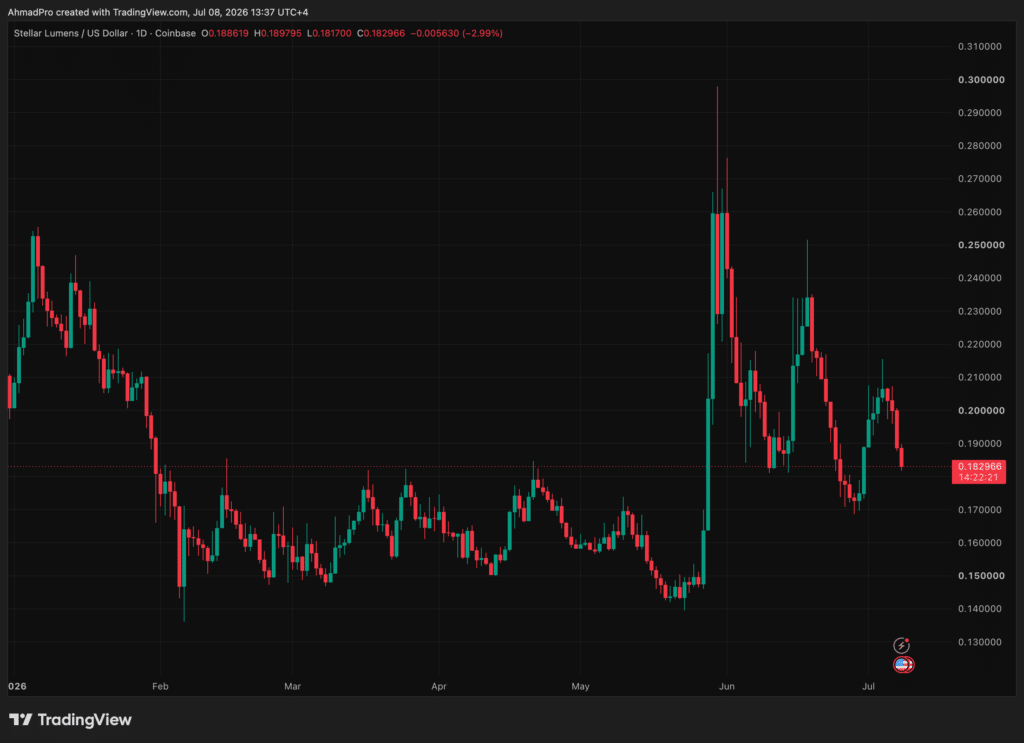
A close above $0.25 on strong volume triggers a re-rating toward $0.40 to $0.50, with $1.50 achievable in a broader bull cycle through 2026. Sideways grinding between $0.18 and $0.25 for several months is the base case, with institutional catalysts providing a floor but insufficient retail demand to break resistance. A sustained close below $0.18 invalidates the near-term recovery thesis and opens downside toward $0.13 to $0.15.
The $1.50 target implies a market cap well above $50 billion, a level XLM has not touched since its 2018 peak. Achievable in a peak bull environment but requiring near-perfect execution on both macro conditions and network adoption. That is not impossible. It is just a long way from $0.19.
LiquidChain Targets Early-Mover Upside as Stellar Tests Key Levels
XLM’s institutional story is compelling, but at a $6.75 billion market cap, the asymmetry is bounded. The move from $0.19 to $1.50 is an 8x, meaningful, but not the kind of return profile that early-stage capital typically hunts.
Traders rotating out of mid-cap consolidation often look for lower-entry infrastructure plays with uncapped upside, and that’s the pitch the current presale cycle is built around.
LiquidChain (LIQUID) is positioning itself as a Layer 3 (L3) infrastructure protocol, a network layer built on top of existing blockchains to handle specific execution tasks, with a specific focus on cross-chain liquidity.
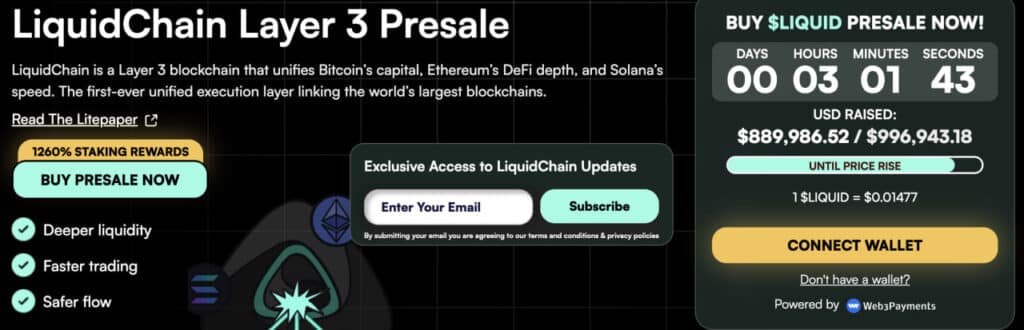
The project’s stated USP (unique selling proposition) is fusing Bitcoin, Ethereum, and Solana liquidity into a single execution environment, meaning developers deploy once and access all three ecosystems rather than building separate integrations.
The architecture centers on a Unified Liquidity Layer, Single-Step Execution, Verifiable Settlement, and Deploy-Once structure, infrastructure-level features targeting the fragmentation problem that costs DeFi (decentralized finance) protocols real money every day.
The presale has raised $889,886.53 at a current token price of $0.01477. Early-stage presales carry significant risk, no secondary market liquidity, no guarantee of exchange listings, and execution risk on the technical roadmap.
EXPLORE: Best Crypto Presales With Asymmetric Upside in the Current Market

Why you can trust 99Bitcoins
Established in 2013, 99Bitcoin’s team members have been crypto experts since Bitcoin’s Early days.
Weekly Research
100k+Monthly readers
Expert contributors
2000+Crypto Projects Reviewed