








Bitcoin and Gold prices, often discussed as competing stores of value and frequently compared over the last Year for their shared bullish price moves, are entering September on sharply diverging trajectories as investors brace for the Federal Reserve’s next policy move on September 20.
Gold price surged this week to $3,450/oz, its highest level on record – marking a +36.47% increase YoY, fueled by dovish economic signals that strengthened bets on a September rate cut.
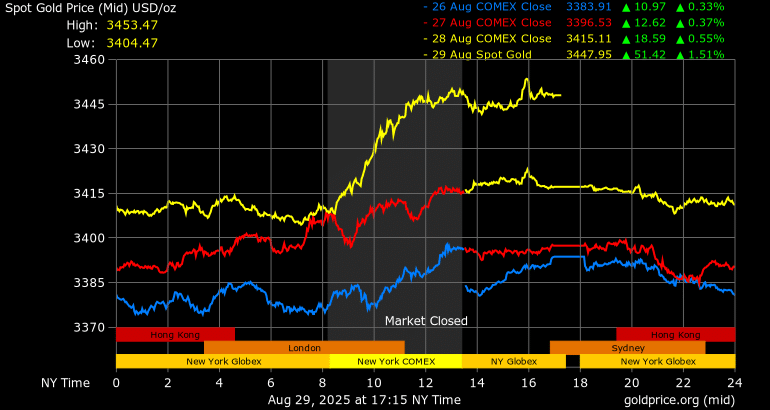
This comes after Friday’s PCE Price Index, the Fed’s preferred inflation gauge, which showed price growth moderating across the United States, while Thursday’s GDP revision posted a surprise +3.3% QoQ gain, reinforcing expectations that the central bank has room to loosen monetary conditions.
How Did Market Reaction to Fed Data Hit Capital Rotations on Wall Street?
Together, the Fed data sent capital flows into gold, cementing its role as the default safe haven heading into the FOMC meeting on September 17.
Bitcoin, by contrast, is struggling to hold key support. After BTC USD peaked at $124,500 earlier this summer, BTC price fell by 13.7% to trade at nearly $108,000, breaching its multi-year parabolic trend line.
Analysts warn that a decisive breakdown in relative strength could drag Bitcoin’s price toward $80,000 by year-end, a correction consistent with prior cycle drawdowns of 77–85%.
The divergence is striking: while gold prices rallied on expectations of easier policy, Bitcoin prices grappled with structural uncertainty over their evolving role after so many macro bull events in 2025.
For years, Bitcoin price was framed as “digital gold,” prized for its scarcity and neutrality. But 2025 has shifted that narrative.
Over $7Bn in BTC now earns native, on-chain yield via protocols that allow holders to stake or deploy coins without relinquishing custody.
Spot ETFs collectively hold 1.26 million BTC (6% of supply), and sovereign reserves in countries like El Salvador further institutionalize Bitcoin.
Unlike gold’s inert $23Tn market cap, Bitcoin is increasingly treated as productive capital, capable of generating returns.
DISCOVER: Best Meme Coin ICOs to Invest in 2025
Why Bitcoin’s Role as Productive Capital is Shifting Correlation With Gold Price
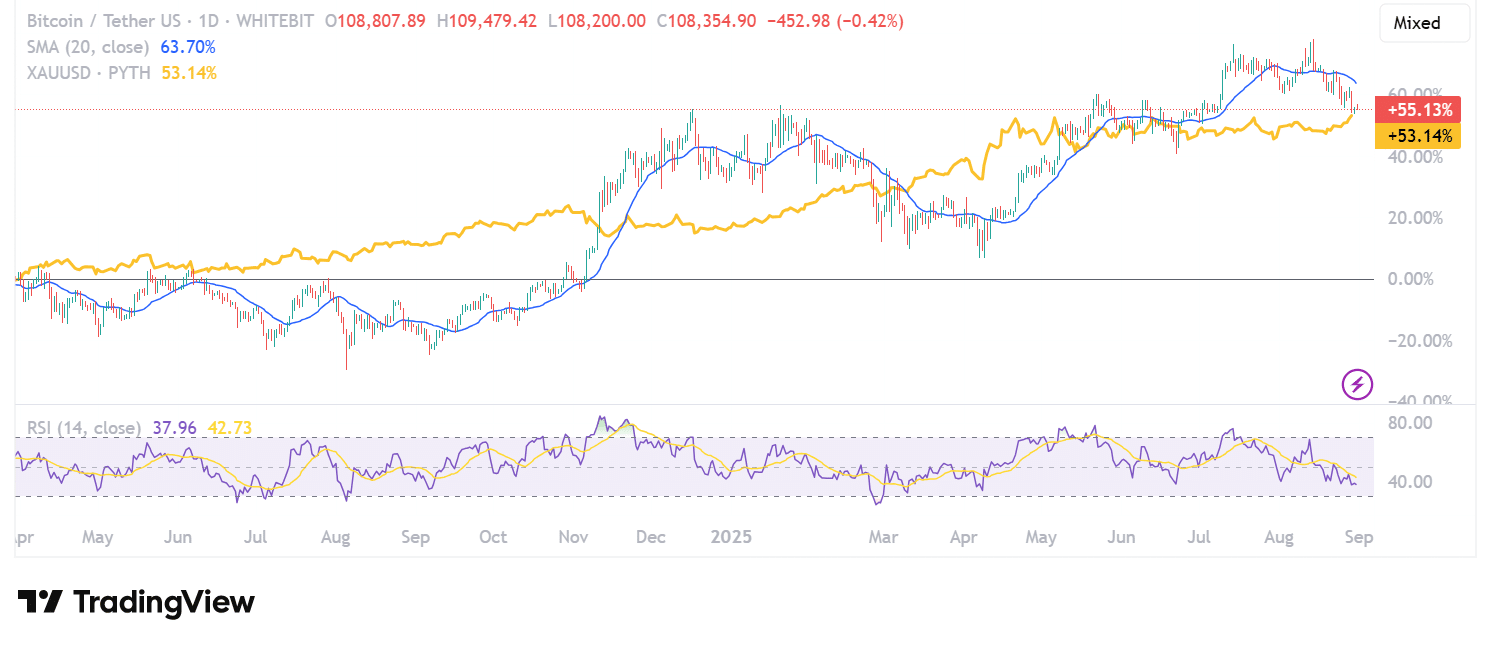
This transformation complicates its correlation with gold price. Scarcity still underpins both, but gold thrives when investors seek safety from policy risk, while Bitcoin is becoming linked to risk-on capital productivity.
Harvard’s endowment illustrated this split in Q2 2025, allocating $116.7M into Bitcoin ETFs and $101.5M into gold funds, treating both as strategic reserves for different reasons.
The gap may widen heading into September. A dovish Fed would likely sustain gold’s rally, but Bitcoin’s next move hinges on whether investors embrace it as more than a hedge.
If BTC’s yield-producing layers attract capital, the asset could rebound as productive capital rather than passive vault money.
However, if markets treat Bitcoin as another high-beta asset, volatility may deepen before any recovery.
The FOMC’s decision could therefore define the next chapter: gold cementing its safe-haven dominance. At the same time, Bitcoin tests whether its evolution beyond “digital gold” will help it withstand the same macro headwinds.
DISCOVER: 9+ Best High-Risk, High-Reward Crypto to Buy in 2025
Bitcoin Hyper: Don’t Miss the Future of Productive Bitcoin Capital
For over a decade, Bitcoin has been branded as “digital gold”, a scarce store of value, passive but powerful. But the future of Bitcoin isn’t just about scarcity. It’s about productivity. And that’s where Bitcoin Hyper (HYPER) changes the game.
While JPMorgan analysts argue Bitcoin is undervalued relative to gold with a $126,000 year-end target, they still frame BTC as a vault asset. Hyper flips that narrative. By fusing Bitcoin’s unmatched security with Solana-grade speed, Hyper transforms BTC from an inert reserve into the base layer of a thriving economy.
Through its Canonical Bridge, Bitcoin locked on Layer-1 is minted into wrapped BTC inside Hyper’s ecosystem, where it powers DeFi protocols, NFT platforms, gaming apps, payments, and tokenized real-world assets.
Settlement is still anchored to Bitcoin’s proof-of-work chain, meaning Hyper delivers speed without compromising trust and security.
And every transaction routes value back to BTC while fueling demand for HYPER, the token that drives fees, staking, and governance across the network. In other words, Bitcoin stops just sitting in treasuries: it starts working.
That’s why analysts and influencers are calling HYPER the closest parallel to Bitcoin’s earliest days. Over $13M has already been raised in presale, but the window is closing. Once Hyper launches, the days of ground-floor entry will be gone.
Don’t let the token building Bitcoin’s most productive era pass you by.
Visit Bitcoin Hyper HereDISCOVER: Next 1000X Crypto: 10+ Crypto Tokens That Can Hit 1000x in 2025

Why you can trust 99Bitcoins
Established in 2013, 99Bitcoin’s team members have been crypto experts since Bitcoin’s Early days.
Weekly Research
100k+Monthly readers
Expert contributors
2000+Crypto Projects Reviewed