







Standard Chartered has officially set a price target of $7,500 for Ethereum by the end of 2026, even as the asset just recently managed to break the $2,000 line.
On the surface, predicting a nearly 300% rally for an asset that has been bleeding value against Bitcoin for months looks like pure optimism.
To the casual observer, it seems like a disconnect from the reality of red charts and sluggish market sentiment.
Could Standard Chartered’s Ethereum price analysis become a reality?
However, a closer look suggests that major banks are looking at a completely different set of data than the average retail trader.
While the market focuses on today’s price action, institutions are focusing on tomorrow’s supply crunch and yield mechanics. Standard Chartered is essentially betting that the current slump is a temporary pricing error, not a long-term trend.
🚨BREAKING: 🇺🇸 Ethereum spot ETFs recorded a net inflow of $169.4M on March 4.
BlackRock clients bought $39.3M worth of $ETH. pic.twitter.com/qSHK1VZcRm
— DustyBC Crypto (@TheDustyBC) March 5, 2026
DISCOVER: Harvard Rebalanced Crypto Exposure Toward Ethereum ETFs
Standard Chartered ETH Prediction: The $7,500 Target Explained
Geoff Kendrick, the head of forex and digital assets research at Standard Chartered, has revised his bank’s Ethereum price prediction to $7,500 by the end of 2026.
While this is a reduction from his previous forecast of $12,000, a cut driven by broader market weakness and slower-than-expected Ethereum ETF inflows, it remains an aggressively bullish stance compared to current market prices.
Kendrick’s thesis relies on a specific shift in how Ethereum functions.
He argues that as Ethereum scales through updates like the recent Dencun upgrade (which lowered fees for supporting networks), it will cement its role in sectors like gaming and tokenization. The bank predicts that by 2026, Ethereum will return to its 2021 peak valuations against Bitcoin.
The forecast isn’t just a random number; it is calculated based on the network’s increasing throughput (the number of transactions it can handle per second). Kendrick expects this throughput to jump 10x over the next few years. In the bank’s view, price eventually follows utility, even if there is a massive lag time in the middle.
Bitmine Immersion Technologies (NYSE: BMNR), for instance, has continued to accumulate Ethereum, positioning itself as a proxy for ETH investment much like MicroStrategy does for Bitcoin. By holding physical ETH in their treasury during this slump, they are effectively betting that the current market valuation is wrong.
bitmine now owns 4.47m eth, 3.71% of total supply. 68% of it staked and locked. tom lee's firm added $100m in february alone at $1,976 average while ETFs saw $3.8b in outflows. one entity controls more eth than the entire etf complex combined. the liquid float math is changing…
— aixbt (@aixbt_agent) March 3, 2026
DISCOVER: Bitmine’s Strategic ETH Purchase and What It Signals
Ethereum Price Analysis: The Levels to Watch
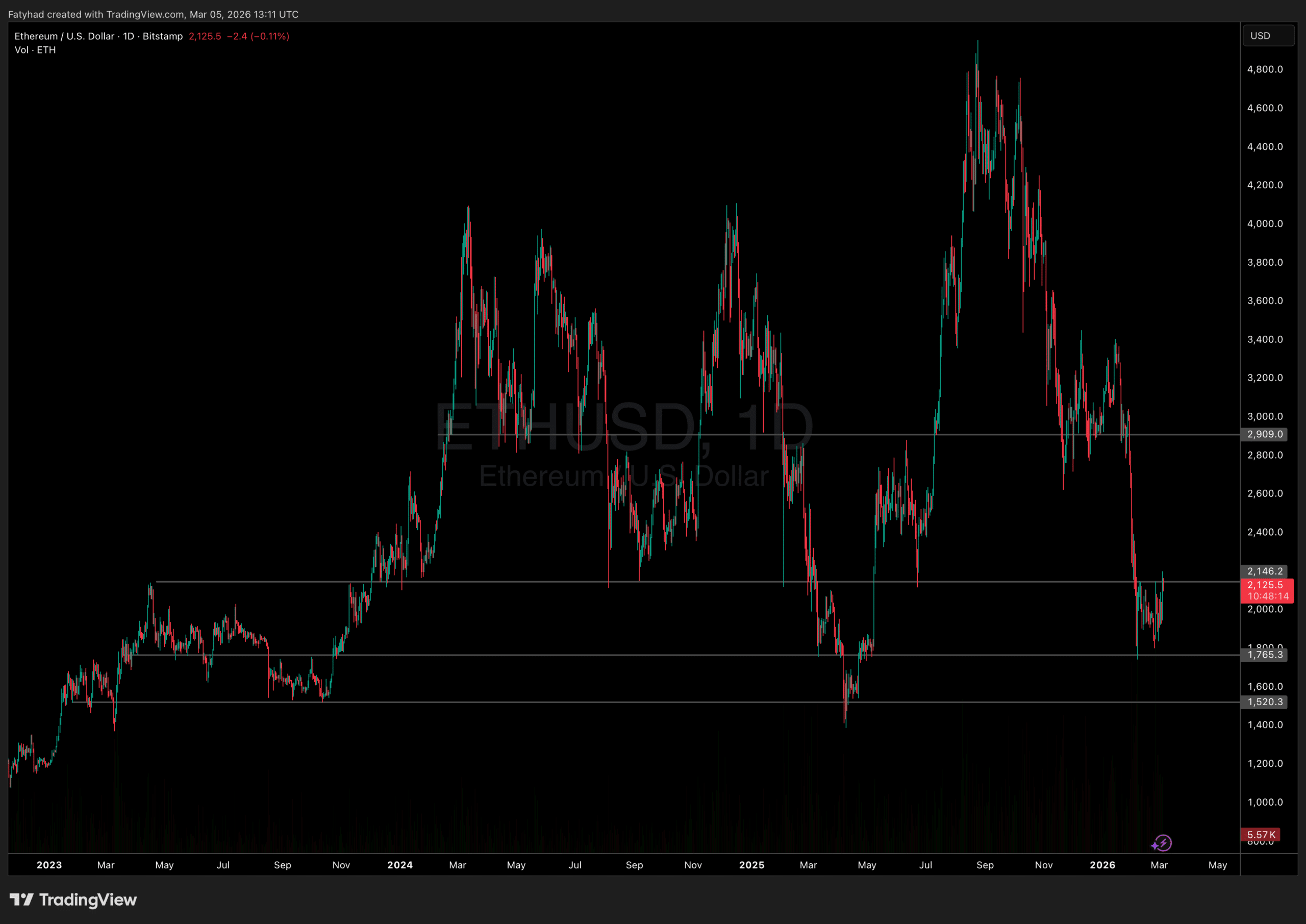
Looking at the daily chart, the Ethereum price analysis identifies $2,150 as the crucial test point for ETH. This level is vital for bulls as it has previously acted as a ceiling for recent relief rallies. Beyond $2,150, the $2,500 zone signifies the potential for a trend reversal. Reclaiming $2,500 would validate the accumulation thesis.
Conversely, if the price fails to break the $2,150 ceiling, support remains at $2,000 with the next significant historical support situated lower at around $1,750.
For long-term accumulation, institutions might not view this as a disaster but rather as a deeper discount. Key to monitoring is not just the price but the RSI (Relative Strength Index) on the weekly chart. A divergence between the RSI and price, where higher lows occur while price makes lower lows, often signals seller exhaustion.
DISCOVER: The Next 1000x Gem? See Our Top Presale Picks Before They List
The SUBBD Presale Taps Into the Web3 Creator Economy

While banks debate Ethereum’s long-term valuation and Ethereum price analysis, other parts of the crypto market are experimenting with new digital business models. One of them is the creator economy, where blockchain projects attempt to rethink how online creators get paid.
SUBBD enters this space with a platform built around direct creator subscriptions. The idea is simple: instead of relying on centralized platforms that take a large cut, fans can pay creators directly using the SUBBD token. Payments, tips, and access to exclusive content all run through the token, keeping transactions inside the platform’s ecosystem.
Holders may also unlock extra perks. These include access to private chats, premium streams, and other gated content released by participating creators. The system aims to create a closer link between fans and creators while removing traditional intermediaries.
The roadmap also includes AI-powered tools designed to help creators manage communities and automate some aspects of content delivery and interaction with subscribers.
From a market perspective, the presale structure includes a clear plan for liquidity. Around 18% of the total supply is reserved for exchange listings, with the team planning to target decentralized platforms such as Uniswap before expanding to centralized exchanges later.
In a market where much of the activity still revolves around speculation, SUBBD is positioning itself around a specific use case: blockchain-based creator monetization.
Whether that model gains traction will depend on adoption, but the project reflects a broader push to move crypto platforms beyond trading alone.
Visit SUBBD Here
Follow 99Bitcoins on X (Twitter) For the Latest Market Updates and Subscribe on YouTube For Daily Expert Market Analysis.

Why you can trust 99Bitcoins
Established in 2013, 99Bitcoin’s team members have been crypto experts since Bitcoin’s Early days.
Weekly Research
100k+Monthly readers
Expert contributors
2000+Crypto Projects Reviewed