






150 milliseconds. That single number sits at the center of the latest Elon Musk Grok AI price prediction, and the model predicts Solana (SOL) reaching $180 to $240 by the end of 2026, with a realistic base case near $200.
The technical case is already in motion. The Agave 4.2 upgrade has just been activated and is reducing slot times to 200 milliseconds while slashing storage rent by 90%.
That expands capacity where it matters. High-frequency trading and tokenization apps get more room, and organic demand for SOL rises as blockspace utilization climbs.
Alpenglow is the bigger swing. Its targeted October mainnet activation would collapse finality to roughly 150 milliseconds. At that speed, Solana competes with traditional payment rails. Grok frames it as unlocking institutional settlement flows that currently favor slower networks.
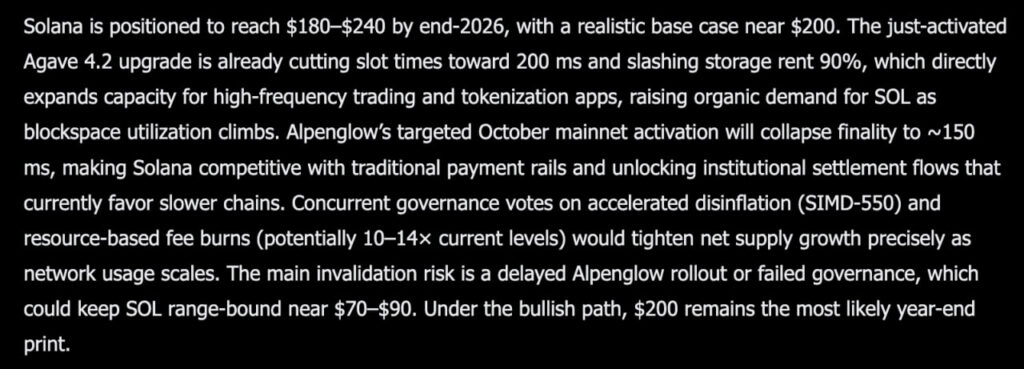
Supply is the other half of the equation. Governance votes are running concurrently on accelerated disinflation under SIMD-550 and on resource-based fee burns.
Those burns could reach 10 to 14 times current levels. Net supply growth tightens precisely as network usage scales, which is the combination bulls want. The invalidation is specific. A delayed Alpenglow rollout or failed governance would keep SOL range-bound near $70 to $90.
That is roughly where it has lived all year. Under the bullish path, $200 remains the most likely year-end print.
DISCOVER: The Next 1000x Crypto Gem Before It Lists on Binance
Solana Price Prediction: Elon Musk Grok AI Predicts Speed Becomes the Repricing Engine
The chart has spent a year compressing. Solana traded above $160 last November, then collapsed through February 2026 to $67 in one continuous leg.
March through May built a listless range between $78 and $97. June broke lower again, bottoming near $60.
July and August ground out a base near $75. Then the last few sessions went vertical, tagging $103 before settling back.
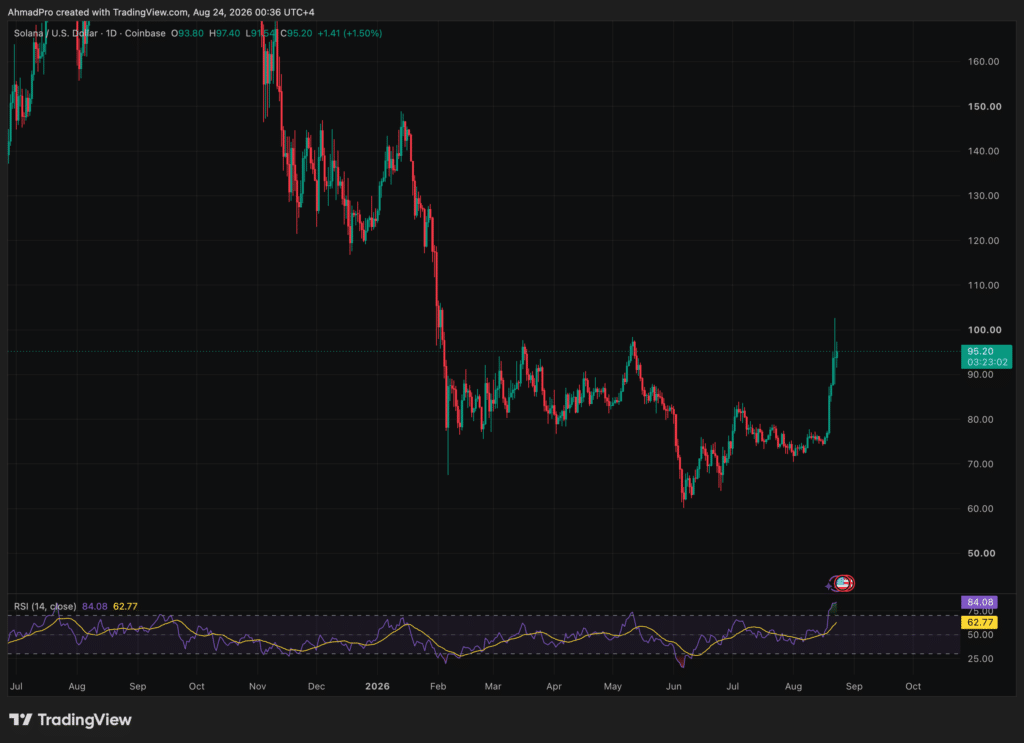
That spike is now cooling into a hold. Solana closed at $95.20, up $1.41 for a gain of 1.50%, with a session range from $91.54 to $97.40.
Resistance sits at $97.40, then the $103 spike high, then the $120 shelf from December. Support runs through $91.54 and $85, with $75 as the structural floor.
RSI reads 84.08 against a signal line at 62.77. The 21-point gap confirms the move is days old rather than weeks.
The signal line has been rising since early August, though. That slower climb beneath suggests accumulation preceded the spike rather than the spike arriving out of nowhere.
October is the date that matters now. Ship Alpenglow on time, and $200 will no longer be a stretch.
EXCLUSIVE: Unlock AI Trading Strategies and Best Crypto AI Trading Bots With BloFinSolana Is Racing Toward 150ms. Bitcoin Hyper Is Bringing That Execution Model to BTC.
Solana’s bullish case is increasingly about speed becoming economically useful. Bitcoin Hyper is applying that same performance-first logic to a network with far more capital but far less native programmability.
The project runs on the Solana Virtual Machine, giving its Bitcoin Layer 2 high-speed execution, ultra-low fees, and smart contract support while still building around Bitcoin’s security.
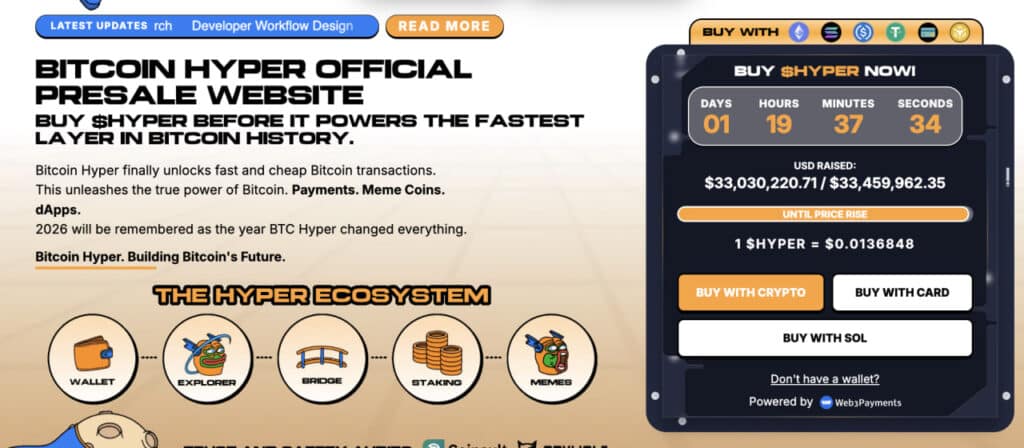
Its Canonical Bridge is designed to move BTC into that environment, while HYPER powers gas, staking, and governance across the ecosystem.
That creates a straightforward thesis: if faster execution can unlock new trading, payments, and DeFi activity on Solana, similar infrastructure could open entirely new use cases for Bitcoin capital that currently sits idle.
Bitcoin Hyper’s presale has already raised more than $33 million, with buyers currently able to stake HYPER for yields of up to 36% APY ahead of the planned 2026 launch.
DISCOVER: Best Meme Coin ICOs to Invest in 2026
Follow 99Bitcoins on X For the Latest Market Updates and Subscribe on YouTube For Daily Expert Market Analysis.

Why you can trust 99Bitcoins
Established in 2013, 99Bitcoin’s team members have been crypto experts since Bitcoin’s Early days.
Weekly Research
100k+Monthly readers
Expert contributors
2000+Crypto Projects Reviewed