






Ninety percent of ETF-held Ether is being locked away to earn yield, and that number is the engine of this forecast. Qwen AI predicts a parabolic repricing from $1,884, and the price prediction reaches $8,200 by Q4 2026.
The technical foundation was laid across two upgrades. Pectra arrived in May 2025 with native account abstraction through EIP-7702, vastly improving Layer-2 user experience.
Fusaka followed in December 2025. It implemented Verkle trees and finalized the rollup-centric scaling roadmap.
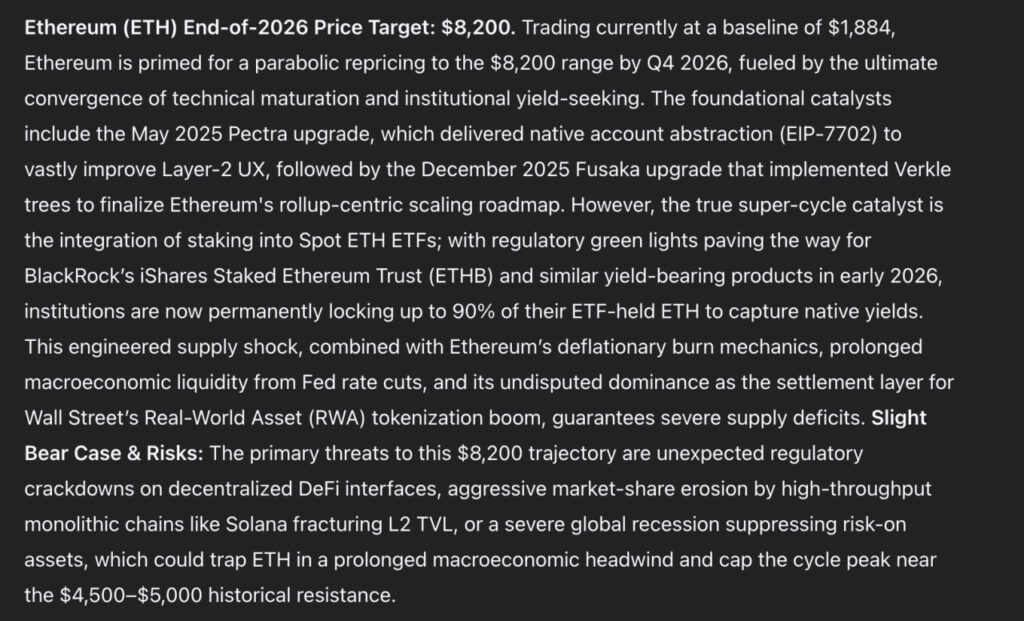
The real super-cycle catalyst is elsewhere. Staking integration into spot ETH ETFs changed what those products are.
Regulatory green lights cleared the path for BlackRock’s iShares Staked Ethereum Trust and similar yield-bearing products in early 2026. Institutions now permanently lock up to 90% of their ETF-held ETH to capture native yields.
Qwen calls that an engineered supply shock. Combined with deflationary burn mechanics, prolonged liquidity from Fed rate cuts, and dominance as the settlement layer for Wall Street’s RWA boom, it guarantees severe supply deficits.
Threats to the trajectory are named directly. Unexpected regulatory crackdowns on decentralized DeFi interfaces come first.
Aggressive market-share erosion by high-throughput monolithic chains fracturing L2 TVL is second. A severe global recession, suppressing risk-on assets, would cap the cycle peak near $4,500 to $5,000, historical resistance.
DISCOVER: The Next 1000x Crypto Gem Before It Lists on Binance
Ethereum Price Prediction: Qwen AI Predicts Wall Street Locks The Float And Throws Away The Key
The weekly chart shows a market three years into a wide range. ETH climbed from $1,600 in 2023 to $4,100 by March 2024.
A second run reached $4,950 in September 2025. That marked the cycle high before the trend reversed.
Late 2025 cut price to $2,800. Early 2026 broke lower still, dragging ETH to roughly $1,850 by March.
Spring bounced to $2,450 before failing again in June near $1,480. Recent weeks have stabilized just under $1,900.
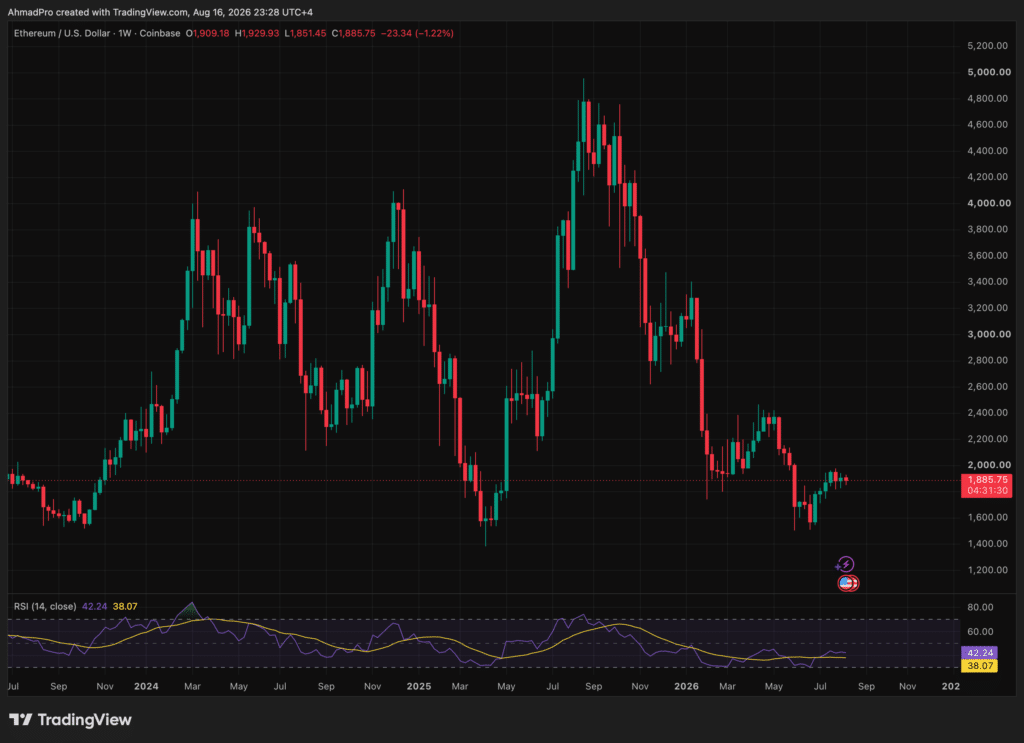
The weekly close reads $1,885.74, down 1.22% and $23.35. The weekly range spanned $1,851.45 to $1,929.93.
Support sits at $1,850, then $1,600 and $1,480 at the June low. Resistance appears at $2,000, then $2,400 and $2,800.
RSI reads 42.24 with its signal line below at 38.07. The oscillator leads by more than 4 points, which is the first constructive signal in months.
Both lines remain under the midline. Momentum is improving from a low base rather than turning outright bullish.
Qwen’s target requires more than a fourfold move. Clearing $2,000 on the weekly is the minimum evidence that the supply deficit is reaching the price.
EXCLUSIVE: Earn $10 USDC Via Binance Sign-UpIf Ethereum Can Turn Staking Into a Supply Shock, Bitcoin Hyper Wants to Bring Yield and Utility to BTC
Ethereum’s bull case rests on making held assets productive. Bitcoin Hyper is applying a similar idea to Bitcoin, but through a new execution layer built around speed, smart contracts, and staking.

The project runs on the Solana Virtual Machine, giving Bitcoin-linked applications access to faster execution and lower fees while anchoring the ecosystem around BTC. Its Canonical Bridge is designed to move Bitcoin into that environment, while HYPER serves as the network asset for gas, governance, and staking.
That creates a different proposition from simply holding Bitcoin and waiting for price appreciation. Bitcoin Hyper is trying to give BTC capital somewhere to work.
The presale has already raised more than $33 million, and buyers can currently stake HYPER for yields of up to 36% APY ahead of the planned 2026 launch.
Explore the Bitcoin Hyper Presale
DISCOVER: Best Meme Coin ICOs to Invest in 2026

Why you can trust 99Bitcoins
Established in 2013, 99Bitcoin’s team members have been crypto experts since Bitcoin’s Early days.
Weekly Research
100k+Monthly readers
Expert contributors
2000+Crypto Projects Reviewed