








Bitcoin institutional story just got complicated. Spot Bitcoin ETFs posted their second consecutive day of net outflows even as BTC price rallied, a split that raises an uncomfortable question: are the biggest players quietly heading for the exits?
Exchange volume surged to $97.08 billion recently, up 90.43%, yet the ETF flow data tells a different story underneath the surface.
Fidelity’s FBTC recorded $79 million in outflows, Ark & 21Shares’ ARKB shed $74.7 million, and Grayscale’s GBTC added another $11 million in exits. BlackRock’s IBIT was a notable exception, pulling in $40.4 million.
The headline surprise: Morgan Stanley’s newly debuted MSBT attracted $30.6 million in net inflows on its very first day, with approximately $34 million in trading volume, a genuinely strong debut for a product most retail investors hadn’t even heard of yet.
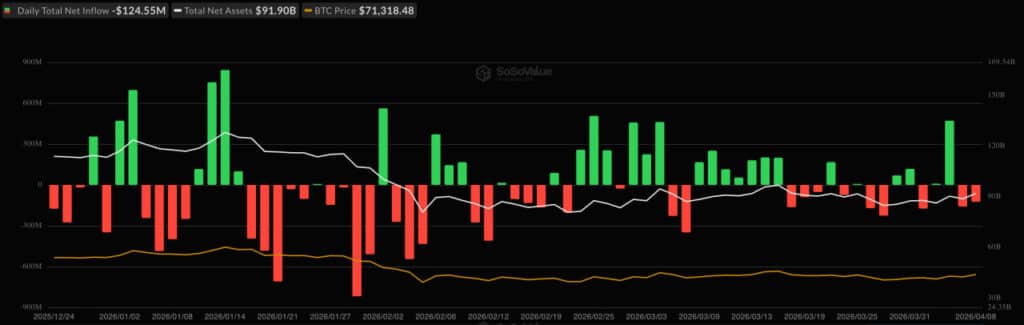
LVRG Research Director Nick Ruck noted that institutions appear to be taking profits rather than joining the momentum, having aggressively bought the dip earlier in the week. The broader macro backdrop, fragile Middle East ceasefire talk, a bombed Saudi pipeline, continued regional instability, kept sentiment firmly in the fear zone. This sets up a Bitcoin price picture that deserves a closer look.
DISCOVER: The Next 1000x Crypto Gem Before It Lists on Binance
Can Bitcoin ETF Outflows Push Price to a Critical Support Test?
Exact real-time Bitcoin price data is limited in the current window, but ETF flows serve as a reliable indirect pressure indicator — and the signal is cautionary. CoinGlass data shows daily net outflows of $159.10 million and -2,310 BTC as of the latest update. That kind of sustained institutional selling doesn’t vanish overnight.
The flow pattern is volatile, not linear. A single day saw $465.4 million in inflows on April 6, followed almost immediately by $94.9 million in outflows on April 7 — led by FBTC (-$49.5 million) and IBIT (-$29.6 million).
That whiplash dynamic points to consolidation, not a clean trend. Total AUM across spot Bitcoin ETFs sits at approximately $90.97 billion to $109.55 billion depending on the source, which remains a massive structural position in the market.
Right now the data is not screaming collapse, it is just showing uncertainty, because everything comes down to flows and whether real demand steps back in.
If inflows pick up again, something close to that $465M daily level, that is where institutions start rotating back in and Bitcoin gets the fuel to push toward new highs.
But what we are seeing now is more hesitation than conviction, with the market stuck in chop as traders balance geopolitical risk against the bigger long term Bitcoin story, so instead of a trend you get sideways movement waiting for a real catalyst.
The risk only shows up if outflows start stacking consistently, because sustained selling pressure is what forces Bitcoin to test lower levels, not just one bad day.
One interesting detail is dominance still sitting high, which means altcoins are not pulling capital away yet, and that actually helps Bitcoin hold up better than people expect.
DISCOVER: Best Meme Coin ICOs to Invest in 2026
Bitcoin Hyper Targets Early Mover Upside as Bitcoin Tests Key Levels
When spot ETF flows turn choppy and institutional positioning looks unstable, some investors look further down the risk curve — not out of panic, but out of logic. If the large-cap trade is crowded and uncertain, early-stage infrastructure with a differentiated thesis becomes worth examining. That’s exactly the conversation happening around Bitcoin Hyper.
Bitcoin Hyper is positioning itself as the first-ever Bitcoin Layer 2 with Solana Virtual Machine (SVM) integration — a technical combination that targets Bitcoin’s three core limitations: slow transactions, high fees, and near-zero programmability.

The project has raised $32,347,799.58 at a current presale price of $0.0136783, with staking rewards available during the presale period. The SVM integration is the genuine differentiator here: it theoretically brings fast smart contract execution to Bitcoin’s security layer, rather than building a separate chain from scratch. Bitcoin Layer 2 infrastructure has drawn increasing attention as ETF-era capital looks for Bitcoin-adjacent yield.
Risk is real. Presales are high-volatility, low-liquidity instruments; most don’t deliver on technical promises, and $HYPER has not yet launched on public markets. Treat it as speculative. If the thesis interests you, research Bitcoin Hyper with appropriate position sizing in mind.

Why you can trust 99Bitcoins
Established in 2013, 99Bitcoin’s team members have been crypto experts since Bitcoin’s Early days.
Weekly Research
100k+Monthly readers
Expert contributors
2000+Crypto Projects Reviewed