





The current crypto cycle has had less rapid price expansion and more by structural pressure. Capital constraints, regulatory oversight, tricky macro environment, and repeated infrastructure failures have narrowed the field of projects able to be noticed.
Within this environment, crypto presales have become a litmus test for whether a protocol is built to endure tighter conditions. The LiquidChain ($LIQUID) crypto presale enters at a moment when markets are no longer rewarding abstract roadmaps, but systems designed to function across chains with verifiable execution.
Interest in the presale has developed smoothly, with over $530,000 raised so far. That figure matters less as a headline number and more as an indicator of how early-stage capital is being deployed. Participation today is selective, focused on architecture, settlement design, and real-world constraints that define the next phase of blockchain development.
How LiquidChain Fits Into the Next Phase of Crypto
The next phase of blockchain development is centered on consolidation and interoperability. Over the past cycles, Bitcoin, Ethereum, and Solana have each built deep liquidity and specialized user bases, yet interaction between them remains inefficient. Capital continues to sit idle in isolated ecosystems, even as demand for cross-chain functionality grows.
LiquidChain is structured to operate as a Layer 3 protocol that unifies execution and settlement across these networks. Instead of moving assets through external bridges or synthetic representations, the system verifies Bitcoin UTXOs, Ethereum state, and Solana accounts directly. Transactions referencing multiple chains settle atomically, reducing the complexity that has historically accompanied cross-chain activity.

This aligns with how infrastructure is changing. Developers increasingly favor environments where applications can deploy once and access liquidity everywhere. Maintaining separate deployments across chains has proven costly and operationally fragile. LiquidChain’s high-performance virtual machine addresses this by executing multi-chain logic within a single environment, designed for real-time DeFi activity.
For users, the implications are practical. Unified liquidity pools enable deeper markets and smoother execution, especially during periods of volatility. Atomic settlement reduces partial fills and execution failures that often surface when interacting across chains. These characteristics point toward a model where blockchain systems are evaluated by reliability and composability, not just throughput benchmarks.
As regulatory scrutiny intensifies, trust-minimized verification becomes a baseline requirement. LiquidChain’s proof-of-state validation layer anchors settlement to the underlying networks themselves, limiting additional assumptions. This fits a broader industry direction where compliance and technical clarity carry as much weight as innovation.
$LIQUID Tokenomics and Token Utility
The $LIQUID token is designed to support network function. Total supply is capped at 11.8 billion tokens, with allocations structured around development, ecosystem growth, and operational sustainability.
Development receives 35% of the supply, underscoring the emphasis on continued protocol advancement. Liquid Labs holds 32.5%, earmarked for execution across marketing, geographic expansion, and ecosystem coordination. AquaVault accounts for 15%, supporting business development and community initiatives. Rewards receive 10%, dedicated to incentivizing liquidity participation, while Growth & Listings take 7.5% to facilitate exchange access and market infrastructure.
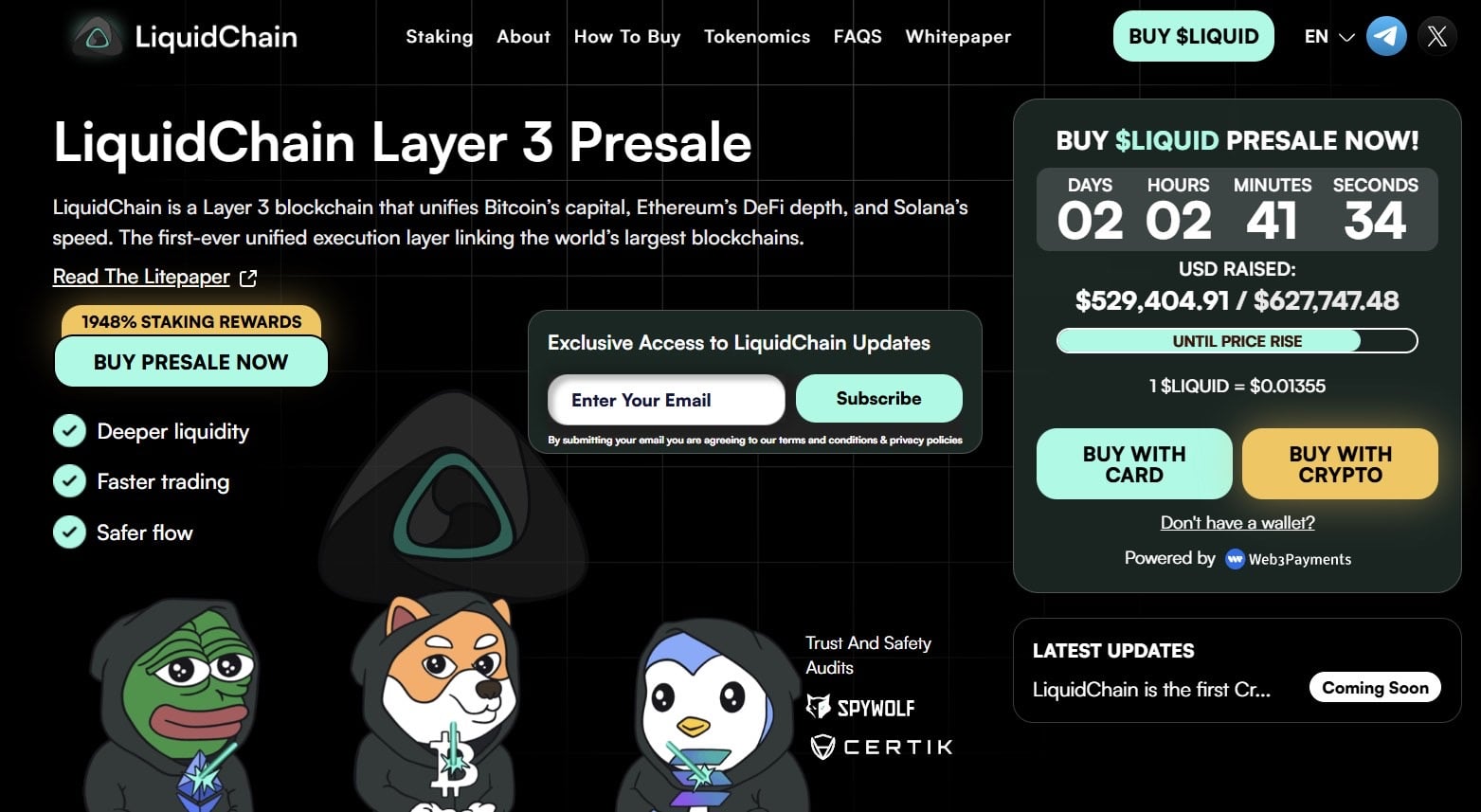
Utility for $LIQUID is tied directly to network activity. The token functions as transaction fuel, covering execution and settlement fees across cross-chain operations. Liquidity staking allows participants to support unified pools while earning protocol-level incentives, reinforcing depth and stability. Developer grants draw from the token supply to encourage applications that rely on LiquidChain’s cross-chain execution layer.
Each utility path connects token demand to actual usage. As applications deploy and liquidity flows through the network, fees, staking, and grants form a closed loop tied to activity rather than narrative. This structure matches how the market now evaluates early-stage assets, with preference given to tokens embedded in functional systems.
A Signal of Where Development Is Headed
Overall, the LiquidChain ($LIQUID) crypto presale offers insight into how blockchain development is being redefined. Infrastructure capable of unifying liquidity, executing across chains, and settling transactions with minimal assumptions has moved from optional to necessary. Projects entering the market without these foundations face growing resistance from both capital and developers.
LiquidChain’s presale sits within this context, presenting a model built for interoperability and execution clarity. Participation levels point to measured confidence, shaped by architecture rather than promotional excess. As the industry progresses through a more disciplined phase, protocols structured around durability and composability stand out.
The next phase of blockchain development will be driven by systems that simplify complexity without introducing new risks. LiquidChain’s design and presale structure align with that direction, offering a view into how early-stage crypto projects are adapting to a market that now demands function first.
Explore LiquidChain and its ongoing crypto presale:
Presale: https://liquidchain.com/
Social: https://x.com/getliquidchain
Whitepaper: https://liquidchain.com/whitepaper

Why you can trust 99Bitcoins
Established in 2013, 99Bitcoin’s team members have been crypto experts since Bitcoin’s Early days.
Weekly Research
100k+Monthly readers
Expert contributors
2000+Crypto Projects Reviewed