





Ledger has begun distributing Bitcoin bonuses to users who move their digital assets into self-custody, launching a two-week “Security Season” campaign that runs through April 7.
The campaign offers between $10 and $80 in Bitcoin to customers purchasing hardware wallets, with additional incentives for those adding physical backup tools or recovery services.
It comes as 2026 sees a sophisticated surge in drainer scams that try to bypass traditional software security, so Ledger is effectively subsidizing the transition from vulnerable wallets to encrypted cold storage.
The promotion, which went live March 24, centers on a “Bitcoin Boost” tiered by device capability. The flagship Ledger Stax, known for its curved E Ink display, carries the highest bounty at $80 in BTC.
The Ledger Flex follows at $70, while the mid-range Nano Gen5 offers $40.
The legacy-style Nano X and Nano S Plus round out the list with $20 and $10 bonuses, respectively.
| Ledger Stax | Premium device with curved E-Ink display | $80 |
| Ledger Flex | Mid-range hardware wallet | $70 |
| Ledger Nano Gen5 | 2.8-inch touchscreen, upgraded from button interface | $40 |
| Ledger Nano X | Bluetooth-enabled device | $20 |
| Ledger Nano S Plus | Entry-level model | $10 |
Users can then increase their total Bitcoin haul by $20 by adding a Cryptotag Zeus, a titanium plate with their seed phrase, designed to withstand fire and flooding, and another $10 by opting into Ledger Recover, the company’s cloud-based private key restoration service. A customer maxing out these options on a Stax purchase would see $110 in Bitcoin deposited into their account.
Ledger sees Security Season as a necessary defense against the evolution of blind signing. Most crypto thefts occur because a user interacts with a malicious smart contract through a software wallet or a browser extension. These interfaces often hide the true nature of a transaction behind a wall of unreadable hex code. You think you are minting an NFT – in reality, you are signing a permission that gives a drainer script full access to your USDT or ETH.
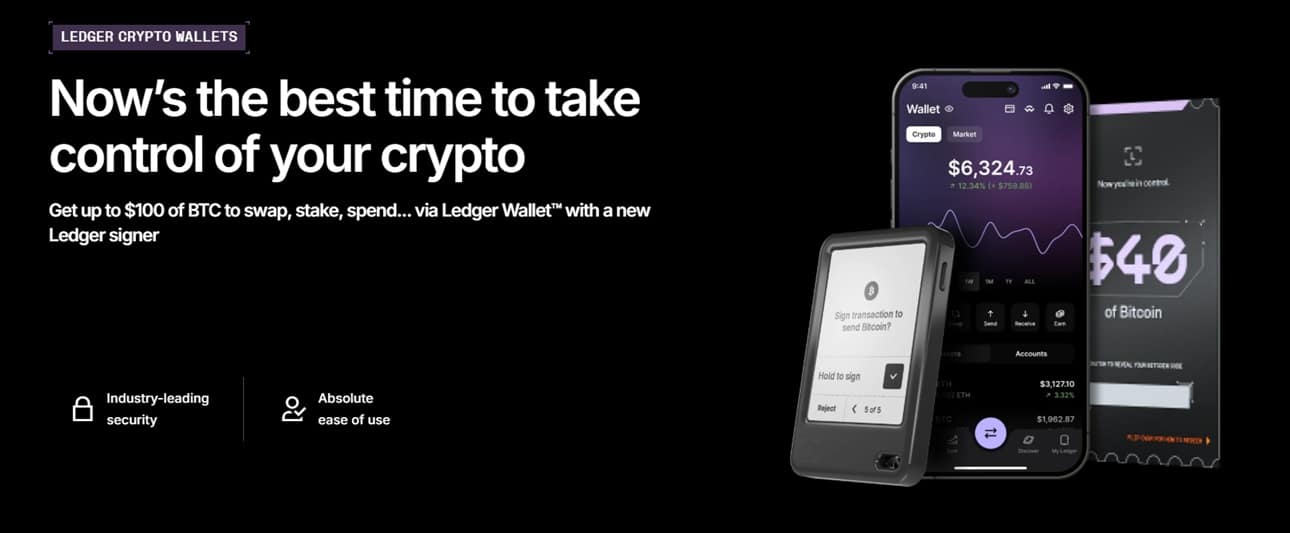
Ledger’s hardware solves this through certified screens. Because the device’s screen is physically separated from the internet-connected computer or smartphone, it cannot be spoofed by malware. The campaign emphasizes that if you cannot see the exact destination address and the exact amount on a trusted physical screen, you are risking your private keys.
The Bitcoin bonuses are delivered directly into the Ledger Live app, which has moved from a simple crypto management tool into a full financial suite, with staking built-in.
Once the Bitcoin arrives, the ecosystem allows you to use it immediately. Users can stake assets to earn rewards, swap them for other tokens, or manage their portfolio without ever exposing their private keys to the internet.
Ledger is the global leader in hardware security for digital assets, having secured about 20% of the world’s crypto assets since its inception. Based in Paris and Portland, the company builds its devices around Secure Element (SE) chips, the same high-security hardware found in passports and credit cards, running on a proprietary operating system called BOLOS.
Unlike software wallets, which store keys on devices constantly exposed to the internet, Ledger keeps the private key entirely offline, even during transaction signing.
By offering up to $110 in Bitcoin, Ledger argues that the cost of entry for professional-grade security should be negligible compared to the risk of a total loss.
The promotion ends on April 7. For those who have watched the drainer scams from the sidelines, the Bitcoin Boost serves as a financial nudge to stop relying on inferior security.

Why you can trust 99Bitcoins
Established in 2013, 99Bitcoin’s team members have been crypto experts since Bitcoin’s Early days.
Weekly Research
100k+Monthly readers
Expert contributors
2000+Crypto Projects Reviewed