




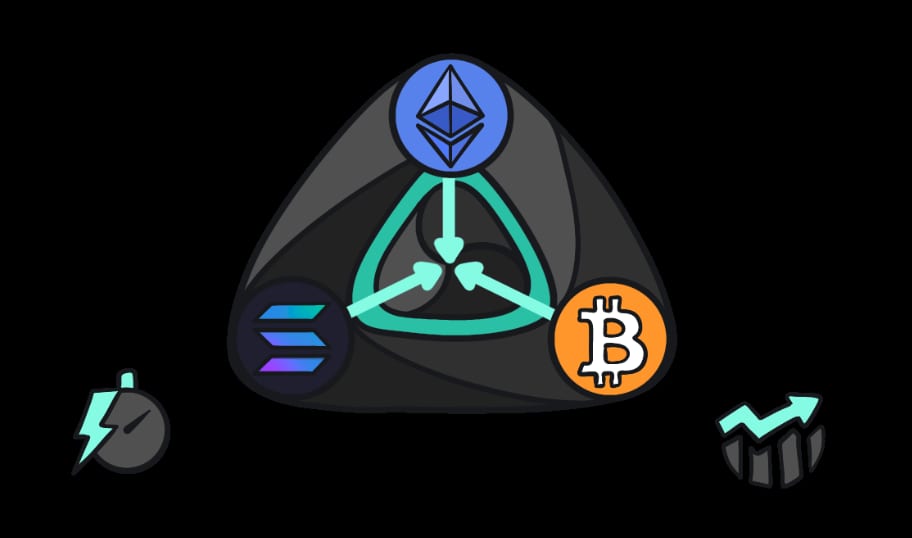
LiquidChain (LIQUID), a Layer 3 blockchain now in development, is picking up traction as its presale moves toward the $1 million mark. For newcomers, the idea is simple: instead of bouncing between Bitcoin, Ethereum, and Solana, LiquidChain aims to bring them together into a single, smoother system.
That matters because one of crypto’s biggest headaches is fragmentation. Your funds, apps, and opportunities are often split across different networks, and moving between them can be slow, expensive, or risky. LiquidChain is building a unified execution layer designed to connect Bitcoin’s capital, Ethereum’s DeFi ecosystem, and Solana’s speed in a single environment.
As interest builds, the presale is attracting buyers looking at infrastructure projects that could make crypto easier to use at scale. LIQUID tokens are currently priced at $0.0447, with the next price increase set to happen in a matter of hours.
If crypto feels like three separate worlds that don’t talk to each other well, LiquidChain’s pitch is to act as the road system connecting them. Rather than forcing users to pick one chain or rely on traditional bridges, the project aims to let liquidity from BTC, ETH, and SOL move more freely for payments, DeFi, and faster applications.
LiquidChain is positioning itself as more than another Layer 2 or simple bridge. It is being built as a Layer 3 network above Bitcoin, Ethereum, and Solana, giving users and developers access to the strengths of all three ecosystems without leaving the LiquidChain environment.
Bitcoin contributes deep capital and security, Ethereum brings mature smart contracts and a rich DeFi stack, and Solana adds high-speed transactions with low fees. LiquidChain’s goal is to combine those advantages into one verifiable environment.
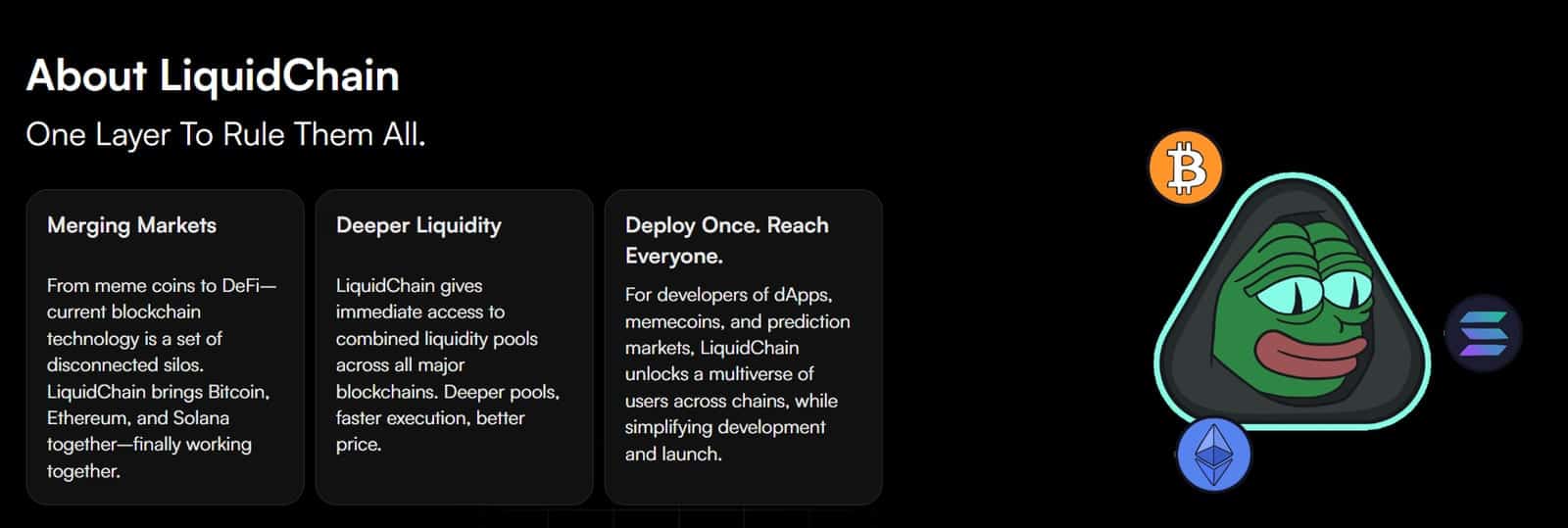
The project says its architecture can avoid traditional wrapped tokens in many cases and reduce dependence on centralized middlemen. Transactions are handled on the Layer 3, with finality anchored back to the underlying chains where needed.
In practical terms, that could mean fewer steps, lower costs, less slippage, and less security risk when moving across ecosystems. For developers, it could also mean building apps that draw on Bitcoin liquidity, Ethereum tooling, and Solana performance from a single place.
What problem is LiquidChain trying to solve?
Crypto is now clearly multi-chain, but liquidity is still scattered. Bitcoin holds most of the market’s value, Ethereum remains the center of DeFi TVL, and Solana is known for high-throughput apps. Users often have to manage different wallets, tools, and transfer routes just to take part across networks.
LiquidChain is targeting that friction with a single coordination layer that aggregates liquidity and execution power from all three chains. If it works as intended, users would not need to think as much about which network they are on and could focus more on what they want to do.
That is especially relevant for DeFi, where speed and capital efficiency matter. The project says developers could build products that use Bitcoin’s security for larger settlements, Ethereum’s tooling for more complex strategies, and Solana’s speed for trading or gaming workloads, all through one chain.
Quiet moves. Higher layers. 🔥
LiquidChain L3. 👁⟁https://t.co/vqvBcdSQYC pic.twitter.com/SWWlwqlmUV
— LiquidChain (@getliquidchain) April 3, 2026
LiquidChain also says it can support native cross-chain lending, borrowing, perpetual trading, and yield farming using liquidity from Bitcoin, Ethereum, and Solana pools at the same time. The benefit, in theory, is deeper liquidity and tighter spreads than more isolated Layer 2 setups can offer.
For advanced users, that could open the door to strategies such as BTC-backed ETH derivatives or leveraged positions with Solana-like speed. For newer users, the bigger takeaway is simpler: fewer barriers between major chains could make crypto products easier and safer to access.
The project says it is focused on verifiable security and decentralization, with the aim of strengthening rather than weakening the properties of the chains underneath it.
How the LIQUID Token Fits into the Ecosystem
At the center of the LiquidChain network is the native $LIQUID token. It is intended to cover gas fees on the Layer 3, support staking for network security and rewards, and later help with governance as the platform develops.
Holders can also stake LIQUID. According to the website, the current expected ROI on staked tokens is 1665%. The idea is to encourage early participants to hold and support the network rather than sell immediately after the presale.
LiquidChain has a fixed total supply of 11,800,000,100 $LIQUID, with no further minting after deployment. The token allocation includes 35% for continued development and ecosystem growth and 32.5% for LiquidLabs, covering global marketing, media, and community-building across Tier 1 regions.
Another 15% is allocated to the AquaVault treasury for strategic partnerships and community activations, 10% is reserved for staking rewards and user incentives, and 7.5% is set aside for exchange listings and ecosystem growth.
With the presale approaching $1 million, supporters are getting access to $LIQUID at an early-stage price before any future exchange debut. The broader case for the token depends on whether LiquidChain can attract users, developers, and liquidity once the Layer 3 goes live.
How to Join the Liquidchain Presale Safely
Joining the presale is straightforward. Visit the official LiquidChain website to buy $LIQUID using SOL, ETH, USDT, or other supported cryptocurrencies and payment methods.
The team recommends using secure wallets during the transaction process. Early buyers can also access staking opportunities during the initial phases.
Security is a major concern for new users, and LiquidChain says it has completed smart contract audits. That includes a review by SpyWolf, which found no malicious logic, no hidden minting capability, and no high-severity vulnerabilities in the core token contract.
Anyone interested can follow the project on Telegram and X (Twitter) for updates, developer announcements, and ecosystem news.

Why you can trust 99Bitcoins
Established in 2013, 99Bitcoin’s team members have been crypto experts since Bitcoin’s Early days.
Weekly Research
100k+Monthly readers
Expert contributors
2000+Crypto Projects Reviewed