






Crypto virtual mining game RollerCoin has had its moment, but a new contender, PepeNode (PEPENODE), is stepping into the spotlight with something far more ambitious.
PepeNode solves many of the problems that hindered earlier mining simulators, offering stronger tokenomics, deeper strategy mechanics, and far more engaging gameplay. Now in presale, it has already raised $2.24 million as early investors bet on it becoming not just the next cult-favorite game, but a breakout crypto project in its own right.
What sets PepeNode apart is its native blockchain-linked token, PEPENODE – the engine of the entire ecosystem and a real asset RollerCoin never offered. Early buyers are accumulating now, anticipating major upside once gameplay launches and exchange listings begin.
The current round prices PEPENODE at $0.0011731, but only for the next three hours before it moves into a higher-priced phase.
RollerCoin Showed What’s Possible; PepeNode Solves What Didn’t Work
RollerCoin launched in 2018 as one of the first browser-based “virtual mining” games to gain meaningful traction in crypto gaming. Over the years, it has built a loyal community, attracting millions of registered players with a simple premise: compete in mini-games to earn hashpower, which then pays out small amounts of real crypto such as BTC, ETH, DOGE, and more.
Unlike physical mining, RollerCoin allows players to simulate the experience by upgrading virtual rigs and boosting their hashpower through gameplay. Its biggest strength has always been accessibility, as anyone with a browser could jump in, grind mini-games, and earn crypto without touching a single ASIC.
And the game has grown enormous. By 2025, RollerCoin reported over 35 million hours played, 53 million miners crafted, 10 billion items traded, and a community of more than 5 million players. With such numbers, it’s clear that it has become a classic in the crypto gaming world.
🎉 5 MILLION players worldwide! and Pack’n Dash event is here to celebrate!
Jump in and unlock crazy rewards through thrilling events. 🎁
Celebrate with us in the comments 👇 You might just win some RLT! pic.twitter.com/6AtIgxVW2r
— RollerCoin 🐹 (@rollercoin_com) September 4, 2025
However, this growth comes with a major downside: shrinking rewards. Because payouts are shared across all players based on total hashpower, a larger user base means each individual’s slice of the reward pool becomes smaller.
Many players have reported that even after hours of grinding mini-games and building rigs, the real-crypto earnings remain tiny relative to the time invested. One Reddit user, in fact, noted grinding for over eight hours a day for two consecutive days, only to earn 35 satoshis, equivalent to barely $0.03. In other words, minimum-wage work pays better.
So despite RollerCoin’s massive popularity, for most players it functions more as a fun hobby than a profitable system. And it leaves virtual mining fans asking if there is finally a way to make a virtual mining game both enjoyable and economically worthwhile?
That answer didn’t exist until PepeNode was conceptualized.
Virtual Mining 2.0: PepeNode
RollerCoin demonstrated a massive demand for virtual mining, but it also exposed the model’s flaws, which PepeNode directly addresses. The first problem was gameplay depth. RollerCoin’s loop revolves almost entirely around repetitive mini-games, offering little in terms of long-term strategy.
PepeNode, on the other hand, makes strategy the core of the experience, with every choice (e.g., nodes to buy, how to combine them, when to expand your server room) directly determining how much crypto you earn, creating a dynamic system-building challenge instead of a grind.
Another issue was that RollerCoin’s gameplay never truly felt like mining. Mini-games may be fun, but they don’t resemble how crypto mining operates.
In contrast, PepeNode simulates the mining process in a virtual environment. Players manage their hashrate, optimize rigs, refine layouts, and later may even deal with cooling, power management, and other mechanics that bring it closer to the genuine mining experience, but without the hardware bills.
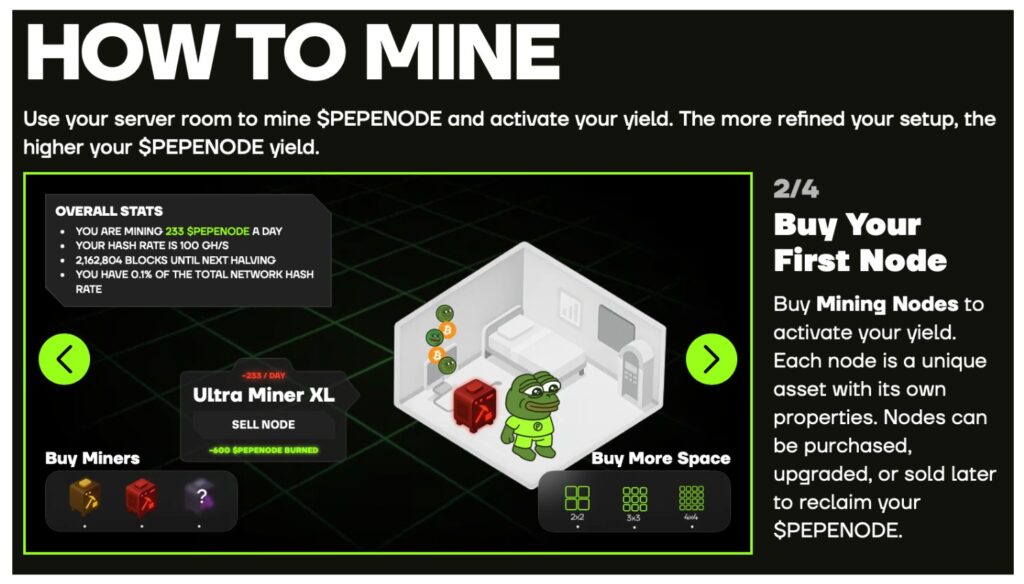
Source: https://pepenode.io/
RollerCoin’s rising popularity wasn’t the issue on its own – the problem was how its reward mechanics were designed. Because rewards come from a single shared pool divided by total network hashpower, increasing hashpower means smaller payouts for every player. In other words, rewards shrink not because more people join, but because the collective hashpower keeps climbing.
PepeNode avoids this problem entirely by tying rewards to the efficiency of each player’s virtual rig rather than a global shared mining pool. What you earn depends on your setup, and as the community grows, rewards don’t get diluted; the ecosystem simply gets bigger.
The P2E Tokenomic Solution
Now, perhaps the biggest gap RollerCoin left behind is the absence of real tokenomics. There’s no on-chain asset anchoring the ecosystem.
Yes, RollerToken exists, but it isn’t a blockchain token, i.e., it has no external market value and only functions as an in-game currency. And while RollerCoin does pay out tiny amounts of BTC, ETH, and other coins, those rewards become less meaningful as more players and more hashpower enter the system.
PepeNode not only introduces a true on-chain asset with the PEPENODE token, but it also fixes one of the core tokenomic problems that earlier play-to-earn games never solved.
Every time players use PEPENODE to upgrade their virtual mining setup, 70% of those tokens are permanently burned, creating a long-term deflationary effect that strengthens the token’s value as the game grows.
On top of that, PepeNode layers in additional rewards by paying out top meme coins like Pepe (PEPE) and Fartcoin (FARTCOIN) – giving players even more incentive to refine their setups. The better the rig, the more valuable assets they can earn.
PEPENODE is building something special from the ground up. 🚨
Buy Meme Nodes. Upgrade Facilities. Earn meme Coins.
All on one platform 🔥https://t.co/FaKIaBpf4I pic.twitter.com/JUTG2F6eXG
— PEPENODE (@pepenode_io) November 11, 2025
Could PEPENODE 100x?
In summary, PepeNode doesn’t just gamify mining or copy what has been done before. Instead, it delivers a far more complete version of what RollerCoin tried to be, which is also backed by real tokenomics and a demand-driven model that supports long-term price appreciation.
This is why several influencers, including Alessandro De Crypto and Borch Crypto, believe PEPENODE could be one of the rare tokens capable of a 100x move once it hits major exchanges.
To be part of what PepeNode is developing, head to the PepeNode site to buy PEPENODE tokens using ETH, BNB, USDT (ERC-20 and BEP-20), or even credit or debit cards.
PepeNode recommends using Best Wallet, widely considered the best crypto and Bitcoin wallet in the market. PepeNode is listed on Best Wallet’s highly accurate project screening tool, Upcoming Tokens, allowing you to buy, track, and claim in-app.
PepeNode’s smart contract has been audited by Coinsult, providing investors peace of mind about the security of its code.
Follow the project on X and Telegram for the latest updates.
DISCOVER: 16+ New and Upcoming Binance Listings in 2025

Why you can trust 99Bitcoins
Established in 2013, 99Bitcoin’s team members have been crypto experts since Bitcoin’s Early days.
Weekly Research
100k+Monthly readers
Expert contributors
2000+Crypto Projects Reviewed