







Was the Financial Times’ latest Bitcoin (BTC) critique a truth bomb – or just a repeat of the same outdated argument that the top crypto “can’t function as a currency”? If there’s any validity to the concern, then Bitcoin Hyper (HYPER), the fastest Layer-2 on Bitcoin, is the project aiming to flip that narrative on its head by finally putting BTC to work.
FT’s argument rests on supply elasticity, claiming Bitcoin can’t operate as money because its supply can’t contract when demand falls. But that misses the real macroeconomic issue: Bitcoin isn’t inefficient because supply is fixed. It’s inefficient because its utility is stagnant.
BTC has nowhere to circulate, no high-speed environment to transact in, and no ecosystem where it serves as a true medium of exchange.
Bitcoin Hyper changes that equation by creating a high-throughput environment where BTC moves at Solana-level speed while still settling on Bitcoin’s base layer. In this model, BTC doesn’t sit idle – it powers decentralized applications, flows across an SVM execution layer, and becomes spendable without sacrificing security.
Early investors can still take part in building this system by securing allocations of HYPER, the native token that powers gas payments, staking, and governance across the entire ecosystem. HYPER is currently priced at $0.013335, but only for the next eight hours before the presale advances to the next round.
Bitcoin’s Sell-Off Revives the Question: Can BTC Ever Be a Currency?
Chief Economist at UBS Global Wealth Management Paul Donovan published an opinion piece in the Financial Times that revived the paper’s long-standing skepticism toward Bitcoin, just as the market entered one of its sharpest pullbacks of the year.
After dropping from October’s highs into the low-$80,000 range, BTC has faced renewed scrutiny from traditional finance commentators who argue the asset can’t function as a currency.
Donovan’s central claim: during Bitcoin’s recent 35% decline, the asset effectively experienced “900% annualized inflation,” proving that a fixed-supply currency cannot contract when demand collapses.
The concern hinges on Bitcoin’s so-called “downward supply inelasticity” – the idea that because Bitcoin can’t destroy supply or tighten monetary conditions in a downturn, it can never stabilize as a medium of exchange.
Fatal flaw in using Bitcoin as currency
To keep the value of a currency stable, what’s needed is the ability to decrease money supply. This needs to occur in the face of falling demand.
If Bitcoin were a currency, there would be no way to decrease its supply.
FT,Nov. 26,p.11 pic.twitter.com/xspd9eurwK
— Hadi Taheri (@haditaheri) November 26, 2025
Traditional currencies, Donovan argues, can be managed by central banks through rate hikes, liquidity drains, or quantitative tightening. Bitcoin, by contrast, simply absorbs volatility, leaving users exposed to sharp swings without policy tools to offset them.
This critique has gained traction as November’s price action disappointed many investors. BTC fell through key support levels, ETF outflows accelerated, and volatility spiked while US equities, on the other hand, rallied on the government reopening and renewed macro optimism.
That divergence echoes Donovan’s concern that if Bitcoin can’t respond to demand shocks, how can it ever operate as a reliable currency?
Yet, this viewpoint assumes Bitcoin remains confined to the base layer, which is slow, settlement-only, and lacks transactional throughput. It also assumes Bitcoin’s demand must come solely from investment flows or store-of-value narratives.
And this is where the traditional critique starts to fall apart. Bitcoin’s “problem” was never its fixed supply but rather the absence of a scalable environment where BTC could actually move. The base layer was never designed for high-frequency economic activity, but for incorruptible settlement.
That gap has existed for 16 years and Bitcoin Hyper is the first project to meaningfully close it.
Bitcoin Hyper Turns Bitcoin From Static Collateral Into a Functional Currency
Bitcoin Hyper directly addresses the structural limitation Donovan highlights by giving Bitcoin something it has never had at scale: an execution environment where BTC can circulate freely, cheaply, and at high speed. Instead of relying on the base layer for everyday transactions, Bitcoin Hyper anchors settlement to Bitcoin while running activity on a Solana-grade execution layer.
It works in practice with Bitcoin Hyper using a canonical bridge that locks BTC on the base chain and mints a wrapped version inside the ecosystem.
That wrapped BTC becomes the medium of exchange across SVM-powered applications, moving with Solana-level speed but still settling back to the Bitcoin network for security and finality.
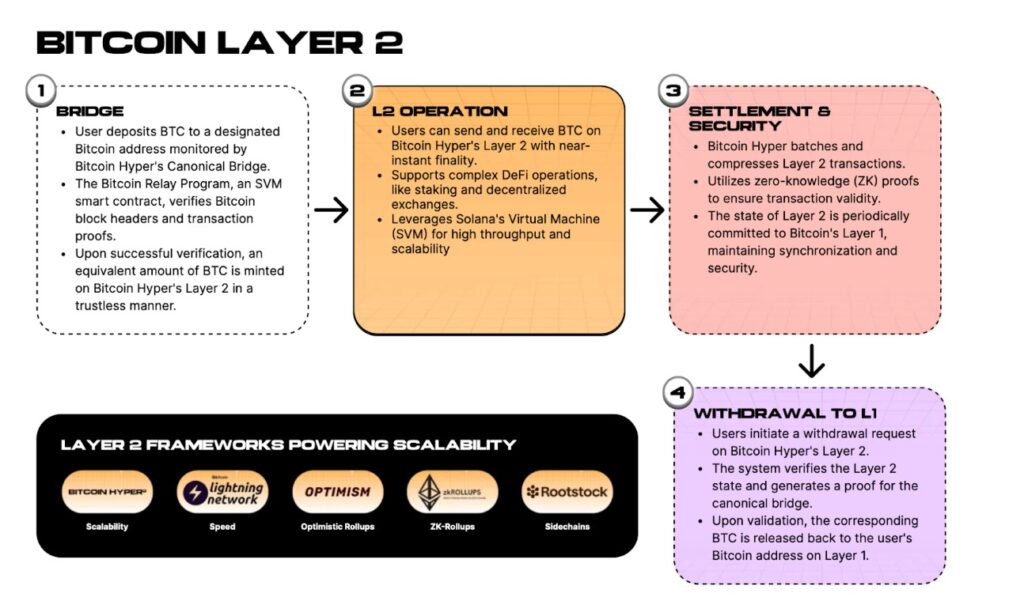
In this setup, Bitcoin is no longer trapped as slow-moving, store-of-value collateral. It gains an active utility loop, transacting across DeFi, gaming, social apps, and real-world applications, all while remaining backed 1:1 by Bitcoin itself.
This removes the very “downward inelasticity” problem Donovan warns about. As more applications are built and used, BTC demand becomes a function of utility, not just macro sentiment or speculative flows.
And the more the ecosystem grows, the more BTC circulates and creates a natural balancing force that didn’t exist on Bitcoin’s base layer.
In short, Bitcoin Hyper doesn’t change Bitcoin’s supply but changes Bitcoin’s velocity. And that shift is exactly what critics claim Bitcoin lacks.
Bitcoin Hyper Gives BTC High-Velocity Environment
If Bitcoin Hyper gives BTC the high-velocity environment it has always lacked, then HYPER is the asset that captures the financial upside of that transformation.
Every wrapped BTC transaction inside the ecosystem requires HYPER to execute. That makes HYPER the indispensable resource of the new layer because, as mentioned, it fuels gas payments, secures the network through staking, and governs how the ecosystem evolves
This is also where Donovan’s critique falls apart. Currencies don’t stabilize because their supply contracts; they stabilize because they maintain steady, utility-driven demand.
To reiterate, Bitcoin Hyper injects that missing demand loop into Bitcoin by giving BTC velocity, turning it from inert collateral into active transactional capital. So, in this ecosystem both BTC and HYPER experience recurring, structural demand rather than speculative boom-and-bust flows.
This is also why timing is critical. Utility-driven demand doesn’t wait. Once wrapped BTC starts moving through apps and HYPER becomes the toll required for every transaction, the market will reprice the token accordingly.
Early buyers are effectively securing the scarce resource of a future economic layer before that demand curve goes vertical.

Not Too Late To Buy HYPER
Bitcoin Hyper has so far raised $28.5 million in the presale and to be part of it as an early investor, you can purchase HYPER directly through the Bitcoin Hyper website using SOL, ETH, USDT, USDC, BNB, or even a credit card.
You can also grow your HYPER holdings right away by staking through the project’s native protocol, currently offering a 60% APY.
Bitcoin Hyper recommends Best Wallet – widely regarded as the best crypto wallet in the market – where HYPER is already listed under its lauded new project screening tool Upcoming Tokens, which makes it easy to buy, track, and claim once live.
Join the Bitcoin Hyper community on Telegram and X for the latest scoop about the project.
DISCOVER: 16+ New and Upcoming Binance Listings in 2025

Why you can trust 99Bitcoins
Established in 2013, 99Bitcoin’s team members have been crypto experts since Bitcoin’s Early days.
Weekly Research
100k+Monthly readers
Expert contributors
2000+Crypto Projects Reviewed