






In This Article
Crypto can’t thrive without infrastructure. Ordinary users, new to crypto, must always find a simple way of using the tech. Without wallets and wallet providers, it is impossible to move value. Same, if no one pumps billions to build or improve existing rails, it becomes incredibly hard for crypto to find mainstream adoption.
Gone are the days when crypto, including holding the 100X tokens, was seen as weird. There are laws in place, and with proper regulation, it is easy to see why Wall Street firms are ready to bet everything they have on decentralized technology.
In a shift that can only be interpreted as the maturation of crypto-as-an-infrastructure, Revolut, a neobank and fintech, has now cumulatively sent over $10.5bn in stablecoin payments as of the end of December 2025. This translated to a +156% jump from the year before, far outpacing the platform’s general growth. This suggests that stablecoins like USDC and USDT are becoming the preferred rail for a specific type of user: the modern, cross-border digital native.
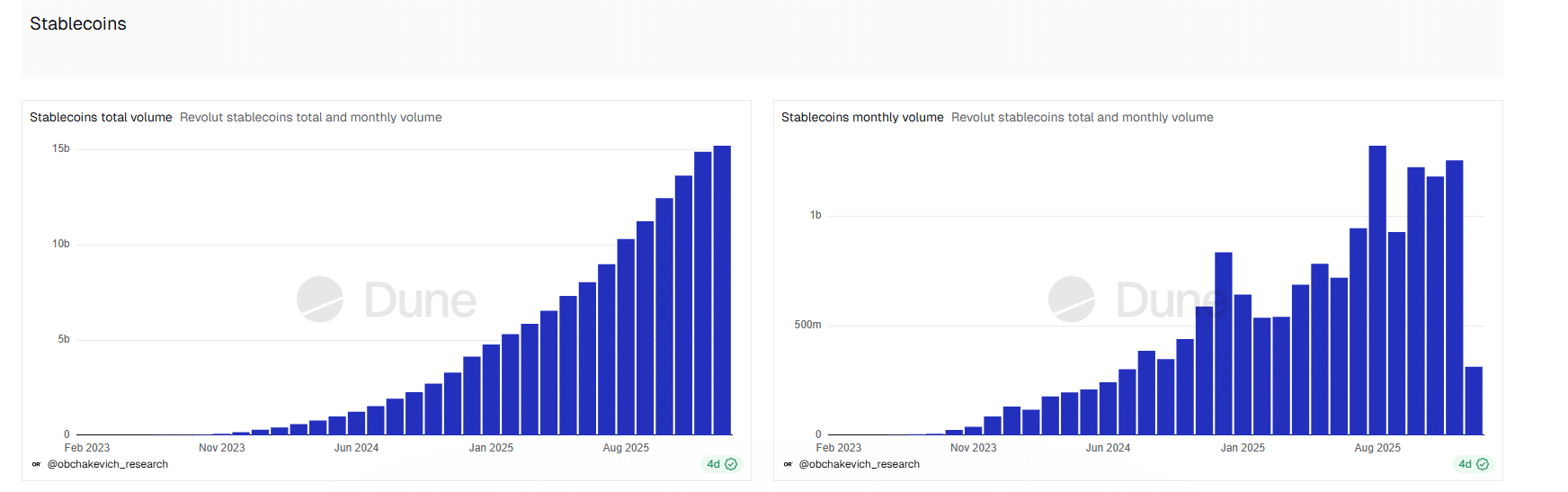
(Source: Dune)
Interestingly, this growth came without any major crypto price rally, which tells us this wasn’t speculation. It fits a wider shift where stablecoins are moving from trading tools into everyday money. To put it in numbers, the total crypto market cap is far below the $3.5T mark, and the last time the Bitcoin price traded above $100,000 was in mid-November 2025.
DISCOVER: 15+ Upcoming Coinbase Listings to Watch in 2026
What actually happened on Revolut?
Stablecoins are cryptocurrencies pegged to the price of a real-world asset, mostly cash, like the USD. Popular fiat-backed digital cash lives on blockchains. According to Dune data, the +156% surge pushed stablecoins to about +0.58% of all Revolut payments.
So far, Revolut, which claims to be a financial superapp, is used by over 65M people. What can be gleaned from the recent growth is that most of its over 65M users started sending dollar‑pegged crypto instead of bank transfers. Most payments landed between $100 and $500, which signals normal spending, not whale activity.
The percentage of stablecoin-enabled transfers via Revolut might not be much, but it matters because it shows stablecoins solving a real problem. Bank transfers can be slow and expensive across borders. Sometimes, especially when sending value to developing territories, transfers can take days. Meanwhile, stablecoins move in minutes on most blockchains, including Solana and Ethereum. What’s more? Stablecoin fees often stay below a dollar. That speed and cost gap explains why stablecoin adoption trends keep climbing.
Other data from 2025 shows that two‑thirds of Revolut’s stablecoin volume ran on Ethereum, with Tron at about +23%. Ethereum is increasingly the go-to platform for DeFi. As of January 14, DeFi protocols on Ethereum managed over $50Bn worth of assets, confirming that Ethereum is more like a global settlement layer. Meanwhile, though Tron is known more for enabling USDT transfers, it lagged behind Ethereum, though it offered relatively low fees.

(Source: X, Markkarpis)
While Ethereum and Tron were widely used as a settlement layer for stablecoins, the neobank also supports other chains, including Solana, the host of some of the best meme coins to buy, and Arbitrum, a popular Ethereum layer-2. A layer-2 is a platform anchored on another chain, in this case, Ethereum, relying on the base layer for security. The more the chains supported, the better for Revolut. As expected, fees matter, and when settlement fees jump, users will naturally gravitate to cheaper rails.
DISCOVER: 9+ Best High-Risk, High-Reward Crypto to Buy in 2026
Stablecoins Here To Stay?
If you send money abroad, this trend hits close to home. Stablecoins cut out correspondent banks. That means fewer middlemen and fewer fees. Bloomberg Intelligence expects global stablecoin payment flows to reach $56.6T by 2030. Fintechs notice this. PayPal, Klarna, and Coinbase are all pushing stablecoin payments. Western Union plans to launch stablecoin settlements in 2026. This is not a crypto‑only story anymore. It’s a payments story.
Introducing KlarnaUSD, our first @Stablecoin.
We’re the first bank to launch on @tempo, the payments blockchain by @stripe and @paradigm.
With stablecoin transactions already at $27T a year, we’re bringing faster, cheaper cross-border payments to our 114M customers.
Crypto is…
— Klarna (@Klarna) November 25, 2025
On the regulatory front, the existence of supportive frameworks like the GENIUS Act lays a solid foundation. After the act was signed into law in July 2025, there have been more tech companies deploying their stablecoins or planning to. For example, after re-entering crypto in 2024, Stripe accelerated its stablecoin integration in 2025. Through its acquisition of Bridge, Stripe now provides infrastructure for other tech firms to “on-ramp” into stablecoins, treating them as digital cash for global payouts.
Still, stablecoins are not risk‑free. They rely on issuers holding real dollars or equivalents. If trust breaks, the peg can break. That’s why regulators watch this space closely. After the turbulence of October 10-11, Ethena’s stablecoin, USDe, depegged, falling to $0.65 to the dollar.
While fixed pegs to other stablecoins like the USDT on DeFi protocols like Aave saved the day, it could otherwise be catastrophic for the decentralized money market and the broader industry. That’s also not forgetting that stablecoins like USDT and USDC need compliance with existing laws since they can be frozen at any time.
DISCOVER:
Follow 99Bitcoins on X For the Latest Market Updates and Subscribe on YouTube For Daily Expert Market Analysis.

Why you can trust 99Bitcoins
Established in 2013, 99Bitcoin’s team members have been crypto experts since Bitcoin’s Early days.
Weekly Research
100k+Monthly readers
Expert contributors
2000+Crypto Projects Reviewed