




In This Article
It’s 2025, and Bitcoin mining has never been more competitive. With network difficulty at record highs and block rewards slashed to 3.125 BTC after the 2024 halving, most smaller miners can no longer go it alone. Mining pools have become essential for anyone hoping to earn consistent rewards in a smaller mining operation. By pooling computational power, individual miners can share in block rewards more regularly instead of waiting months or years for a lucky break.
That said, solo mining isn’t entirely dead. In fact, earlier this year, a solo miner with a modest setup shocked the community by successfully finding a block, earning the full reward and proving that individual wins are still possible (though incredibly rare). Meanwhile, large-scale mining operations and publicly traded companies like Marathon Digital and Riot Platforms continue to dominate the hash rate, shaping the industry’s economics and setting new standards for efficiency.
In this guide, we’ll highlight the top five Bitcoin mining pools in 2025, helping you choose the right one for your setup. Note that this article focuses on mining with your own hardware, not cloud mining or hosted services.
Bitcoin Mining Pools: Summary
Mining pools enable individual miners to combine their mining resources with those of other miners, thereby improving their chances of mining a block and earning Bitcoins. There are several pools to choose from, which are different in size and the payment methods they offer.
Top Bitcoin Mining Pools
Larger pools offer more frequent payments, but smaller pools offer higher rewards (since the reward is split among fewer miners). Here are the top Bitcoin mining pools today:






If you want a detailed understanding of how mining pools work and reviews of each one, keep on reading. Here’s what I’ll cover:
- What are Bitcoin Mining Pools?
- How to Choose a Bitcoin Mining Pool
- Mining Pool Reward Methods
- Top Mining Pools Reviewed
5. Comparison of the Best Bitcoin Mining Pools
6. Emerging Best Pool to Watch: Ocean Pool
7. Conclusion
1. What are Bitcoin Mining Pools?
New Bitcoins enter circulation as a “prize” for miners who managed to guess the solution to a mathematical problem. The winning miner gets to add the latest block to the blockchain and update the ledger of Bitcoin transactions.
Today, most miners join pools using payout systems like FPPS or PPLNS, which distribute both block rewards and transaction fees proportionally, providing a more predictable income stream.
For a detailed explanation of the mining process, watch the video below:
By design, the more miners you have, the more difficult it gets to solve the math problem, and vice versa.
This system is called ‘mining difficulty’ and it was designed to regulate the flow of new Bitcoins into the system (i.e., to prevent inflation). The surge in Bitcoin’s popularity dramatically increased the mining difficulty, effectively making small-scale home mining obsolete.
As more and more people jumped on the mining wagon, the mining difficulty rose to a point that it became unprofitable to mine with a home operation. Throw in the initial and ongoing costs involved in home mining (buying the gear, electricity bills, etc.), and not only will you not make a profit, but you’ll actually lose money.
Enter mining pools.
Mining pools are groups of miners who combine their mining resources to increase their hashing power (i.e., computing power). The more hashing power you own, the better your chances of adding a block and claiming the mining reward.
With mining pools, miners are more likely to solve problems than they would when mining solo. The rewards are then split between the pool members proportionally to the amount of hashing power their gear contributed to the solution.
The mining pool owner usually charges a fee for setting up the pool as well. The pools vary in their payment methods, as well as in the fees they charge and other parameters.
2. How to Choose a Bitcoin Mining Pool
Here are a few factors to consider when you’re choosing a mining pool:
- Pool Size: Bigger pools offer more regular payments. However, the payout is smaller because it’s shared among more members. Smaller pools offer less frequent payments but larger payouts. Whichever you choose, the return should even out in the long term.
- Fees: Some Bitcoin mining pools charge fees, and some don’t. Fees can range from as little as 0%, and go as high as 4% off the reward.
- Reliability and Security: An important thing to look out for is whether you can trust the pool to not cheat and steal your funds, or not get hacked and lose your earnings.
- A good way to mitigate such risks is by joining a more veteran, established pool. Make sure to also read user reviews before you join, keeping in mind that there’ll always be disgruntled users, so nothing should be taken at face value.
- Payout Policy: Whether you want regular daily payments or to get paid whenever a block is solved by the pool, make sure to do your due diligence before you sign up for a pool.
- Risks and Considerations: As of 2026, two or three pools control over half of the Bitcoin hash rate, raising concerns about potential centralization. To support network decentralization, some miners intentionally choose smaller, reputable pools.
3. BTC Mining Pools Reward Methods
Before we can understand how mining pool reward methods work, we need to first understand what shares are, in relation to mining.
Simply put, shares are units that allow pool owners to calculate an individual miner’s contribution to the hashing effort. Whenever miners are mining via a pool, they receive shares that are proportional to their contribution to solving a block.
Miners can then get paid by the pool, according to the number of shares they received. To be clear, in terms of the Bitcoin network, shares are invisible; they are only used internally by the mining pools. According to the share amount, the pool’s payment can take several forms.
Pay-Per-Share (PPS)
In a PPS payment scheme, miners receive shares that can be paid out at any point along the hashing process. PPS allows miners to get paid for shares they received, regardless of whether a block has been solved during their participation.
To achieve that, the pool operators pay miners from their own balance. The shares’ rate is fixed and known in advance.
A newer version of PPS exists, PPS+ rewards. This method takes the form of PPS, as well as the TX fees included in the block. The reward TX fees are distributed using PPLNS. This payment method guarantees payments and leaves the miners with very little risk of not being paid for their contribution. The downside of this scheme is the high fees the pool owners charge to mitigate the risk they take by paying regularly.
Proportional
Similar to PPS, miners submit shares during the block finding period.
The more hashing power you have and the longer you mine for the block, the more shares you can submit. Once a block is found, the pool pays the miners according to the number of shares they received.
However, in this payment method, the value you will receive for each share will equal the block rewards divided by the total number of shares submitted by all miners. This means that the more miners that join the pool, the lower the value of each share you receive.
Score-Based
This payment method was designed to prevent miners from pool-hopping.
Your mining time and hashing power are calculated into a ‘scoring hash rate’ score. The longer you stay in the pool, the greater your score is, and the greater the value of the shares you receive.
Once you stop mining, your score gets smaller, and the value of your shares drops accordingly. Miners are rewarded once a block is found.
Pay-Per-Last N Shares (PPLNS)
In PPLNS, miners only get paid for shares received during a predefined “window” that ends with the solving of a block.
Unlike other payment schemes, shares received outside of the window will not be rewarded at all. This window can either be defined as a time frame (uncommon) or by a certain number (N) that represents the last shares received up to the block solving.
For example, if N equals 1 billion, once a block is found, only the last 1 billion shares will be rewarded. While not defined anywhere explicitly, N is usually set as a multiple of the mining pool difficulty with a constant (usually 2).
Due to this, PPLNS is also called Pay-Per-Luck Shares. When implemented correctly, miners can’t predict the right time to join.
With PPLNS, miners can either get higher rewards if they get to receive more shares within the last N shares, or get no reward at all if they don’t. Naturally, if you hang around a certain pool for long enough, your hits and misses should eventually even up.
4. Top 5 Bitcoin Mining Pools
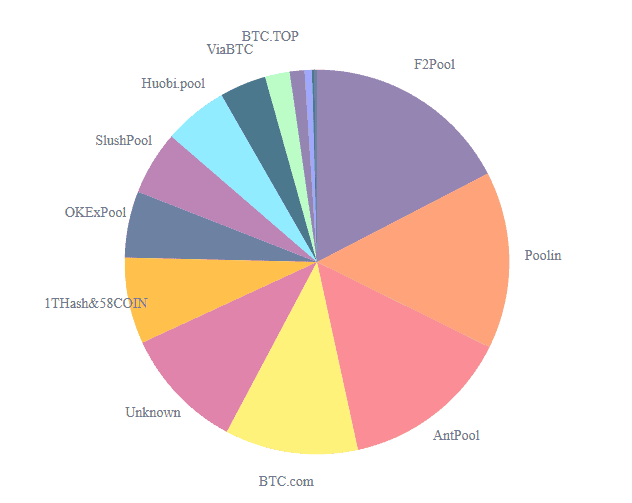
May 2020: Hashrate distribution by mining pool.
Image credit: blockchain.com
Braiins Pool (ex-SlushPool)
Our Verdict
9.5/10
- Pool size – 10/10
- Fees – 8/10
- Reliability & security – 10/10
- User experience – 10/10
- Payout policy – 10/10
Pros:
- Established medium + pool
- Score-based method reduces the risk of cheating
- User-friendly dashboard
Cons:
- 2% fee may be too much for some people
Announced in 2010, Braiins Pool (formerly known as SlushPool) was the very first Bitcoin mining pool and undoubtedly led the way for many other mining pools to come. Founded by SatoshiLabs current CEO Marek Palatinus (aka Slush), it’s based in the Czech Republic and follows a score-based system to discourage pool-hopping.
This is a medium-sized to large pool. Braiins Pool claims a 2% fee under the FPPS (Full Pay-Per-Share) reward model. Braiins Pool’s dashboard is very user-friendly and provides excellent detail with regular updates.
While it may not be the largest of the Bitcoin mining pools, it’s certainly considered one of the best, well-respected for its transparency and technical innovation (notably the open-source Braiins OS firmware).
Antpool
- Pool size – 9/10
- Fees – 8/10
- Reliability & security – 10/10
- User experience – 9/10
- Payout policy – 9/10
Pros:
- Offers both PPLNS (0% fees)
- In addition, you get PPS+ reward types
- Plenty of security options
Cons:
- Owned by Bitmain (considered a drawback for Bitcoin maximalists)
Antpool is a medium-sized Chinese Bitcoin mining pool operated by Bitmain Technologies.
One advantage Antpool has is that you can choose between PPLNS (0% fee) and PPS+ (4% fee from the block reward and 2% from mining fees). Payments are made once per day if the amount exceeds 0.001 Bitcoin.
Those new to Bitcoin mining will appreciate the clean interface. The dashboard clearly displays earnings and hash rates.
There are also a variety of security options, including two-factor authentication, email alerts, and wallet locks.
Visit AntpoolBTC.com
Our Verdict
9/10
- Pool size – 10/10
- Fees – 9/10
- Reliability & security – 8/10
- User experience – 9/10
- Payout policy – 9/10
Pros:
- Established large pool
- Low withdrawal fees
- TX fees included in payouts
Cons:
- 1.5% fee, owned by Bitmain (considered a drawback for Bitcoin maximalists)
Known for their wallet and their own blockchain explorer, BTC.com has been around for a while, before opening a pool in 2016. Owned by Bitmain Tech, BTC.com is one of the largest pools around.
BTC.com has its own payment method, FPPS, which is similar to PPS+ includes TX fees in the payouts, along with the block reward. As for mining fees, BTC.com charges 1.5% and has a 0.001 BTC payment threshold.
F2Pool
- Pool size – 10/10
- Fees – 8/10
- Reliability & security – 8/10
- User experience – 9/10
- Payout policy – 8/10
Pros:
- Additional coins supported
- Low payout threshold
- Daily payouts
Cons:
- 2.5% fee
F2Pool is a medium-sized pool established in 2013. Operating a PPS+ reward system, F2Pool takes a 2.5% fee, which is a bit on the high side.
Aside from Bitcoin, F2Pool also supports mining Litecoin (LTC), Ethereum (ETH), Zcash (ZEC), as well as other coins. There’s a daily automatic payout, and the minimum withdrawal is 0.005 BTC.
Unlike some Chinese Bitcoin mining pools, it has an English interface. The layout is quite simple, with information presented clearly and concisely.
Visit F2PoolKano CKPool
Our Verdict
8/10
- Pool size – 8/10
- Fees – 9/10
- Reliability & security – 9/10
- User experience – 7/10
- Payout policy – 8/10
Pros:
- Low fees (0.9%)
- Welcoming community
Cons:
- Interface isn’t user friendly
Also known as KanoPool, Kano CKPool burst onto the mining scene in 2014. This small Bitcoin mining pool offers a PPLNS payment model, charging a 0.9% fee.
With regard to payout, for each block found, you will need to wait +101 block confirmations to get paid, which might take some time.
The pool’s interface could do with an update, as it’s not the most user-friendly. It doesn’t have much in the way of features, but it does have two-factor authentication as an extra layer of security.
ViaBTC
- Pool size – 9/10
- Fees – 8/10
- Reliability & security – 9/10
- User experience – 9/10
- Payout policy – 9/10
Pros:
- Additional coins supported
- Daily payouts
Cons:
- 4% fees for PPS
- 2% for PPLNS
Launched in 2016 and headquartered in China, ViaBTC is a medium mining pool. In addition to BTC, the pool supports LTC, BCH, ETH, ZEC, and DASH mining.
ViaBTC offers both PPS (4% fee) and PPLNS (2% fee) payment methods. ViaBTC is known for being able to maintain a high uptime, more than 99.9% as of writing.
Visit ViaBTCComparison of the Best Bitcoin Mining Pools
It’s easy to get bogged down in the technical details about this tool, which is why we’ve shortened everything for you. Take a look at this summary and comparison of the best mining pools and their main features.
Mining Pools |
Pool Size |
Fees |
Reliability & security |
Payout Policy |
| Braiins Pool | Medium | On the high side, 2% | Solid, with its score-based system | Around 2% fee under the FPPS model; customizable thresholds; users can set minimum withdrawal amounts. |
| Antpool | Medium | Choose from 0% (PPLNS), 4% fee (PPS), or 2% (mining fees) | Great, with a wide variety of options: 2FA, email, wallet locks | 1x per day if the amount is 0.001 BTC + |
| BTC.com | Large | 1.5% | Good | Payouts include TX fees |
| F2Pool | Medium | High: 2.5% | Reasonably good | Daily automatic payout; minimum withdrawal of 0.005 BTC. |
| Kano CKPool | Small | Low: 0.9% | 2FA + added security | Lengthy waiting time; +101 block confirmations |
| ViaBTC | Medium | Choose between 4% fee (PPS) and 2% (PPLNS) | Good | Daily payouts; 99.9% uptime |
6. Emerging Best Pool to Watch: Ocean Pool
While the mining pool market remains dominated by giants like Antpool, F2Pool, and ViaBTC, Ocean Pool is now emerging as one of the most promising newcomers in 2025.
Ocean Pool offers miners the ability to choose or construct block templates, which gives more transparency and control, being a big draw for those concerned about centralization. It currently holds ca. 1% of global Bitcoin hashrate, placing it among the pools beyond the top 5 that are growing in influence.
Why do miners like it? Low fees, decentralization ethos, flexibility in payout, and a more miner-centric governance model. For miners who want more agency, Ocean Pool might offer a better trade-off between consistent rewards and ethical/decentralized mining.
7. Conclusion
Bitcoin mining pools remain an essential part of the network’s ecosystem. Following the 2024 halving, pooling resources has become more crucial than ever for achieving stable and predictable mining rewards.
Joining a mining pool is the logical thing to do if you want to make money mining Bitcoin. As you can see, the pools vary in size, payment methods, and fees, which can make all the difference in navigating Bitcoin’s increasingly competitive mining environment.
If you’re just starting, perhaps it would be best to join a large established mining pool to gain some experience. Once you feel comfortable, you can optimize your earnings by choosing smaller or low-fee pools.
See also:
- Bitcoin Mining Hardware Reviews & Comparison
- What is Bitcoin Mining and How Does it Actually Work in 2026
- Best Bitcoin Mining Software for Windows, Mac&Linux in 2026
FAQs
What is the best miner for Bitcoin?

The best Bitcoin miner in 2026 depends on your electricity costs and setup, but overall, newer-generation ASICs like the Antminer S19 XP and Antminer S21 series currently deliver the best efficiency and hashrate. These models outperform older miners such as the Antminer S17 Pro, which was once top-tier but is now considered outdated.
For most miners, efficiency (J/TH) and reliability matter more than raw power, especially after the 2024 halving. Always check up-to-date profitability and availability before buying, as market conditions and electricity rates can greatly affect returns.
How many Bitcoins can you mine a day?
The number of Bitcoins you can mine per day depends on your mining hardware, hashrate, network difficulty, and electricity costs. With today’s difficulty (2026) and top-tier ASICs like the Antminer S21, a single miner typically earns a few thousandths of a Bitcoin per day, i.e., roughly 0.00002 to 0.0001 BTC before electricity costs.
Solo mining is extremely unlikely to yield rewards; that’s why most miners join pools to receive small, steady payouts instead of waiting to hit a full block (currently 3.125 BTC after the 2024 halving).
Is Bitcoin mining still profitable?
Bitcoin mining can still be profitable, but it heavily depends on your electricity costs, hardware efficiency, and market conditions. After the 2024 halving, block rewards dropped to 3.125 BTC, which significantly reduced earnings.
You can calculate the exact profitability of Bitcoin mining with a Bitcoin mining calculator. Remember that home mining is practically extinct, and you’re up against some big players, so in most cases, it won’t be worth mining if you’re not doing it professionally.

Why you can trust 99Bitcoins
Established in 2013, 99Bitcoin’s team members have been crypto experts since Bitcoin’s Early days.
Weekly Research
100k+Monthly readers
Expert contributors
2000+Crypto Projects Reviewed