







Morpho Association raised $175M from the likes of a16z and Paradigm, marking the largest funding round in DeFi history and valuing the protocol at approximately $2Bn. Co-founded by Merlin Egalité, the protocol boasts over $11Bn in deposits and powers lending for major platforms like Coinbase, Kraken, and Binance.
While it may seem like a typical crypto funding round, the investor list reveals a different story. Traditional firms such as Apollo Funds, VanEck, SBI Group, and Bpifrance are involved, indicating this is more than a speculative crypto bet.
Morpho Raises $175M at $2B Valuation in Round Led by Paradigm, a16z Crypto and Ribbit
According to Fortune, DeFi lending protocol Morpho raised $175 million in a funding round led by Paradigm, a16z Crypto and Ribbit Capital, with participation from Apollo Funds, Circle… pic.twitter.com/zE7hJssUsW
— Wu Blockchain (@WuBlockchain) June 9, 2026
The article highlights the central tension: while it appears to be a DeFi protocol raise, the combination of traditional investors and the goal of creating an open credit network suggests a shift towards on-chain credit becoming regulated financial infrastructure.
This news came as the MORPHO token surged +11% in the past 24-hours, buoyed by the $175M investment, with daily volume surging to $38.8M.
Morpho Explained: What a DeFi Lending Protocol Actually Does
A sharp rise today for $MORPHO from $1.76 to $1.97 – an intraday high. However, price has quickly corrected and now trades at $1.82 showing a weak notional foundational knowledge most people who traded the asset has on the protocol.
A side gist.
The global bond market, which… https://t.co/ugnaSgSJe9 pic.twitter.com/lHavnkAqQS
— aniutah.hl (RWA ARC) (@migbassi) June 9, 2026
Morpho acts as the underlying plumbing for lending on crypto platforms, ensuring seamless transactions. When platforms like Coinbase offer loans against Bitcoin, Morpho’s smart contracts manage settlement, collateral, and interest rates invisibly.
As a non-custodial, permissionless DeFi lending protocol, Morpho allows institutions and developers to create customizable credit products on their platforms. Its core offering, Morpho Blue, enables users to set their own collateral types, oracles, and risk parameters, avoiding a shared pool with strict rules.
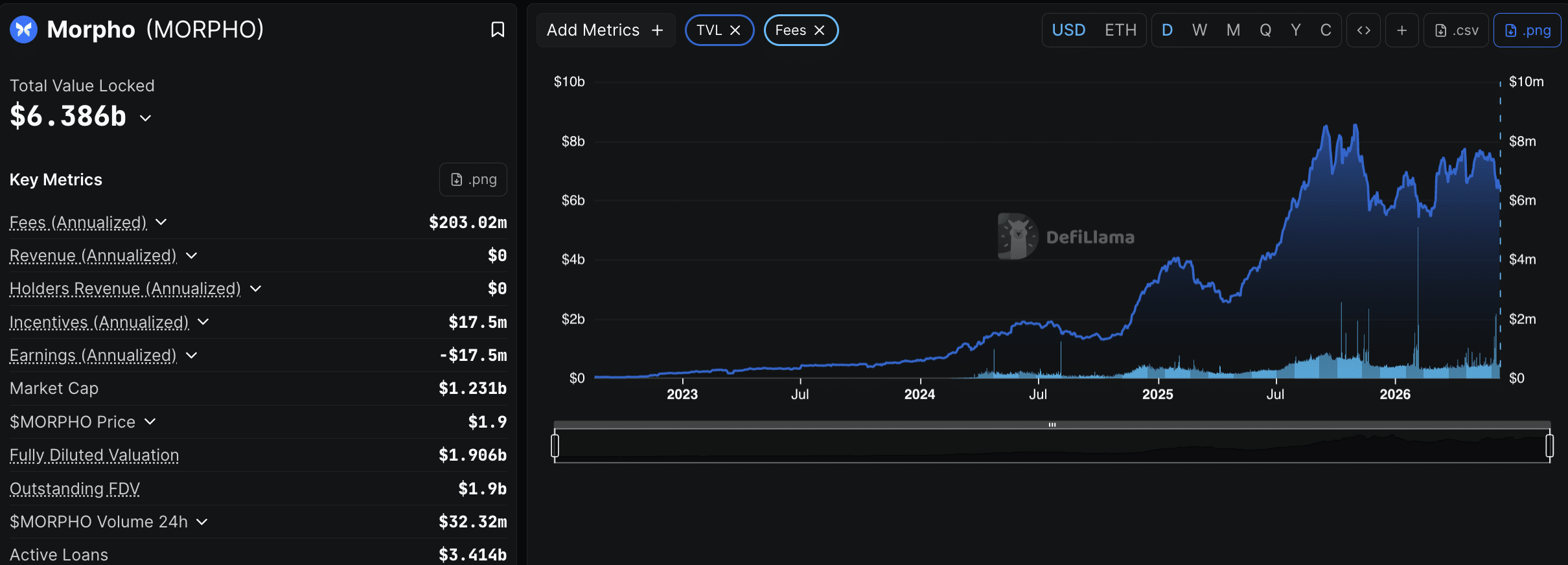
With a total value locked of $6.57Bn (or $11Bn using a broader measure), Morpho operates at a scale that many traditional lenders would admire.
By April 2026, Coinbase’s Morpho-powered loan service had originated over $2.17Bn in USDC and expanded to the UK, with borrowing limits up to $5M. It’s a protocol already in commercial use, not waiting for adoption.
DISCOVER: Best Meme Coin ICOs to Invest in 2026
The Institutional DeFi Play: Why This a16z-led Round Is Different From a Typical Crypto Raise
Most DeFi funding rounds are led by crypto-native firms, but this round included notable players like Apollo Funds and Bpifrance, indicating a shift towards institutional involvement in on-chain credit. Gabe Mennesson from Ribbit Capital highlighted that lending is a significant profit pool in finance, yet its infrastructure is often inefficient.
This perspective appeals to partners focused on traditional financial returns rather than crypto gains. The a16z crypto team noted that Morpho’s vision of improving traditional finance with blockchain is already being realized by major institutions.
Morpho is integrated with major players such as Coinbase, Kraken, and Société Générale, enhancing its footprint in fintech payments.
Uniquely, investors such as a16z purchased Morpho tokens at open-market prices rather than through traditional discounted allocations, reflecting strong conviction in its potential. Morpho’s architecture could serve as a foundational layer for institutional products in on-chain credit.
EXCLUSIVE: Earn $10 USDC Via Binance Sign-Up
What the $175M Raise Actually Means for DeFi Investors
Paradigm General Partner Frankie outlined the long-term outlook: every major bank and asset manager will seek exposure to on-chain credit markets. While this remains a prediction rather than a confirmed timeline, it highlights the analytical work needed to bridge that gap.
Bull Case: Institutional integrations, backed by a $175M war chest and TradFi co-investors, accelerate the transition of traditional credit portfolios to blockchain. With Apollo and VanEck providing capital and distribution, Morpho could become a significant settlement layer for global credit in five years, making its current $2Bn valuation seem conservative.
Base Case: Morpho strengthens crypto-native integrations, forms partnerships with a few major banks or fintechs in the next 18 months, and surpasses $10Bn in TVL. However, fragmented regulatory frameworks may slow down the projected adoption by pension funds and sovereign wealth funds. Morpho could become a leading DeFi lending infrastructure without fully reaching mainstream TradFi.
Bear Case: Regulatory challenges force Morpho to create permissioned markets, which conflict with its open architecture and fragment liquidity. TradFi players might develop their own on-chain credit platforms, while smart contract risks could deter institutional interest in DeFi lending.
The base case appears to be the most realistic given the current landscape. Institutional traction is evident, yet the path from investment to operational deployment is slower, hinging on regulatory approvals and risk assessments.
Watch for three key indicators: whether Apollo Funds or VanEck launches credit integrations with Morpho within 12 months, whether Morpho Blue’s TVL exceeds $10Bn, and whether any pension or sovereign wealth funds disclose on-chain credit exposure through Morpho. These points will be more telling than any funding announcements regarding the future of DeFi lending.
EXPLORE: Best Crypto Presales With Asymmetric Upside in the Current Market

Why you can trust 99Bitcoins
Established in 2013, 99Bitcoin’s team members have been crypto experts since Bitcoin’s Early days.
Weekly Research
100k+Monthly readers
Expert contributors
2000+Crypto Projects Reviewed